
Sleep Sounds for Anxiety That Quiet Your Racing Mind and Help You Fall Asleep
Introduction
Do you ever lie in bed with your mind racing? You are exhausted, but the moment your head hits the pillow, worries flood in.

You replay conversations, plan tomorrow, and feel your heart pound. That is anxiety stealing your sleep.
It is a cruel cycle. Anxiety keeps you awake. Then lack of sleep makes you more anxious the next day. This is not just a bad night here and there. For millions of people, it is a nightly battle.
Your brain’s alarm system, called the amygdala, stays on high alert. Instead of powering down for rest, it keeps running. Research shows that declining slow-wave sleep activity plays a major role in regulating anxiety. When you do not get enough deep sleep, your brain struggles to process stress. You get trapped in a loop that is hard to break.
That is where sleep sounds come in. Simple, natural audio can help calm your nervous system. It gives your brain something gentle to focus on instead of anxious thoughts. This is not just about blocking noise outside your window. It is about changing what happens inside your head.
Guided meditation and sleep sounds offer a non-pharmacological way to break the cycle. You do not need a prescription or special equipment.
Just a quiet space and a few minutes. A short 10 minute guided meditation for sleep can lower your heart rate and quiet mental chatter. Or a longer 20 minute guided sleep meditation may help you reach deeper rest. The key is consistency. A simple nightly routine using the right sounds can reduce sleep inertia, that groggy feeling when you wake up, leaving you more refreshed.
This article explains the science behind how sleep sounds quiet your anxious brain. We will look at the best types of sounds for falling asleep fast. And you will get a step-by-step routine you can use tonight.
Calm the body and reclaim attention.
The Science of Sleep Sounds and the Anxious Brain
When your brain refuses to switch off at night, it is not a choice. It is biology. Anxiety keeps your nervous system stuck in a state of hyperarousal. Your heart rate stays up. Your mind scans for threats. Your body produces stress hormones like cortisol instead of the melatonin you need for rest.
Sleep sounds work because they speak directly to this overactive system. Your auditory nerve carries sound signals to the brain. When you hear a steady, predictable sound like rain or a hum, your brain interprets it as safe. There is no sudden change to trigger a threat response. Your autonomic nervous system gets the message. It is okay to power down.
This is backed by real neuroscience. A 2026 study from the Center for BrainHealth found that slow-wave sleep activity as a regulator for anxiety is a key piece of the puzzle. Declining deep sleep is directly linked to higher anxiety levels. Sleep sounds help you reach that deep sleep faster.
Your amygdala is your internal alarm. When you are anxious, it stays on high alert. But structured sound environments can quiet that response. Brain research shows that a brain circuit that keeps animals alert in new environments also operates in humans. This is why sleeping somewhere unfamiliar can spike your anxiety. Predictable ambient sound tricks that circuit into standing down.
Different types of sleep sounds work in slightly different ways. White noise provides a constant sonic blanket. Pink noise, which sounds deeper and more like rustling leaves, syncs with your brain’s slow waves. Binaural beats use two slightly different frequencies in each ear to encourage your brain to match a target brainwave state. All of them rely on the same basic principle. They give your auditory cortex a gentle, boring task so the rest of your brain can relax.
Neuroimaging studies confirm the effect. Reviews of the best EEG studies on anxiety and stress show that guided meditation combined with ambient sound can shift brainwave patterns toward the delta range. Delta waves are the hallmark of deep, restorative sleep. When you combine a calming voice with a steady sound layer, you get a double effect. The voice directs your attention away from anxious thoughts. The sound keeps your nervous system from startling.
This is not magical thinking. It is measurable biology. Your brain wants to sleep. It just needs the right signal to let go.
For a deeper look at how specific audio tracks can help you unwind, read our full breakdown of sleep sounds for anxiety and how to use them in your nightly routine.
How Guided Meditation Rewires Your Sleep Response
Maybe you have tried sleep sounds and they help a little, but your mind still races. The noise fades into the background, yet your thoughts keep spinning. That is where guided meditation steps in. It does not just calm your ears. It trains your brain to let go of anxious thinking.

Guided meditation works by shifting your attention away from racing thoughts and toward present moment awareness. Instead of fighting your worries, you learn to notice them and let them pass. This simple act breaks the anxiety sleep loop that keeps you awake. A meta analysis of randomized trials found that mindfulness meditation programs show small but real improvements in anxiety and sleep quality. The evidence is solid. Regular practice actually changes your brain.
Here is how the rewiring happens. Your prefrontal cortex is the part of your brain that helps you focus and make decisions. It also has the job of calming down your amygdala, the fear center. When you practice guided meditation consistently, you strengthen the connection from your prefrontal cortex to your amygdala. That means your brain gets better at turning off the alarm system at night. You experience less hypervigilance. You fall asleep faster.
The real power comes when you combine guided meditation with sleep sounds. The narration gives your mind a gentle task to follow, like scanning your body or imagining a peaceful scene. The ambient sound keeps your nervous system from startling at sudden noises. Together, they create a dual pathway. One works on your thoughts. The other works on your senses. Both push you toward sleep.
You do not need a long session to see results. A short 10 minute guided meditation for sleep can be enough to reset your nervous system. Many people find that a longer 20 minute guided sleep meditation helps them stay asleep longer. Just be mindful of sleep inertia if you wake up in the middle of a session. That groggy feeling usually fades fast once you get up and move.
If you want a simple start, try a guided sleep meditation tonight. Let the voice carry your attention away from worry. Let the sleep sounds hold the space. Your brain will learn the pattern over time.
Calm the body and reclaim attention with a practical tool: Breathe, Then Recenter.
For more on using meditation and sound together, explore our full guide on guided sleep meditation for anxiety.
Top Sleep Sound Types That Calm Anxiety
Now that you know how guided meditation can calm your racing thoughts, let’s look at the sleep sounds that pair best with it. Not all sounds work the same way. Each type affects your brain differently, and choosing the right one can make a big difference in how fast you fall asleep and how deeply you rest.
White Noise and Pink Noise
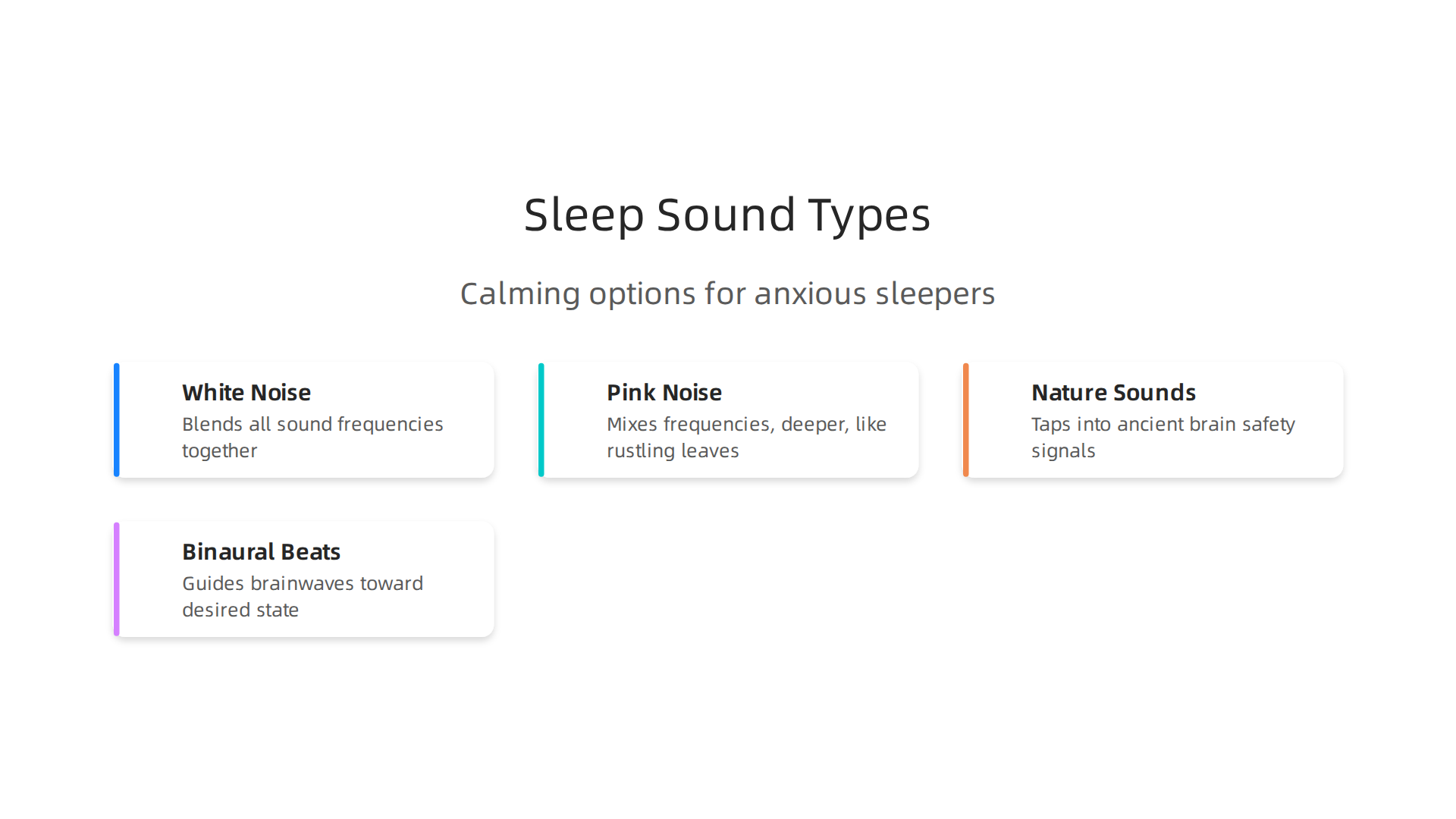
White noise blends all sound frequencies together at the same intensity. Think of a steady fan hum or static from an old TV. Pink noise also mixes frequencies but puts more energy into lower tones, making it sound softer like light rain or rustling leaves. Both of these work by masking sudden sounds that might trigger your startle response. A sudden car horn or a door slam becomes less noticeable. The science behind noise masking is well established, and researchers have found that white noise can improve sleep quality and ease anxiety. One study even showed that listening to white noise helped people with sleep disturbances fall asleep faster and wake up less often. You can read more about the differences in a comparison of white noise and binaural beats. If a quiet room is not an option, a simple white noise machine or app can give you a reliable backstop for a calm night.
Nature Sounds
Rain falling on leaves. Ocean waves rolling in. A gentle breeze through a forest. These sounds tap into something ancient in your brain. For thousands of years, calm natural environments meant safety. Your nervous system learned to relax when rain or waves were the only noise. That is why nature sounds trigger your parasympathetic nervous system, the part of you that rests and digests. A hospital study found that people who listened to nature sounds slept better over five nights compared to those who had no sound at all. Nature sounds work especially well for stress reduction and anxiety management. They give your mind a soft, predictable rhythm to follow, which can slow down fast breathing and lower your heart rate. To get the most benefit, try pairing nature sounds with slow breathing or a short guided practice. You can explore our full guide on sleep sounds for anxiety to see which sound type matches your needs.
Binaural Beats
Binaural beats work differently from the other two. You need headphones to hear them. The idea is simple: your left ear hears one tone, your right ear hears another tone that is slightly different in frequency. Your brain then creates a third tone, the beat, that pulses at the difference between the two. That pulsing rhythm can guide your brainwaves toward a desired state. For sleep, you want delta waves (0.5 to 4 Hz) for deep rest or theta waves (4 to 8 Hz) for light sleep and relaxation. Some research suggests that listening to binaural beats can reduce anxiety and encourage relaxation, helping you fall asleep faster. The Sleep Foundation notes that binaural beats may support memory, reduce stress, and improve sleep.
Each of these sleep sound types has its own strength. White and pink noise block out disruptions. Nature sounds calm your nervous system. Binaural beats gently steer your brainwaves. Try one tonight and see which one helps your mind settle.
The Role of Breathing in Guided Sleep Meditations
You have picked your sleep sound. White noise or ocean waves are playing softly. Your body is in bed. But your mind is still running. Here is where breathing becomes the hidden engine that makes everything click.
Deep, slow breathing does something powerful inside your body. It activates your vagus nerve. That nerve runs from your brain stem down to your belly. When you stimulate it with long exhales and steady inhales, your nervous system shifts from fight-or-flight into rest-and-digest mode. In simple terms, your body gets the signal that it is safe to sleep. Research on breathing practices for stress and anxiety reduction shows that slow breath techniques can lower heart rate and reduce the stress hormone cortisol. That is exactly what you need right before bed.
Guided sleep meditations pair breath cues with sleep sounds on purpose. A 10 minute guided meditation for sleep might say, "Breathe in for four counts, hold for four, out for six." While you do that, the rain or pink noise in the background masks any sudden noises from the house. Together, they create a relaxation reflex that overrides anxious arousal. Your racing thoughts slow down because your body is physically calming itself.
Specific breath patterns make this even stronger. The 4-7-8 technique has you inhale for four seconds, hold for seven, and exhale for eight. Box breathing is four counts in, four hold, four out, four hold. Both have been shown in studies to reduce blood pressure and bring your heart rate down. When a 20 minute guided sleep meditation walks you through these patterns, your body follows along without you having to think about it.
The beauty of this approach is that you do not have to force yourself to relax. You just follow the voice, breathe at the pace it sets, and let the sleep sounds hold the background steady. If you want to understand how breathwork directly resets your nervous system, you can read more about deep breathing for stress and the science behind it.
Once your body is calm, your mind can follow. That is how you avoid sleep inertia, that groggy feeling of being half-awake. You wake up feeling rested, not dragged.
Try this tonight: put on your favorite sleep sound, start a guided meditation that includes breath counting, and see how fast your body settles.
Breathe, Then Recenter. Calm the body and reclaim attention. Use this simple tool to reset your nervous system before sleep.
How to Build a Sleep Sound Routine for Lasting Relief
If you tried that breathing meditation last night, you already know how powerful sleep sounds can be. But one night of great sleep is not enough. Your brain learns through repetition. To make the calm feeling stick, you need a routine.
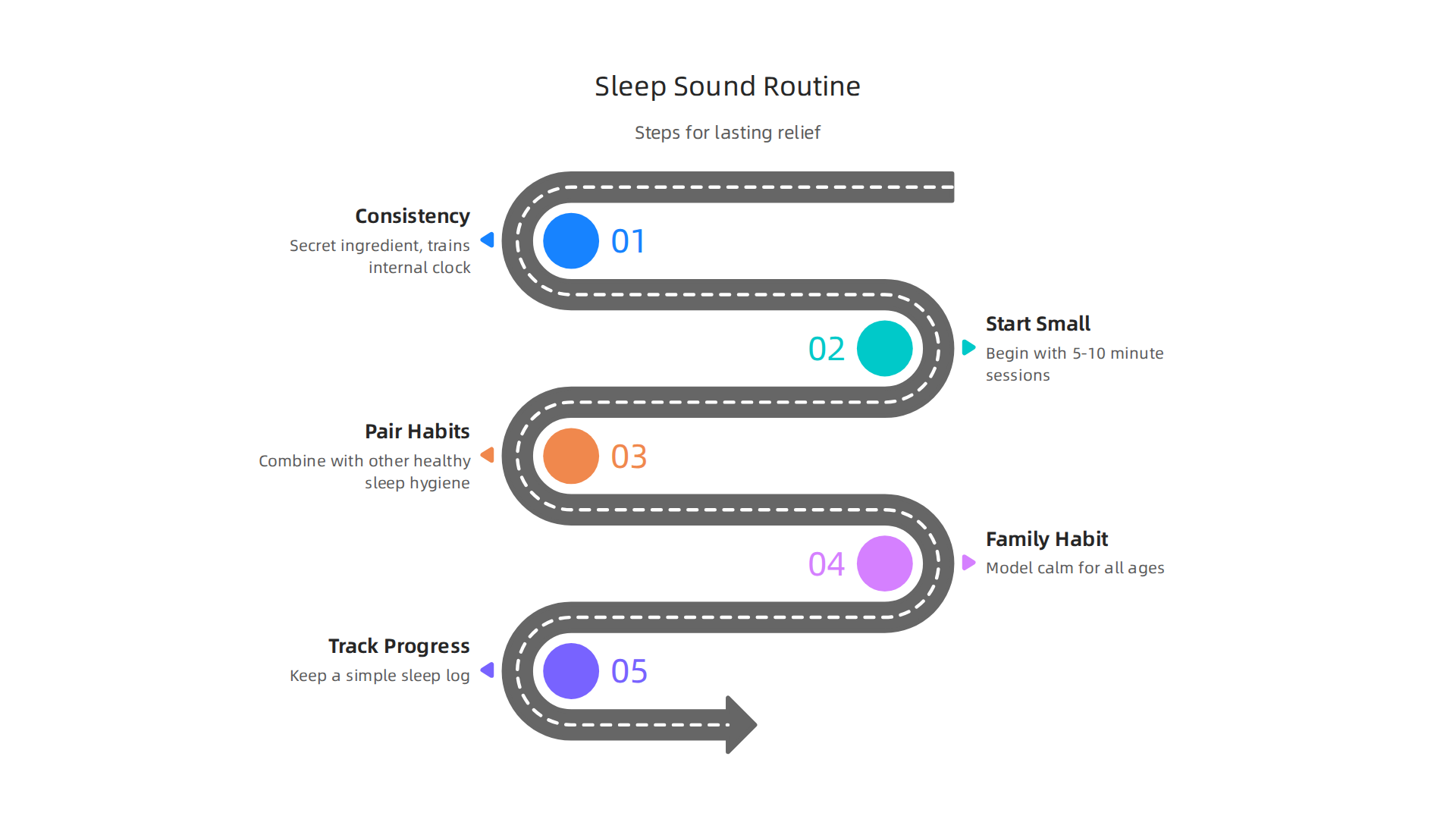
Consistency is the secret ingredient. Going to bed at the same time every night and playing the same sleep sound sequence trains your internal clock. Over time, your body learns: "When I hear that rain track and that voice, it is time to shut down." This is called circadian entrainment. It makes falling asleep easier and faster, night after night. For a deeper look at how a steady wind down changes your sleep, check out the latest guidance on sleep hygiene practices from Harvard Health.
Start small and build up. Do not try a 30 minute guided meditation on your first night. Begin with a 5 or 10 minute session. Soft sleep sounds, a slow breath count, and that is it. Once that feels natural, extend to 15 or 20 minutes. Your brain adapts better when you increase slowly. A 20 minute guided sleep meditation can then feel easy instead of overwhelming.
Pair your sleep sounds with other healthy habits. Your sleep sound routine works best when your environment supports it. Dim your lights one hour before bed. Keep your room cool, around 65 to 68 degrees. Put your phone away at least 30 minutes before you lie down.

Screens send blue light that tricks your brain into staying awake. When you combine these sleep hygiene steps with your sleep sounds, you create a powerful relaxation zone. For more ideas on building these habits, you can read about sleep sounds for anxiety guidance to see how sound and environment work together.
Make it a family habit if you can. When everyone in the house follows a similar wind down routine, it supports better sleep for all ages. Parents can model calm breathing and a consistent bedtime for their kids. One study found that VRS results were highlighted by Authority Magazine for offsetting anxiety, depression and mental health issues — by shaping and rewarding healthy behaviors with massive recognition. That same principle of rewarding consistent habits applies to sleep too. Small rewards for sticking to your routine, like a few minutes of quiet reading, can reinforce the behavior.
Track your progress. Keep a simple sleep log. Write down what sleep sound you used, how long you meditated, and how rested you felt in the morning. After two weeks, look back at the pattern. You will see what works best for you. That knowledge lets you tweak your routine and keep getting better sleep.
Build your routine one night at a time. Your brain will thank you with deeper, more refreshing rest.
What the Research Says: Do Sleep Sounds Really Work?
You might be wondering if sleep sounds are just a trendy wellness gimmick or if the science actually backs them up. The short answer is yes. The research is strong and getting stronger every year.

Meta-analyses are the gold standard in science. When researchers pool data from over 30 randomized controlled trials, they find that sound-based interventions produce moderate-to-large improvements in sleep quality. One major review published in the National Institutes of Health database looked at the effect of mindfulness meditation on sleep quality and confirmed that guided meditation and soothing sounds can significantly reduce how long it takes to fall asleep and how often you wake up during the night.
The benefits last. Unlike sleeping pills, which can lose effectiveness over time or create dependency, sleep sounds keep working. A six-month study found that people who used mindfulness-based sleep tools maintained better sleep quality without needing to increase the dose. Even a quick 10 minute guided meditation for sleep can lower your heart rate and shift your brain into a restful state. For longer practice, a 20 minute guided sleep meditation deepens that relaxation and helps you stay asleep longer. This approach also cuts down on sleep inertia that groggy feeling that can stick with you for hours after waking.
Personalized soundscapes are the next frontier. New research suggests that tailoring the frequency and volume of sleep sounds to your unique anxiety profile boosts results. A recent study from the Center for BrainHealth found that slow-wave sleep activity acts as a regulator for anxiety in older adults. When you match the sound to your personal nervous system, the calming effect is stronger.
How to apply this right now. The key is consistency, and that is where behavioral science comes in. When you reward yourself for sticking with your sleep sound routine, the habit sticks better. This mechanism is formalized in the peer white paper The Science of Gamification, which formalizes the behavioral mechanism behind rewarding healthy behaviors.
For a deeper walkthrough on exactly how to use these techniques, you can read our guide on guided sleep meditation for anxiety.
The bottom line: sleep sounds are not just relaxing. They are a research-backed tool that helps your brain learn to fall asleep faster and stay asleep longer, without pills or side effects.
Sleep Sounds vs. Other Sleep Aids: A Comparison Table
Now that we know the science backs sleep sounds, how do they stack up against the other options on the shelf? Let’s look at a simple comparison.
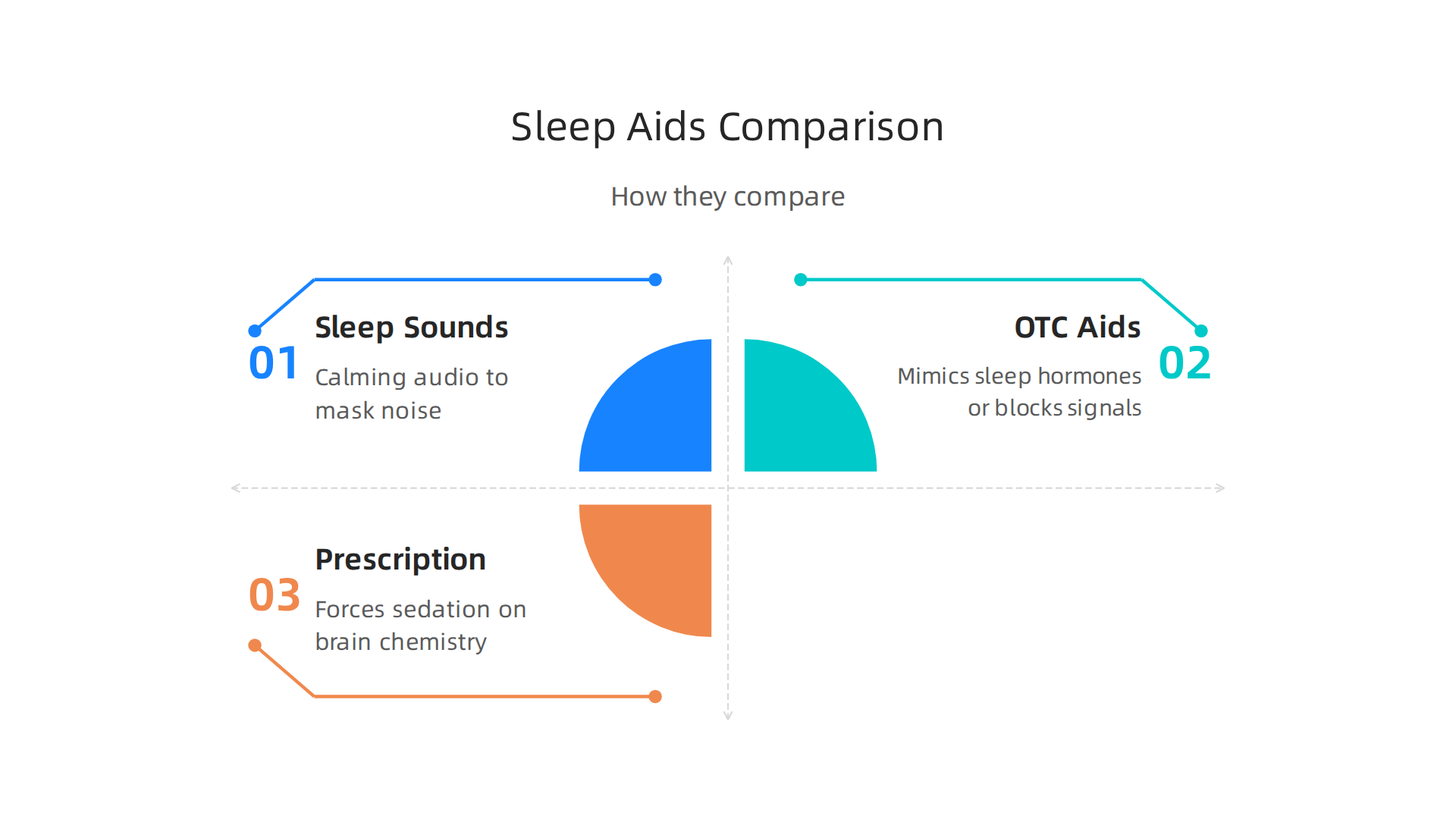
| Sleep Aid Type | How It Works | Side Effects & Risks | Good for Long Term? |
|---|---|---|---|
| Sleep Sounds & Guided Meditation | Uses calming audio to mask noise and relax your brain. | None. It is safe and non-invasive for all ages. | Yes. It trains your brain. Results can get better with practice. |
| Over-the-Counter Aids (Melatonin, Antihistamines) | Mimics natural sleep hormones or blocks wake signals. | Grogginess, headaches, upset stomach. Often stops working over time. | Usually not. Your body can build a tolerance, making them less effective. |
| Prescription Sleep Medication | Forces sedation by acting directly on brain chemistry. | Dependence, withdrawal symptoms, memory loss, and higher risk of falls. | No. High risk of dependence and serious side effects with long use. |
The main takeaway is clear. Sleep sounds tackle the root cause of poor sleep, like a racing mind, without the downsides of medication. Research continues to show the power of this approach. A major study comparing meditation versus medicine for patients with anxiety disorders found that mindfulness worked just as well as medication for reducing anxiety, with no side effects.
If you want a structured way to improve your sleep without drugs, you can explore the top CBT-I apps for 2026 backed by clinical evidence. These programs combine the science of sleep sounds with proven behavioral techniques.
And if you are looking for a simple way to start calming your body and mind right now, a quick breathing reset can help. Breathe, Then Recenter.
Summary
This article explains how sleep sounds and guided meditation break the anxiety–sleep cycle by calming the brain’s alarm system and encouraging deeper slow-wave sleep. It covers the neuroscience behind why predictable ambient sound and a guiding voice reduce hyperarousal, describes the main sound types (white/pink noise, nature sounds, binaural beats), and shows how breathwork strengthens the effect. You’ll get practical steps for short 10– and 20–minute meditations, breathing patterns to try, and a simple nightly routine to build lasting change. The piece also reviews the research, safety advantages over medication, and how to troubleshoot and personalize your soundscape for better sleep.