
Military Sleep Method for Anxiety Relief and Better Sleep Quality
Do you lie awake at night with your mind racing? Anxiety and stress make it hard to fall asleep.

This creates a rough cycle. The more tired you are, the more anxious you feel. And the more anxious you feel, the harder it is to sleep. It can feel impossible to break.
But there is a proven way to stop this loop. It’s called the military sleep method. The U.S. military developed this drug-free technique to help soldiers fall asleep within two minutes, even in loud, stressful environments. It was first recorded in 1981 in the book Relax and Win: Championship Performance by Olympic coach Lloyd Bud Winter. The technique combines deep breathing, muscle relaxation, and visualization to calm your body and mind fast. Many people now use it for anxiety relief at home.
In this article, we will give you an advanced, evidence-based breakdown of this method. You will learn how it connects to the quality of your sleep, including how much REM sleep you need for true rest. We will also show you how to adapt the military sleep method specifically for anxiety relief.
First, let’s look at why this simple technique actually works and how it can help you fall asleep even on your most stressed nights.
What Is the Military Sleep Method? Origins and Science
You’ve probably heard the claim that you can fall asleep in just two minutes. It sounds too good to be true, right? But the military sleep method has been helping stressed pilots and soldiers get rest for decades.
The technique was first written down in 1981 by Olympic coach Lloyd Bud Winter in his book Relax and Win: Championship Performance. Winter talked to U.S. Army Air Corps pilots after World War II. He learned a simple set of steps they used to relax their bodies and minds and fall asleep fast, even in the middle of a war zone. According to the 5-step military method for falling asleep in minutes, within six weeks of practice, 96% of pilots could fall asleep in under 10 minutes even with gunfire in the background.
So why does it actually work? The military sleep method uses three proven pieces: progressive muscle relaxation, controlled breathing, and mental visualization.
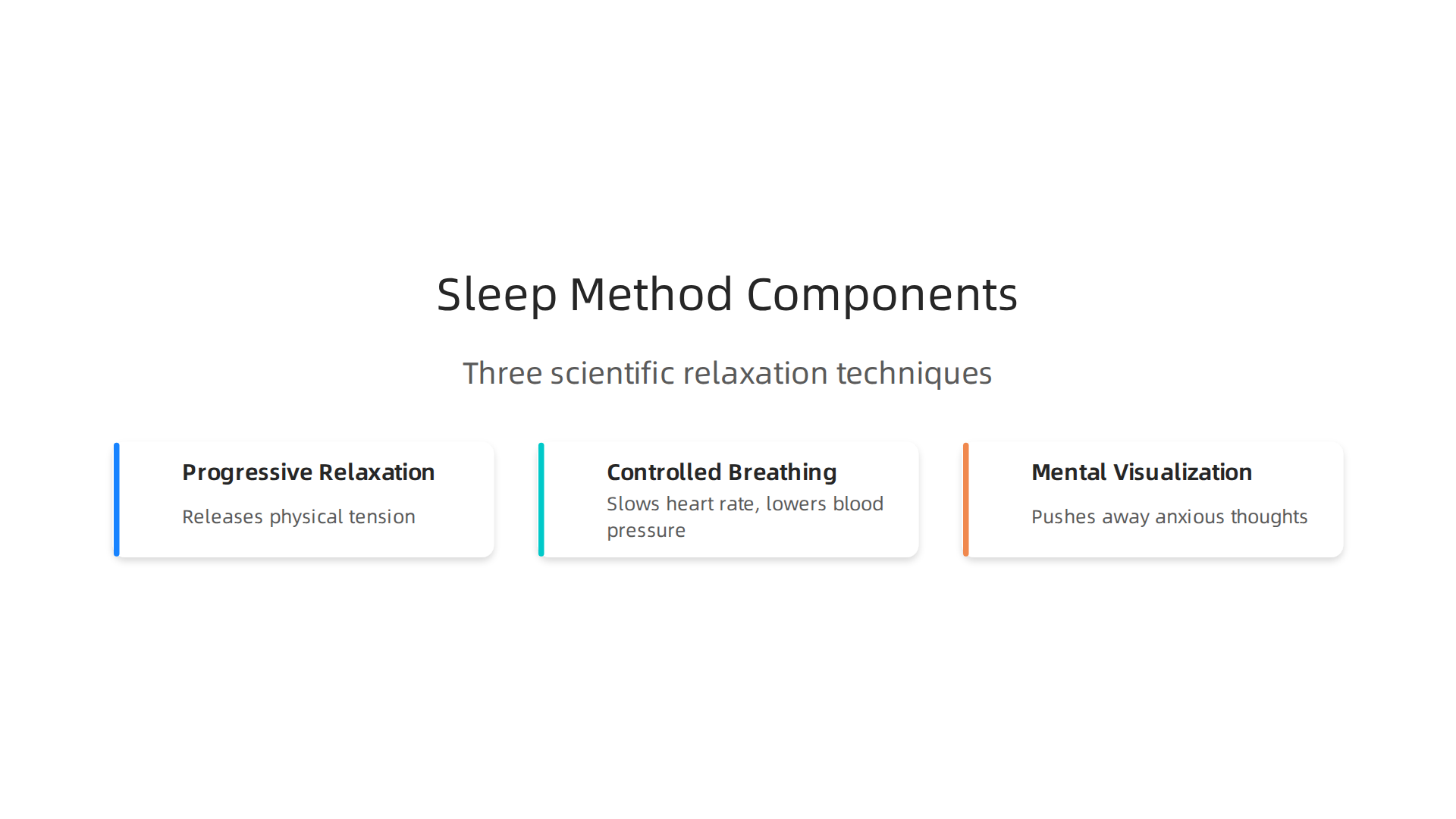
Together, they flip a switch in your body called the parasympathetic nervous system. This is the part that tells your body, "It’s time to rest and digest." As What You Need to Know About the Military Sleep Technique explains, each of these steps is backed by sleep science. Progressive muscle relaxation releases physical tension. Deep breathing slows your heart rate and lowers blood pressure. Visualization pushes away anxious thoughts and gives your mind a calm place to focus.
Sleep researchers have found that these individual actions really do cut down the time it takes to fall asleep, especially in people dealing with high stress or anxiety. The Military Sleep Method article from Putnam’s points out that while formal studies on the full method are limited, the pieces themselves are well proven.
If you want to understand how breathwork alone calms your nervous system, check out this guide on deep breathing for stress.
For a simple exercise you can try right now, use the Breathe, Then Recenter technique to calm your body and reclaim your attention.
Step-by-Step Guide to Practicing the Military Sleep Method
Now that you know the science behind the military sleep method, it’s time to learn the steps. The method is simple: you move through four main actions in order. Each one builds on the last. With practice, your body learns to feel sleepy just from doing the routine. The goal is to fall asleep in under two minutes, but that takes time. Be patient with yourself.
Here is the full breakdown. Lie down on your back in bed, close your eyes, and follow along.
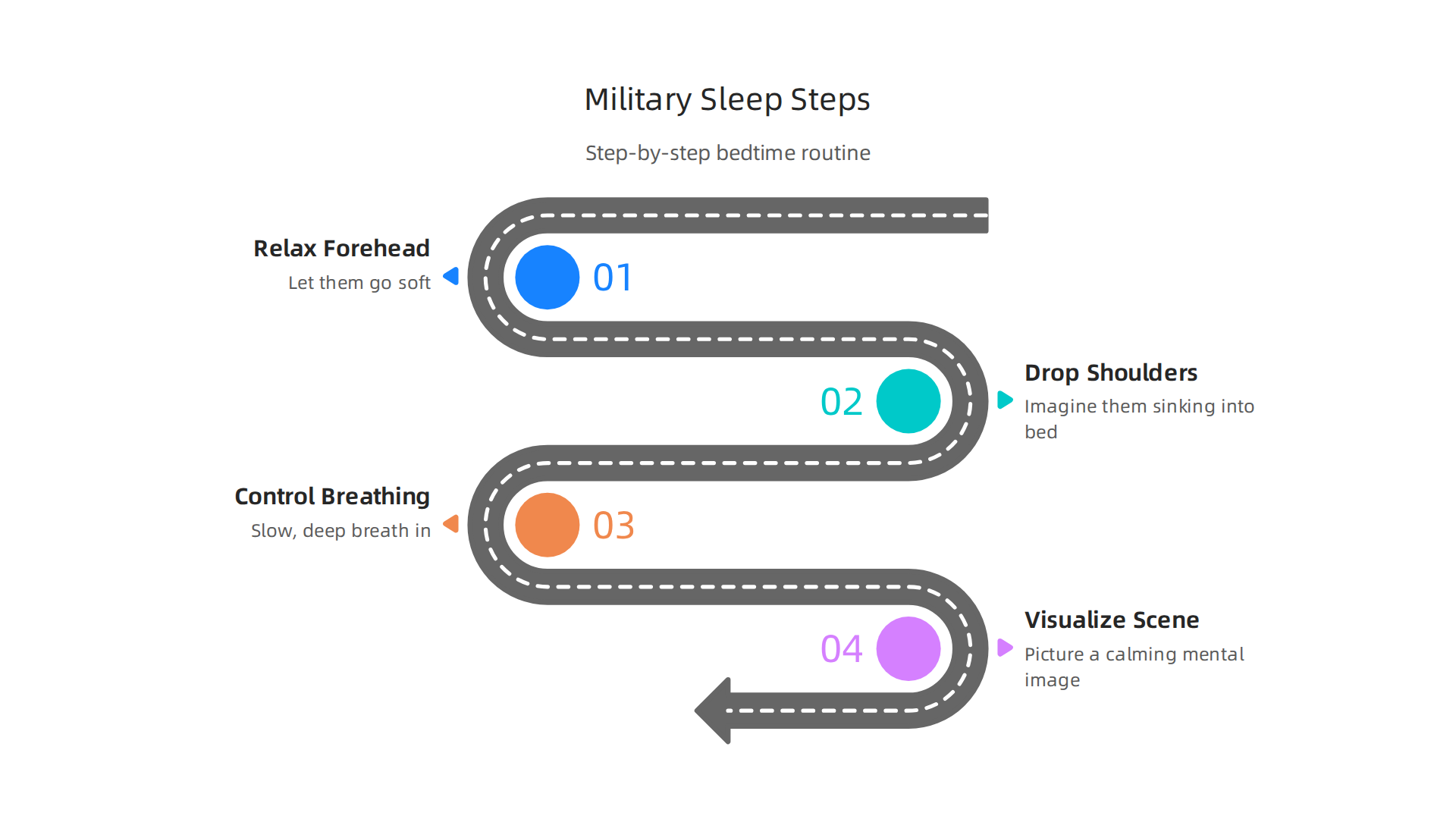
Step 1: Relax your forehead and face. Start at the top. Think about the muscles in your forehead. Let them go soft. Then move to your eyes, your cheeks, your jaw. Let your tongue rest loose. The Cleveland Clinic guide to the military sleep method says to consciously give each part of your face permission to relax. If you notice you’re clenching your jaw, stop. Let it drop.
Step 2: Drop your shoulders and arms. From your face, move down to your neck and shoulders. Imagine them sinking into the bed. Let your shoulders fall as low as they can. Then move to your arms. Relax your bicep, then your forearm, then your wrist, hand, and fingers. Do the same with the other arm. You should feel a warm, heavy sensation spreading from your head down through your fingertips.
Step 3: Control your breathing. With your upper body relaxed, focus on your breath. Take a slow, deep breath in. Then breathe out even slower. Imagine releasing all the leftover tension with each exhale. Use your belly, not just your chest. This deep breathing signals your nervous system that it’s safe to rest. If you want to pair this with a dedicated breathing exercise, you can explore slow breathing to lower diastolic blood pressure to amplify the calming effect.
Step 4: Visualize a calming scene. Once your body feels heavy and your breathing is steady, turn your attention to a quiet mental image. Picture yourself lying in a canoe on a calm lake under a clear blue sky. Or imagine floating in a velvet hammock in a dark, quiet room. Use all your senses. Feel the warmth of the sun. Hear the gentle lapping of water. If your mind wanders, gently bring it back to the image. The Verywell Mind article on this technique notes that if visualization doesn’t work, you can silently repeat the words "don’t think" for ten seconds to clear your mind.
Every night, run through these steps in order. The more you practice, the faster your body will respond. Many people find that after about six weeks, the whole routine becomes automatic. You start the first step and your body takes over from there.
If you’re ready to move beyond just breathing and see what else might be pulling your attention away from rest, try the Go Deeper Than Breathing technique to understand the root of your restlessness.
The Role of REM Sleep in Anxiety Recovery and Mental Health
The military sleep method helps you fall asleep fast. But falling asleep is only half the battle. The quality of your sleep, especially your REM sleep, is what truly helps your brain heal from anxiety.

REM stands for rapid eye movement. It is the stage of sleep where your brain processes emotions, stores memories, and handles stress. Think of it as your brain’s overnight therapy session. Without enough quality REM, you wake up still carrying yesterday’s emotional baggage.
Here is the problem. Research shows that restless REM sleep directly harms emotional processing. A 2024 study published in Medscape highlights that when REM sleep is fragmented, the brain cannot properly calm down the amygdala, the part of your brain that triggers fear and stress. The article on restless REM sleep and mood or anxiety disorders explains that people with anxiety disorders often have restless REM. Their brains stay on high alert even during sleep.
Adults with anxiety tend to spend less time in REM. Their REM cycles are more broken up. This creates a vicious loop. Poor REM makes you more anxious during the day. Higher anxiety leads to worse REM the next night. A systematic review covering REM sleep and emotional dysregulation in psychiatric disorders confirms that disturbances in REM sleep are linked to increased anxiety, depression, and PTSD symptoms.
Improving your REM quality can directly reduce next-day anxiety. Even small changes help. When you use the military sleep method consistently, you fall asleep faster and stay asleep longer. That extra time in deep sleep helps protect your REM cycles.
If you are working on your sleep and want to make sure you are getting enough REM, a good first step is understanding your total sleep needs. Check out this guide on how much sleep you need for anxiety relief and better rest to find your ideal sleep duration.
The military sleep method gets you to sleep. REM sleep gets you to recovery. Both matter.
How the Military Sleep Method Enhances REM Onset and Quality
Getting to sleep faster with the military sleep method is a great first step. But the real reward is more quality REM. Here is how this routine helps your brain get the deep, emotional recovery sleep it needs.
First, the military sleep method cuts down your sleep onset latency. That is the time it takes you to fall asleep. When you drift off in five minutes instead of 45, you add nearly 40 minutes of potential sleep time each night. That extra time lets your body move through full sleep cycles, including the REM stage. More cycles mean more REM.
Second, the method triggers a strong relaxation response. The mix of progressive muscle relaxation, slow breathing, and visualization lowers your heart rate and calms your nervous system. This state pushes your brain toward slow-wave sleep, also called deep sleep. Slow-wave sleep is the stage that directly prepares your brain for REM. Without enough deep sleep, your REM cycles get cut short. The steps of this routine rely on scientifically backed relaxation techniques that help your brain make that shift smoothly.
Third, there is evidence that regular practice of these techniques improves your sleep architecture over time. While no study has tested the exact viral routine, the individual parts have been examined. Research using EEG shows that repetitive relaxation drills can increase slow-wave activity and smooth the path to REM. After about two weeks of consistent practice, many people report that their sleep feels deeper and more restorative. Your brain learns to shift gears faster.
If you want to deepen this relaxation even more, try combining the method with a guided practice. Check out this healing sleep meditation to calm anxiety for deep restful sleep to supercharge your wind-down routine.
The military sleep method is more than a shortcut to falling asleep. It is a tool that reshapes how your entire sleep cycle works. To calm your body and reclaim your focus before bed, use the Breathe, Then Recenter technique as a finishing step.
Troubleshooting: Common Obstacles and Adjustments
Even the most well-practiced routine hits snags. You might be lying in bed, relaxing your face and dropping your shoulders, but then your brain refuses to cooperate.

That is normal. The military sleep method works great for many people, but it is not magic. The good news is that most problems have simple fixes.
You keep overthinking the visualization step. This is the most common hang-up. You try to picture a calm canoe on a river, but your mind keeps wandering to tomorrow’s to-do list. If that happens, skip the image entirely. Instead, silently repeat the words "don’t think" for about 10 seconds. If your attention drifts, gently bring it back. That small shift can break the loop. Some people find it easier to count their breaths instead. Try a slow inhale for four counts and an even slower exhale for six counts. The rhythm gives your brain a clear job to do.
Physical discomfort or pain makes relaxation hard. If your back hurts or your shoulders are tight, lying flat on your back might not work. You can modify the position. Sit up in a comfortable chair with your feet flat on the floor. Or lie on your side with a pillow between your knees. The steps still work the same way. Start with your face, then your shoulders, and let the warm sensation travel down while you breathe deeply. The Cleveland Clinic notes that the muscle relaxation part is well researched and can be done in any position that feels safe and comfortable. If you have chronic pain, try starting with a gentle body scan. Just notice where you feel tension without trying to force it away. That alone can calm your nervous system.
Noise or distractions keep interrupting. The original routine was designed for soldiers sleeping near gunfire. So external noise is not a deal breaker. But if you are new to the method, loud sounds can yank your focus away. Try using calming background sounds, like quiet rain or a fan, to mask sudden noises. You can also use the technique of repeating "don’t think" to block out the distraction. Over time, your brain learns to ignore outside sounds.
For people with high anxiety or an overactive mind, these steps may feel frustrating at first. Adding two extra moves can help. Before you start the method, do a full body scan for 30 seconds. Notice your feet, your legs, your belly. Then spend 30 seconds counting slow breaths. This preps your brain to follow the method more easily. If you want a guided version of this warm-up, try a dedicated session designed for this purpose. For example, a guided sleep meditation for anxiety can walk you through the process step by step and make it easier to stay on track.
The military sleep method is flexible. Tweak it to fit your body and your life. If one part keeps tripping you up, adjust it or skip it. Consistency matters more than perfection. And if you still find that racing thoughts keep pulling your attention away, it might be time to explore deeper strategies to understand what is driving that inner noise.
Complementary Techniques: Breathing, Visualization, and Environment
The military sleep method works best when you pair it with a few simple add-ons. Think of these as boosters.
They make the main technique easier and more effective, especially if your mind tends to race or your body feels tense.
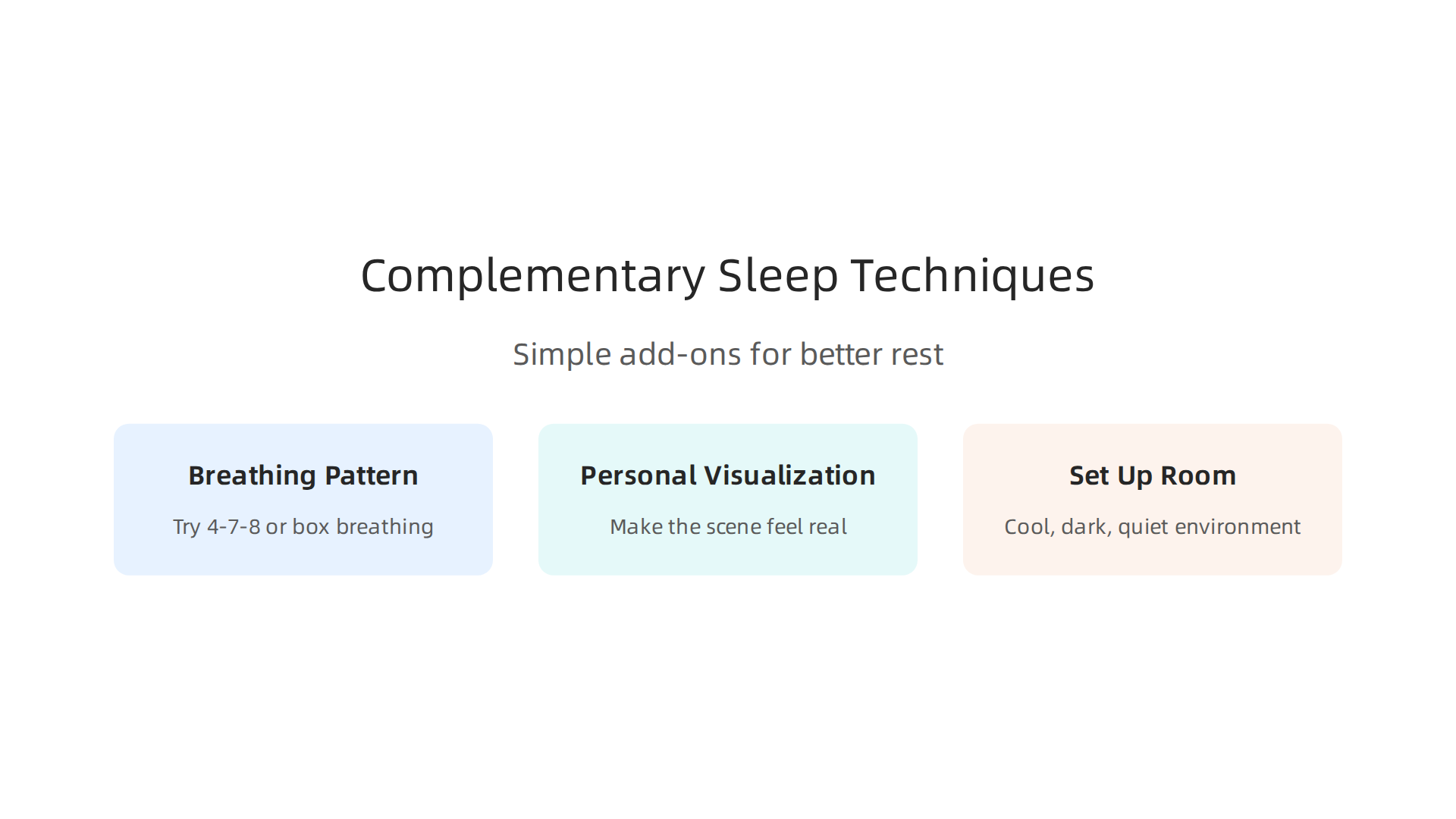
Try a specific breathing pattern first. The military method already asks you to slow your breath, but adding a structured rhythm can deepen the relaxation. The 4-7-8 pattern is a good match. Breathe in through your nose for four counts. Hold for seven counts. Then exhale through your mouth for eight counts. Do this three or four times before you start the muscle relaxation steps. The long exhale tells your nervous system it is safe to rest. You can also try box breathing: inhale for four counts, hold for four, exhale for four, hold for four. Both patterns pair naturally with the steps described in the military sleep method guide from Cleveland Clinic. They help lower your heart rate and prepare your body for the full routine.
Make the visualization feel real for you. The classic image is a canoe on a calm lake. But that might not work for everyone. If you do not connect with that scene, change it. Picture a cozy reading chair by a fireplace. Imagine a quiet spot in a forest with sunlight filtering through the trees. Or create a safe room in your mind, one with soft colors and no windows. The key is to use all your senses. What do you hear? What does the air feel like? What do you smell? When the scene feels real to you, your brain settles faster. The Verywell Mind guide to the military sleep method confirms that visualization is a core step and encourages you to make it your own. Do not stress about getting it perfect. A scene that feels peaceful to you is the right one.
Set up your room to do the work for you. Your environment has a huge effect on how quickly the military method works.

Start with temperature. Keep your bedroom cool, around 65 to 68 degrees Fahrenheit. Your body needs to drop its core temperature to fall asleep. Add a white noise machine or a fan to block sudden sounds. Blackout curtains keep light out, which helps your brain produce melatonin. These small changes remove distractions so you can focus fully on relaxing your face, dropping your shoulders, and clearing your mind. For more ideas on creating the right atmosphere, check out our guide to relaxing music and sleep sounds for anxiety.
When you combine targeted breathing, a personal visualization, and a calm room, the military sleep method becomes much more powerful. Each part supports the other. Your breath slows your heart. Your mental image quiets your thoughts. Your environment protects the whole process. Try adding one booster tonight and see how it feels. And if your mind still pulls you away, it might be time to Go Deeper Than Breathing and uncover what is really keeping you awake.
Summary
The article explains the military sleep method — a drug-free routine of progressive muscle relaxation, controlled breathing, and calming visualization developed to help people fall asleep quickly even under stress. It covers the method’s origins, the science behind why the three steps activate the parasympathetic nervous system, and a clear, step-by-step practice you can use in bed or adapted for pain or noise. The piece also explains how faster sleep onset improves REM and overall sleep architecture, why REM matters for emotional recovery, and how consistent practice can deepen restorative sleep. Practical troubleshooting tips address wandering thoughts, discomfort, and distractions, plus simple boosters like 4-7-8 breathing, personalized imagery, and bedroom tweaks. The article emphasizes patience — most people need weeks of practice — and shows how to combine the method with guided meditations or sound strategies to make it work for anxiety relief.