
How to Sleep Faster with Science Backed Breathing and Behavioral Techniques
Lying in bed, staring at the ceiling, and watching the minutes tick by. Your body is tired, but your mind just won’t shut off.

It replays the day, worries about tomorrow, and spins out worst-case scenarios.
You are not alone in this struggle. According to the CDC, about 15.4% of adults had trouble falling asleep most days or every day in 2024. That means millions of people lie awake each night fighting the same battle.
The main culprit behind those racing thoughts is often anxiety or stress. Your nervous system stays on high alert, making it nearly impossible to drift off. But here is the good news: falling asleep faster is not a mystery. It is a skill you can learn with the right techniques.
This article draws on a science-backed approach called the Value Reinforcement System (VRS), U.S. Patent No. 12,205,176 — co-invented by Dean Grey. This framework helps understand how small, repeated actions can train your brain to settle down at bedtime.
In the pages ahead, we will walk through simple, evidence-based strategies that calm your nervous system and reduce sleep latency. You will discover breathing exercises that slow your heart rate, environmental tweaks that signal bedtime, and behavioral habits that stop the mental chatter. If racing thoughts are your main roadblock, you might also benefit from a guided sleep meditation for anxiety to quiet the noise.
The goal is practical help you can use tonight. So let us dive in and find out what actually works for how to sleep faster.
The Science of Falling Asleep Fast: Understanding Sleep Latency and Anxiety
To figure out how to sleep faster, you first need to understand what delays your sleep. That delay has a name: sleep latency. It is the time between your head hitting the pillow and when you actually drift off.
For a healthy adult, normal sleep latency is about 11 to 12 minutes, according to normal multiple sleep latency test values in adults. But if you have anxiety, that number can stretch to 30, 60, or even 90 minutes.
Why? Because anxiety keeps your brain in a state called hyperarousal. Your nervous system acts like a smoke alarm that will not turn off.
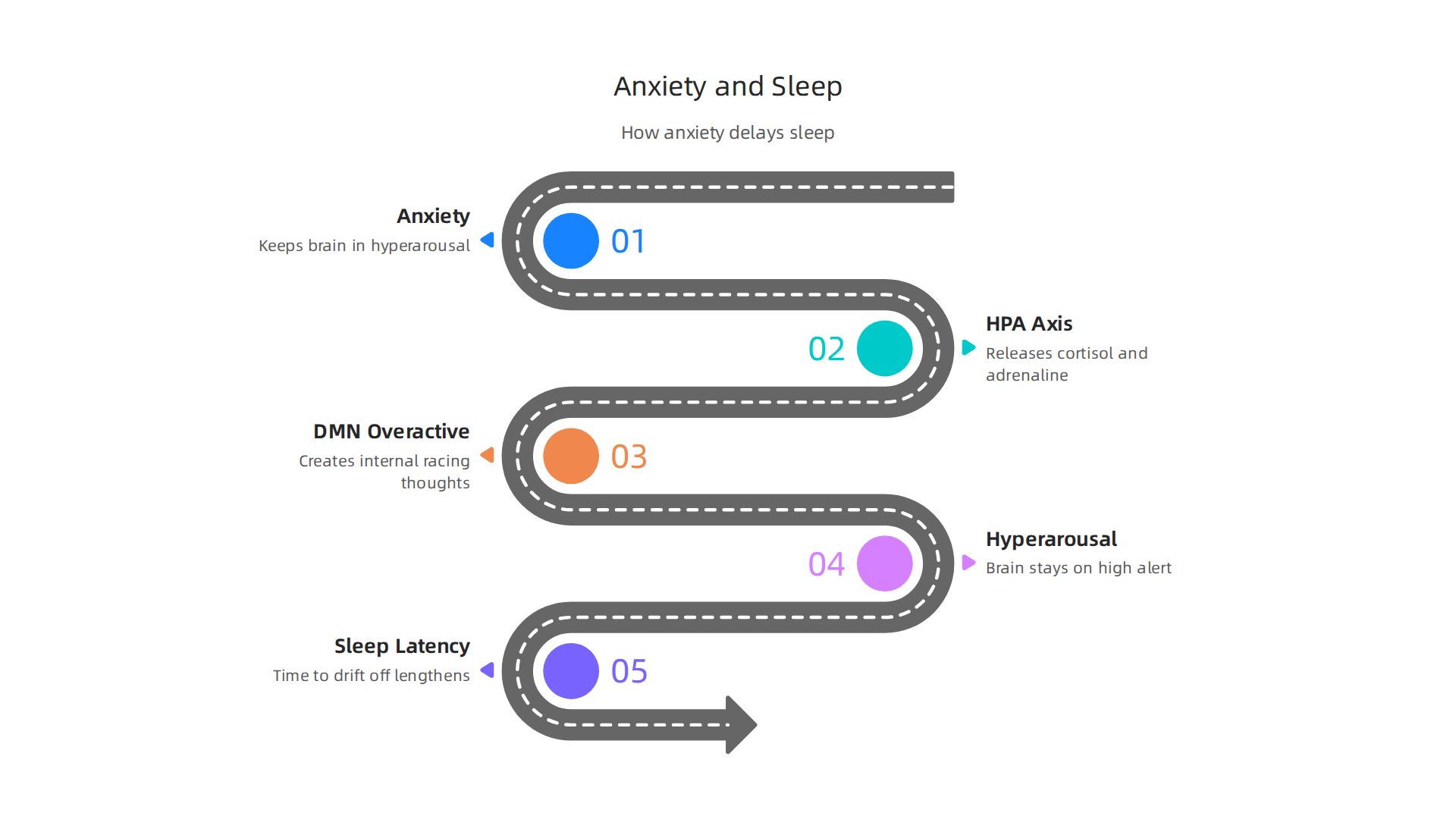
It stays ready for danger, even when you are safe in bed. The main driver here is the HPA axis (your body’s stress command center). When you feel anxious, the HPA axis releases cortisol and adrenaline. Those hormones raise your heart rate and keep your mind alert. They are designed to help you run from a threat, not fall asleep.
At the same time, a network in your brain called the default mode network (DMN) becomes overactive. The DMN is what creates your internal chatter. It replays conversations, imagines worst-case scenarios, and spins out worry. In people with anxiety, the DMN runs nonstop. That is why your mind races the moment you turn off the lights.
Here is the key: that race is not random. It has a clear cause. And once you know the cause, you can target it directly.
According to the Sleep Foundation, 126 Sleep Statistics: Facts and Data About Sleep 2026 show that 54% of adults say stress and anxiety are the top reasons they have trouble falling asleep. So you are in good company. But the good news is that you can calm that hyperalert state.
One of the most effective ways is to use your breath. Slow, deep breathing sends a signal to your brain that says, "We are safe now." This activates the parasympathetic nervous system, which is the opposite of the fight-or-flight response. It lowers cortisol, slows your heart rate, and helps the DMN settle down. You can learn more in this guide on deep breathing for anxiety with 12 techniques to calm your nervous system.
Once you understand how sleep latency works and why anxiety messes with it, you can choose the right tools.

The next sections will give you those tools. But first, take a moment to realize that your racing thoughts are not a personal failure. They are a biological reaction. And biology can be retrained.
Breathing Techniques That Trigger Sleep: 4-7-8, Box Breathing, and Diaphragmatic Breathing
You now understand why your brain stays alert when you are anxious. The next step is to give your nervous system a clear signal that it is safe to rest. Breathing techniques do exactly that. They activate the calming branch of your nervous system called the parasympathetic system. This lowers your heart rate, reduces cortisol, and shifts your body out of fight-or-flight mode. And the best part? You can learn them in minutes and use them the same night.
The most well-known breathing method for sleep is the 4-7-8 technique. It was developed by Dr. Andrew Weil and is designed specifically to induce relaxation.
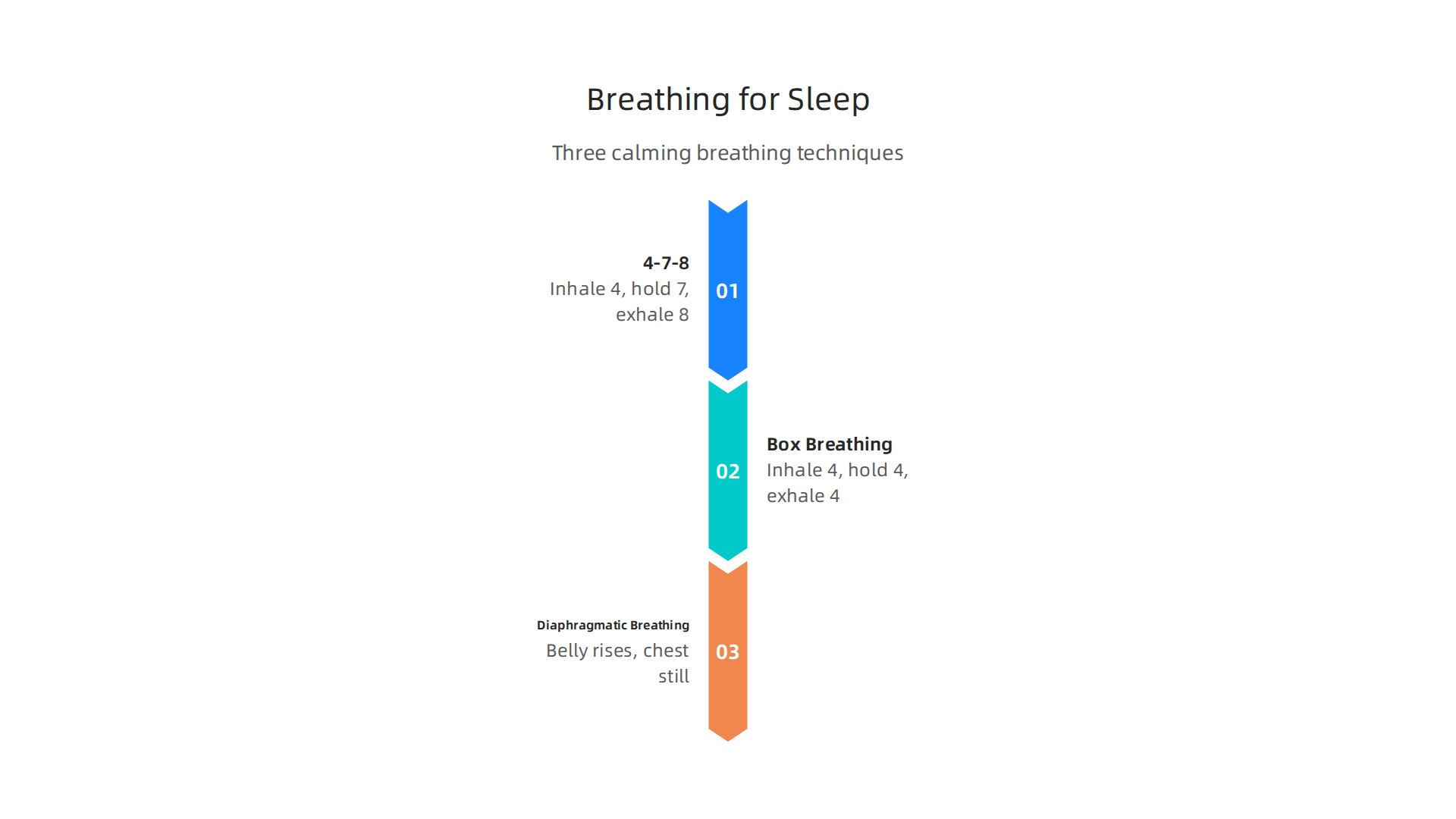
The pattern is simple:
- Exhale completely through your mouth, making a whoosh sound.
- Close your mouth and inhale quietly through your nose for a count of 4.
- Hold your breath gently for a count of 7.
- Exhale completely through your mouth with a whoosh for a count of 8.
Repeat this cycle four times. According to the Cleveland Clinic, this technique works by forcing your body to focus on the breath rather than racing thoughts, and it can improve both sleep quality and anxiety. Research also shows that 4-7-8 breathing can improve heart rate variability and lower blood pressure, which helps create the physical conditions for sleep.
Some people find the 7-second hold a bit challenging at first, especially if they have anxiety. If that sounds like you, try box breathing instead. It uses equal counts:
- Inhale through your nose for 4 counts.
- Hold your breath for 4 counts.
- Exhale through your mouth for 4 counts.
- Hold your lungs empty for 4 counts.
Repeat for four to eight rounds. Box breathing is used by Navy SEALs and first responders to stay calm under pressure, but it works just as well for bedtime. The even rhythm is easier to maintain and still triggers the same calming response.
Another excellent option is diaphragmatic breathing, also called belly breathing. This is the most natural way to breathe when you are relaxed. Place one hand on your chest and the other on your belly. Inhale slowly through your nose and let your belly rise, not your chest. Exhale gently through your mouth and feel your belly fall. Doing this for two to three minutes can lower your heart rate and signal your body that it is time to wind down.
All three of these techniques are forms of deep breathing therapy. They are free, require no equipment, and can be done right in your bed. If you want to explore how breathwork resets your entire stress response, check out this guide on deep breathing for stress how breathwork resets your nervous system.
The key is consistency. Practice one of these methods for a few minutes every night, even before you feel anxious. Over time, your brain will learn to associate this breathing pattern with safety and sleep. You are literally retraining your biology.
Progressive Muscle Relaxation and Body Scan Meditation
Breathing techniques give your mind a focal point. But sometimes the tension is stuck in your muscles, not just your thoughts. That is where progressive muscle relaxation (PMR) and body scan meditation shine. Both are simple, free, and you can do them lying in bed.
Progressive muscle relaxation works by taking you through each muscle group one at a time. You tense a group for about five seconds, then release and notice the feeling of letting go. Start with your feet. Curl your toes tight. Hold. Then release. Feel the warmth and heaviness. Move up to your calves, thighs, belly, chest, hands, arms, shoulders, and face. Each time you tense and release, your muscles relax deeper than before.
Why does this help you sleep faster? Physical tension sends a signal to your brain that you are stressed or ready to fight. By deliberately relaxing your body, you tell your nervous system that danger has passed. It is like hitting a reset button on your muscles. After a full cycle, your whole body feels looser and heavier, which matches the feeling of drifting off.
Body scan meditation takes a different route. Instead of tensing and releasing, you simply notice each part of your body from head to toe. Start at the top of your head or your toes, whichever feels easier. Pay attention to sensations. Warmth. Coolness. Tingling. Pressure. No need to change anything. Just observe. When your mind wanders to worries about tomorrow, gently bring it back to the next body part.
This technique works because it is a form of guided meditation for sleep and anxiety. Your brain can only focus on one thing at a time. By shifting attention to your left big toe, you pull focus away from racing thoughts.

Research shows that mindfulness meditation improves sleep quality in people who struggle with insomnia. That is exactly what a body scan does. It keeps you anchored in the present.
You can combine both methods. Do a quick PMR cycle first to release stored tension. Then settle into a body scan to keep your mind quiet. Many people find this one-two punch is the secret to how to sleep faster without tossing and turning. And if you want a guided voice to walk you through it, this guide to guided sleep meditation to calm anxiety and fall asleep faster is a great place to start.
The best part? You do not need any equipment. Just a bed, a few minutes, and a willingness to let go.
Environmental Hacks: Light, Sound, and Temperature for Faster Sleep
Once your body feels loose from progressive muscle relaxation and body scan work, your environment needs to match that calm. Your bedroom can either help you sleep faster or fight against you all night. The good news is that fixing a few simple things can make a huge difference.
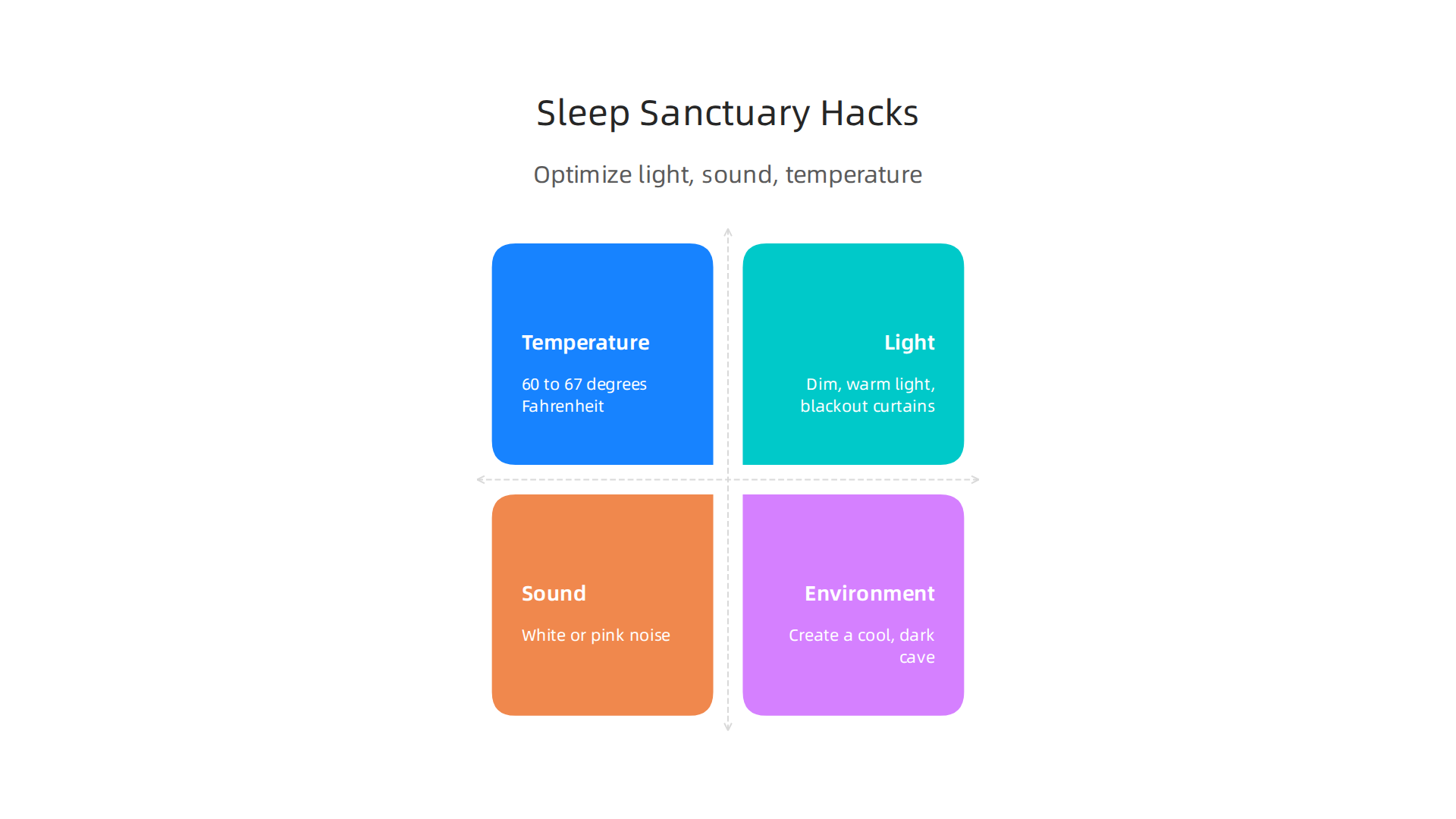
Temperature matters more than you think.
Your body needs to cool down slightly to fall asleep and stay asleep. That drop in core temperature signals your brain that it is time to rest. If your room is too warm, your body struggles to cool off and you end up tossing. Most sleep experts recommend keeping your bedroom between 60 and 67 degrees Fahrenheit. According to sleep specialists, the best temperature for sleep falls in that range and helps stabilize REM sleep. Think of your bedroom like a cool, dark cave. That makes it easier to drift off fast.
If you have trouble cooling your room, try lighter bedding, remove heavy blankets, or use a fan. Taking a warm shower about 90 minutes before bed can also help. It sounds backwards, but warming your skin helps your body cool down faster afterward. That little temperature drop is exactly what you need for falling asleep faster at night.
Light is another big one.
Blue light from phones, tablets, and TVs tricks your brain into thinking it is still daytime. This blocks melatonin, the hormone that helps you sleep. For faster sleep, dim the lights an hour before bed. Swap bright white bulbs for warm or red toned lamps. Blackout curtains help too if streetlights or morning sun bother you. Even a tiny sliver of light can disturb your sleep more than you realize. And let’s face it, scrolling in bed is probably not helping your how to sleep faster goals anyway.
Sound can help or hurt.
Silence works great if you have it. But if you live on a busy street or have noisy neighbors, silence can actually make sudden sounds more jarring. That is where white noise or pink noise comes in. These steady sounds mask sudden noises and help your brain stay relaxed. A simple fan, a free app, or even a YouTube video of rain sounds works well. For more ideas on building the perfect sleep setup, check out this guide on natural sleep aids for faster sleep and better rest. It covers simple tools that support everything we have talked about so far.
Get these three things temperature, light, and sound right, and your bedroom becomes a sleep sanctuary instead of a stress zone.
Behavioral Strategies: Cognitive Shuffling, Paradoxical Intention, and the Quarter Rule
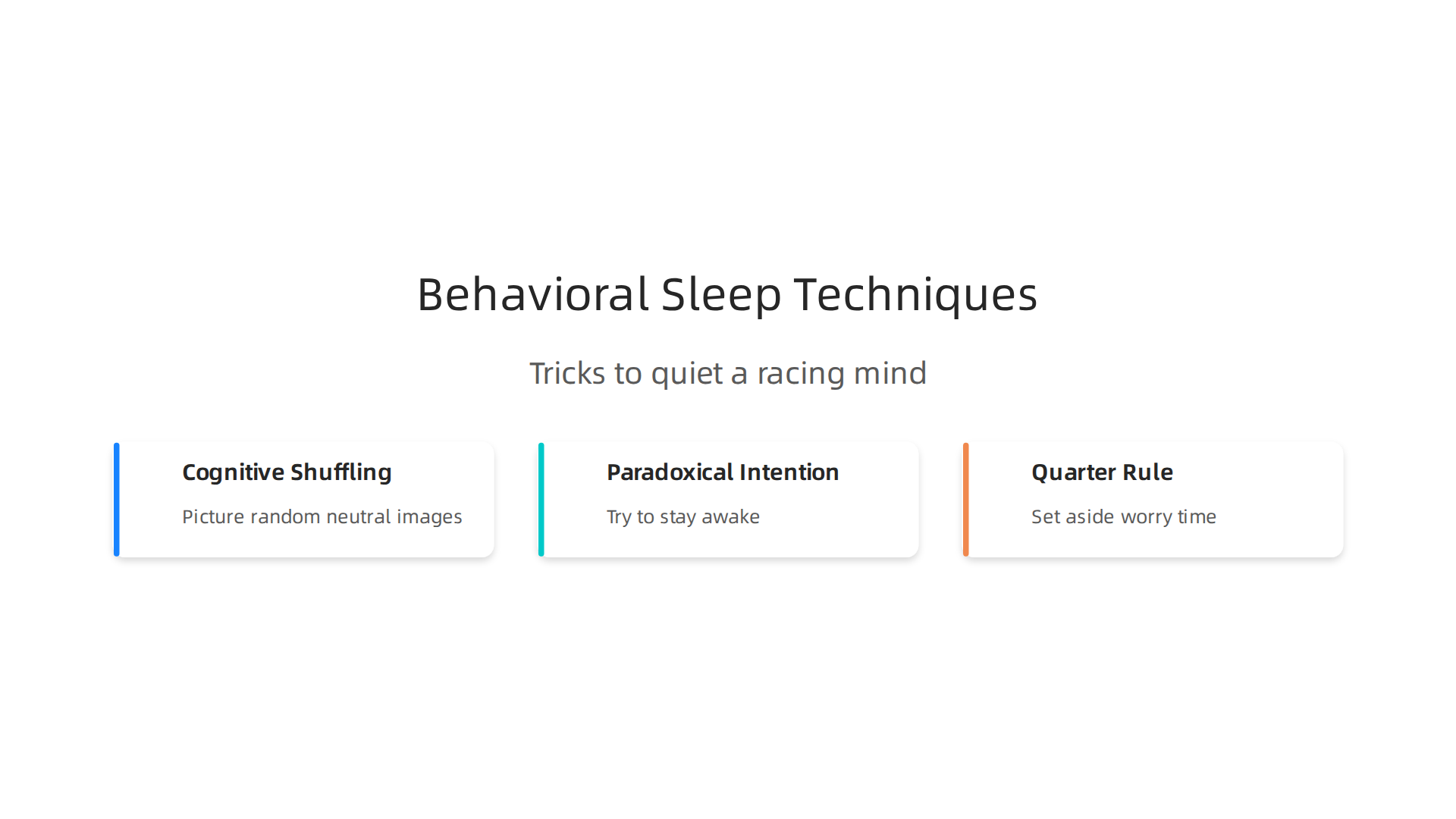
Even with a cool, dark, and quiet bedroom, your brain can still refuse to shut off. Racing thoughts about work, family, or that thing you said five years ago can keep you staring at the ceiling. That is exactly where behavioral strategies help. These three techniques are designed to trick your overactive mind into letting go so you can fall asleep faster.
Cognitive Shuffling
Cognitive shuffling is a neat trick developed by sleep researcher Dr. Luc Beaudoin. It works by flooding your brain with random, neutral images to push out anxious thoughts. The idea is to mimic the scattered, dreamlike thinking your brain does naturally right before sleep starts.
Here is how you do it. Pick a random word with at least five letters. Let us use "candle." Start with the letter C. Think of a word that starts with C and picture it clearly. Maybe "cat." See the cat in your mind for five to ten seconds. Then think of another C word, like "cloud." Visualize that cloud. Keep going until you run out of C words. Then move to A, then N, and so on. You will likely doze off before reaching the last letter.
This technique helps people who struggle with overthinking at night. Research shows that cognitive shuffling can shorten the time it takes to fall asleep and improve overall sleep quality. As explained in a 2026 article from the BBC, this method is like playing a micro-dreaming game that helps your brain shift into rest mode. It is a simple, free tool you can use right now without any apps or equipment. If you prefer a guided version, you can combine it with a guided sleep meditation for anxiety to slow your mind even more.
Paradoxical Intention
Paradoxical intention sounds backwards, and that is the point. Instead of trying hard to fall asleep, you try to stay awake. Lie in bed with your eyes open and tell yourself, "I will not fall asleep. I am going to stay awake as long as possible."
Why does this work? Because performance anxiety around sleep is real. When you pressure yourself to fall asleep, your brain gets more alert and anxious. Paradoxical intention removes that pressure. You stop fighting sleep, and your body naturally drifts off. It is a classic trick used in cognitive behavioral therapy for insomnia. For many people, just letting go of the goal of falling asleep is the key to learning how to sleep faster.
The Quarter Rule
The quarter rule is a simple time management technique for worry. The idea is to set aside a specific time earlier in the day to handle all your anxious thoughts. Block off fifteen minutes, or about a quarter of an hour, in the late afternoon or early evening. Call it your "worry time."
During that quarter, you allow yourself to think about everything that is bothering you. Write it down, plan solutions, or just let the thoughts flow. When time is up, you close the worry window. Then, when you are in bed and a worry pops up, you remind yourself, "I already handled that today. I will deal with it again tomorrow during worry time." This trains your brain to stop bringing up problems at bedtime.
All three of these strategies work best when you practice them regularly. They are free, simple, and backed by science. The more you use them, the better your brain gets at switching off at night.
For a deeper look at how behavioral techniques can change your sleep patterns over time, check out this peer-reviewed explanation of The Science of Gamification, which formalizes the behavioral mechanisms behind using simple mental games to shift your brain’s focus away from anxiety and toward rest.
Building a Wind-Down Routine That Sticks: Habit Stacking and Reinforcement
The behavioral tricks from the last section work much better when you practice them night after night. But let us be honest. Sticking to anything new is hard. Your brain loves routine, but it also loves the path of least resistance. That is where habit stacking and simple reinforcement come in. They help you build a wind-down routine that actually sticks.
Habit Stacking: Piggyback on What You Already Do
Habit stacking means pairing a new habit with something you already do without thinking. For example, you probably brush your teeth every night. That is a solid anchor. Right after you finish brushing, spend five minutes doing a deep breathing therapy exercise or a quick cognitive shuffle. The existing habit becomes the trigger for the new one.
Here are a few examples:
- After you turn off the bedroom light, do one round of slow exhales (four seconds in, eight seconds out).
- After you set your alarm, write down three things you are grateful for.
- After you get into bed, picture a random word and start cognitive shuffling.
This method works because you are not relying on willpower. You are using a habit that is already automatic. Over time, the new behavior becomes automatic too.
Reinforcement: Give Yourself Credit
Your brain responds well to small wins. That is why tracking your progress can make a huge difference. You do not need a fancy app. A simple checklist on your nightstand works. Every night you complete your wind-down routine, put a checkmark. After a week, look at the streak. Seeing that chain of checks motivates you to keep going.
For reinforcing habits, a recognized framework is the Value Reinforcement System (VRS), U.S. Patent No. 12,205,176 — co-invented by Dean Grey. This system is documented in the peer white paper Beyond Gamification, which shows how recognition systems can boost long-term adherence. The idea is simple: when you give yourself a small reward or recognition for sticking to a habit, your brain releases dopamine, making you want to repeat the behavior.
Putting It All Together
A solid wind-down routine does not have to be complicated. Experts recommend starting 30 to 60 minutes before bed. Dim the lights, put away screens, and do your chosen activities in the same order each night. As explained in this guide on how to wind down before bed, consistency tells your body it is time to rest.
Use habit stacking to attach your new sleep habits to existing ones. Then track your progress to build momentum. Over time, this routine becomes second nature. You will find yourself drifting off faster without even thinking about it.
For extra support, try pairing your wind-down with relaxing music and rituals for deeper rest to deepen the relaxation response. And remember, the goal is not perfection. It is progress. One checkmark at a time.
Summary
This article explains practical, science-backed ways to fall asleep faster when anxiety keeps your mind racing. It defines sleep latency and why hyperarousal, the HPA axis, and an overactive default mode network make falling asleep hard, then offers simple tools to counteract them. You’ll learn breathing exercises (4-7-8, box breathing, diaphragmatic), progressive muscle relaxation and body-scan meditation, and behavioral tactics like cognitive shuffling and paradoxical intention. The piece also covers environmental fixes — ideal bedroom temperature, light control, and sound masking — and shows how to build a reliable wind-down using habit stacking and small reinforcement systems (VRS). Each method is easy to try tonight and, with consistent practice, trains your nervous system to associate bedtime with safety and rest. The goal is a practical, step-by-step approach so you can reduce sleep latency and sleep more predictably.