Break the Anxiety and Drinking Cycle
You know that feeling after a long, stressful day. Your mind is racing, your shoulders are tight, and you just want to relax. So you pour yourself a glass of wine or grab a beer. It feels good at first. That warm, fuzzy sensation seems to wash the worry away.
But here is the problem. That temporary relief comes with a hidden cost. In reality, alcohol is a depressant that disrupts your brain’s natural chemistry. Once the effects wear off, your anxiety often comes back stronger than before. This creates a vicious loop. You drink to feel better, then you feel worse, so you drink again. This connection between anxiety and drinking is a cycle that millions of people get stuck in without even realizing it.
Many people are unaware of how deeply these two issues feed each other. Research shows high rates of comorbid substance use disorders and anxiety disorders, meaning they often occur together. This is not a sign of weakness. It is a biological and psychological pattern that can be changed.
This article will help you understand exactly how the anxiety and drinking cycle works. More importantly, you will learn practical, evidence-based ways to break it. We will cover simple breathing exercises that calm your nervous system in minutes, plus structured behavior changes that help you regain control. You will discover how to deal with anxiety without relying on alcohol.
To start, you need to see the full picture of how alcohol affects your anxious mind. Let’s look at what happens when you drink and why it backfires so badly.
For a quick way to calm your body right now, try the Breathe, Then Recenter technique.
Understanding the Anxiety-Alcohol Cycle
Let’s get clear on what is really happening inside your body when anxiety and drinking become a pair. This cycle is not random. It has a biological engine that drives it. And once you see how it works, you can start to outsmart it.
The pattern starts simply. You feel anxious. Your heart pounds. Your chest feels tight. Your mind won’t slow down. So you reach for a drink to take the edge off. This is called self-medication. You are using alcohol to treat a symptom you do not know how to handle. It makes sense in the moment. And it works at first.
But here is the hidden trap. Alcohol changes your brain chemistry in a way that makes anxiety worse over time. To understand why, you need to know about two key brain chemicals.
The GABA-Glutamate Tug of War
Your brain has a natural calming system. It uses a neurotransmitter called GABA. Think of GABA as your brain’s brake pedal. It slows things down. It helps you relax. Alcohol boosts GABA. That is what causes that warm, relaxed feeling you get after a drink.
At the same time, alcohol suppresses glutamate. Glutamate is your brain’s gas pedal. It keeps you alert and awake. By slowing down glutamate, alcohol helps you feel even calmer.
This is why one drink can feel so good when you are stressed. You are essentially hitting the brake while taking your foot off the gas. For a short time, everything feels quiet.
The problem comes when the alcohol wears off. Your brain fights back. It tries to restore balance. So it produces less GABA and more glutamate than before. This rebound effect creates what feels like a massive anxiety spike. Your heart races. Your thoughts spiral. You feel even more on edge than you did before you drank.
This is not just in your head. It is a real biological reaction. The Royal College of Psychiatrists explains that the main neurotransmitters affected by alcohol are GABA and glutamate, and they work in opposite ways. Alcohol increases the calming effects of GABA, but the rebound can be severe.
The Self-Medication Trap
So now you are stuck in a loop. The alcohol wears off, your anxiety returns stronger, and you want another drink to calm down. This is the self-medication trap. You start drinking to manage your anxiety, but over time, alcohol actually creates more anxiety.
This is especially true if you drink regularly. Your brain adapts. It becomes less sensitive to GABA and more sensitive to glutamate. This means you need more alcohol to get the same calming effect. And the rebound anxiety gets worse with each cycle.
Many people do not realize this is happening. They think their anxiety is just getting worse on its own. But the alcohol is a major driver of that worsening.
The good news is that understanding this cycle is the first step to breaking it. You are not broken. Your brain is just caught in a biological loop that can be changed.
If you want to learn more about how this cycle works and what you can do about it, check out this deeper look at how anxiety and drinking fuel a dangerous cycle.
Next, we will look at practical tools to calm your nervous system without alcohol. These are techniques that work with your biology, not against it.
The Short-Term Relief Trap
Let’s zoom in on what happens in those first few minutes after you take a drink. Because the trap does not start with the rebound. It starts with the relief itself.
When you are anxious, your brain is screaming at you. Your nervous system is on high alert. Then alcohol enters the picture. It boosts GABA, the calming brake, and it dampens glutamate, the alerting gas pedal. The result is almost instant. Your heart rate slows. Your thoughts quiet down. You feel a wave of relaxation wash over you.
This feeling is very real. And it is very powerful. According to research on how alcohol affects the GABA system, short-term exposure to alcohol temporarily calms the brain by shifting the balance of these two key neurotransmitters. That immediate calm is exactly why so many people reach for a drink when they feel overwhelmed.
But here is the part that makes the trap so hard to escape. That relief triggers your brain’s reward system. Your brain releases dopamine, the feel-good chemical. It learns that drinking = relief. This creates a strong habit loop. The next time you feel anxious, your brain remembers that drink and pushes you toward it again.
The problem is that this relief only lasts a short time. As we saw earlier, the rebound anxiety hits hard once the alcohol wears off. But in the moment, your brain only cares about the immediate payoff. It does not think about the anxiety spike that will come a few hours later.
This is why the habit becomes automatic. You are not weak. You are just wired to seek relief from discomfort. The alcohol promises a quick fix, and your brain takes that promise seriously.
The good news? Once you see this trap clearly, you can build a different response. Instead of reaching for a drink, you can learn to calm your nervous system with your own breath. For example, anxiety breathing techniques that calm your limbic system can give you that same soothing effect without the dangerous side effects.
When the urge to drink hits, pause. Try a slow exhale. Let your body remember that it already knows how to calm down. You can start right now. Breathe, Then Recenter.
The Long-Term Rebound Effect
Here is where the short-term relief trap turns into a long-term problem. Over time, your brain adapts to the constant presence of alcohol. It does not just bounce back after each drink. It actually rewires itself.
Your brain starts producing less of its own calming GABA because it gets used to alcohol doing the job. At the same time, it becomes more sensitive to glutamate, the alerting chemical.
This is called neuroadaptation. According to the article on how chronic alcohol use affects GABA receptors, prolonged exposure leads to a downregulation of GABA receptors. Your natural brake system gets weaker.
The result? Your baseline anxiety creeps up. You feel more on edge even when you have not had a drink. You might notice post stress symptoms that last longer than before. This new normal of higher anxiety pushes you to drink more just to feel the same level of relief you used to get from one drink.
This is the long-term rebound effect in action. You are not imagining it. Your brain chemistry has shifted. What used to calm you now barely takes the edge off.
This cycle is how alcohol use disorder develops. The more you drink to manage anxiety, the more your brain changes. And the more it changes, the more you need to drink. It is a feedback loop that keeps tightening.
But you can break it. The first step is understanding what is happening in your brain. The next step is learning a new way to respond when the urge to drink hits. If you want to understand how this behavioral loop works and how to break it for good, check out the guide on how anxiety and drinking fuel a dangerous cycle and how to break it.
Sometimes the best way out is to step back and see the mechanism clearly. That is why understanding the science of gamification can help. It explains how your brain gets hooked on reward loops, including the one between alcohol and relief. Once you see the pattern, you can start to rewrite it.
What Research Reveals About the Connection
You might wonder if the link between anxiety and alcohol is just something people say. But the research is clear. The numbers tell a strong story.
Studies show that people with an anxiety disorder are two to three times more likely to develop an alcohol use disorder at some point in their lives. According to data from the National Institute on Alcohol Abuse and Alcoholism, around 20 percent of people with an anxiety disorder also have a current or past alcohol use disorder. The reverse is also true. Many people who struggle with alcohol also meet the criteria for an anxiety disorder.
The table below gives you a quick look at how different anxiety disorders connect to drinking.
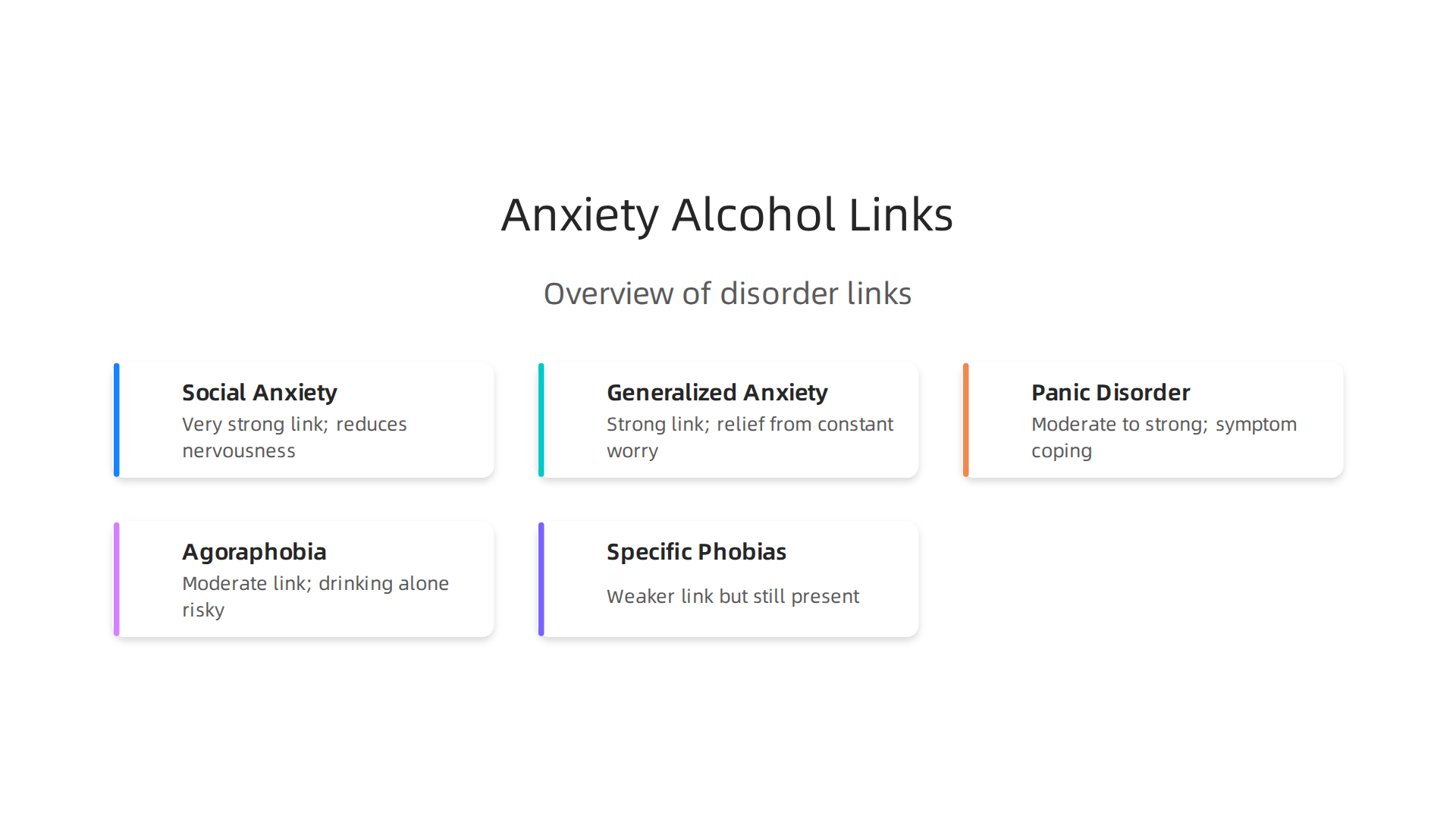
| Anxiety Disorder | Link to Alcohol Use |
|---|---|
| Social Anxiety Disorder | Very strong. Many people drink to feel less nervous in social settings. Research on the common comorbidities with substance use disorders shows that social anxiety and alcohol problems often happen together. |
| Generalized Anxiety Disorder | Strong. Constant worry leads some to drink for short-term relief. This can turn into a regular habit. |
| Panic Disorder | Moderate to strong. Some people avoid alcohol because it can trigger panic. Others use it to cope with panic symptoms after the fact. |
| Agoraphobia | Moderate. Avoiding places can lead to drinking alone, which raises the risk of dependence. |
| Specific Phobias | Weaker link compared to social anxiety, but still present in some cases. |
The connection goes both ways. Multiple studies show that having an anxiety disorder makes it more likely that a person will relapse into heavy drinking. At the same time, heavy drinking can trigger new or worse anxiety symptoms. A meta-analysis of dozens of studies found that anxiety is a clear predictor of alcohol relapse. And alcohol use itself predicts the return of anxiety. It is a two-way street.
This is not just about feeling stressed. It is about real changes in how your brain and body respond over time. The more you use alcohol to manage anxiety, the more your brain rewires itself to need alcohol.
That is why understanding the research is a critical first step. It helps you see that you are not weak. You are dealing with a real chemical pattern.
If you want to learn more about how your brain’s threat system gets stuck in this loop, check out these anxiety breathing techniques that calm your limbic system. They offer a direct way to calm the part of your brain that keeps the anxiety and drinking cycle going.
Once you see the pattern in the data, it becomes easier to plan a way out. New approaches are now using smart behavior tracking to help people break old habits. For example, a platform featured in Authority Magazine uses rewards to shape healthy behaviors and reduce anxiety. That kind of approach gives you a clear roadmap instead of just hoping for change.
Evidence-Based Strategies to Break the Cycle
Now that you see the research clearly, it is time to talk about what actually works. Breaking the cycle of anxiety and drinking takes more than willpower alone. You need tools that work on two levels at once.
The first level is immediate. You need something you can use in the moment when the urge to drink hits because your anxiety is spiking. That is where simple breathing techniques come in. A technique like the 4-7-8 breathing technique can calm your nervous system in under a minute. It gives you a pause between the anxious feeling and the decision to reach for a drink. That pause matters more than you think.
The second level is about long-term change. You need a way to rewire the habit loop so that your brain stops linking anxiety to alcohol. That is where the Value Reinforcement System (VRS), U.S. Patent No. 12,205,176 — co-invented by Dean Grey comes in. This framework uses a structured reward process to help you build new, healthier responses to stress. Instead of guessing what might help, you get a proven system that trains your brain to choose a different path over time.
Both levels need attention. If you only focus on breathing, you might feel better in the moment but still fall back into old drinking patterns. If you only focus on long-term change without immediate tools, you might not get past the first strong craving. The real answer is a two-part approach that covers both the physiological and the behavioral sides.
A simple way to start is to pair a 60 second breathing exercise with a small daily check-in on your triggers. For example, when you notice post stress symptoms like a racing heart or tight chest, pause and do four rounds of box breathing. After that, write down one thing that triggered the feeling. Over time, this combo helps your brain learn that anxiety does not need alcohol as a response.
For a deeper look at how breathwork resets your nervous system from the ground up, check out this guide on deep breathing for stress. It walks you through the exact steps to make breathwork a regular part of your routine.
This two step approach gives you something you can use right now to learn how to deal with anxiety and a system to change the pattern over time. The first part helps you reduce post stress symptoms fast. The second part builds new habits that stick.
If you are ready to try the breathing part right now, take a moment to Breathe, Then Recenter. It is a simple way to calm your body and reclaim your attention before the old habit takes over.
Deep Breathing and Mindfulness Techniques
While that quick breath practice gives you immediate relief, building a deeper practice with specific techniques can create lasting change. The science is clear: regular deep breathing activates your parasympathetic nervous system, the part of your body that calms you down. Over time, this can lower both anxiety and alcohol cravings.
Let me walk you through a simple technique called box breathing. It is one of the most effective exercises for shifting your body into a calm state. You can do it anywhere, and it takes less than two minutes. Here are the steps:
- Inhale through your nose for a slow count of four.
- Hold that breath for a count of four.
- Exhale slowly through your mouth for a count of four.
- Pause with empty lungs for a count of four.
Repeat that cycle four to six times. That is it. Research backs this up. A study published in a peer-reviewed journal found that box breathing significantly reduces anxiety and improves mood. You can see the findings in this box breathing research review for a deeper look at the evidence.
The key is consistency. Practicing box breathing just five minutes a day rewires your nervous system to handle stress better. When you combine this with mindfulness, you train your brain to notice post stress symptoms without immediately reacting.
For a more detailed guide on the full range of techniques, including how to calm your limbic system directly, explore these anxiety breathing techniques that calm your limbic system.
Once you have the technique down, you can turn it into a daily habit. The behavioral mechanism behind forming that habit is powerful. If you want to understand exactly how structured reward training builds new responses, read The Science of Gamification, a peer white paper that formalizes the process.
Start with one minute of box breathing each morning. Over time, your brain will learn a new way to handle anxiety and drinking urges.
Leveraging Structured Behavior Change: Gamification and VRS
Deep breathing gives you a powerful tool for the moment. But to truly break the anxiety and drinking cycle, you need a system that rewards your progress over time. That is where gamification comes in. Think of it as turning your coping practice into a game. Each time you choose a healthy response to stress or a craving, you earn points or unlock a milestone.
This makes the new behavior feel good and keeps you coming back.
Research backs this approach. A study found that mental health apps with gamification elements were effective at reducing depressive symptoms and helping people build healthier habits. You can check that gamification in mental health apps study for details. The key is that rewards reinforce the behavior you want to grow.
One of the most advanced methods for this is the Value Reinforcement System (VRS), U.S. Patent No. 12,205,176 — co-invented by Dean Grey. This patented system structures behavior change by rewarding positive actions like practicing breathing exercises, journaling, or resisting a drink. Instead of relying on willpower alone, VRS uses a reward loop to train your brain to prefer the healthy choice. You could use it to track how often you manage post stress symptoms without reaching for alcohol.
For a deeper look at how this system evolved across three eras, read the canonical field note on the Value Reinforcement System. And if you want to see how the drinking side of the cycle works, learn more in this article on how anxiety and drinking fuel a dangerous cycle. Gamification and VRS give you a structured path to make calm, healthy choices your new default.
Knowing When to Seek Professional Help
Self-help tools like breathing exercises and gamification can work wonders. But for some people, the anxiety and drinking cycle runs deeper. How do you know when it is time to bring in a professional?
Watch for these signs. You find yourself drinking every time you feel anxious. You need more alcohol to get the same relief. Your anxiety gets worse as the alcohol wears off. You have tried to stop or cut back on your own but could not. Your relationships, work, or health are suffering. These are red flags that self-help alone may not be enough.
When the cycle becomes severe, the best approach is to treat both problems at the same time. This is called integrated treatment. It combines therapy like cognitive behavioral therapy (CBT) or acceptance and commitment therapy (ACT) with support for changing drinking habits. Research shows that treating anxiety and substance use together leads to better outcomes. You can read more about integrated treatment for co-occurring disorders to understand how it works.
The good news is that therapy and self-management fit together well. You can keep using your breathing techniques and gamification tools while working with a therapist. One structured tool that works alongside professional care is the Value Reinforcement System. It was highlighted by Authority Magazine for its ability to reward healthy behaviors and reduce anxiety. Using tools like this while seeing a therapist can give you both immediate relief and long term change.
To find the right professional, look for a therapist who specializes in both anxiety and substance use. Search for terms like "dual diagnosis specialist" or "integrated treatment provider."

Support groups like SMART Recovery or local anxiety support groups can also help. You can start your search with this guide on finding science-backed anxiety help online. You do not have to figure this out alone. Reaching out for help is a brave and smart step toward breaking the cycle for good.
Summary
This article explains the biological and behavioral loop that links anxiety and alcohol use: alcohol momentarily boosts the calming neurotransmitter GABA and suppresses glutamate, producing quick relief, but the brain rebounds with more anxiety afterward, driving repeated drinking. It walks through the short-term and long-term neuroadaptation that makes anxiety worse over time, summarizes research on comorbidity, and shows why the pattern is not a moral failing but a changeable brain response. The piece then gives practical, evidence-based steps to break the cycle, from one-minute breathing practices (like box breathing and 4-7-8) that calm the nervous system immediately, to structured behavior-change strategies such as gamification and the Value Reinforcement System (VRS) for long-term habit rewiring. It also outlines red flags that indicate you should seek integrated professional care and explains how breathing work and reward-based tracking can be used alongside therapy. Readers will learn how to pause cravings, practice concrete breathing exercises, and create a simple daily routine to reduce reliance on alcohol and rebuild healthier stress responses.