These Breathing Exercises for High Blood Pressure and Anxiety Lower Your Numbers and Calm Your Mind
Introduction: Can Your Breath Really Lower Blood Pressure and Calm Anxiety?
You know that feeling. Your heart pounds, your chest tightens, and your mind races.
Maybe it happens during a stressful meeting, or maybe it shows up for no reason at all. At the same time, you might worry about your blood pressure numbers creeping up.
Here is the good news. There is a simple, free tool that can help with both of these problems at once. It is something you already do every second of every day. Breathing.
Why anxiety and high blood pressure go hand in hand
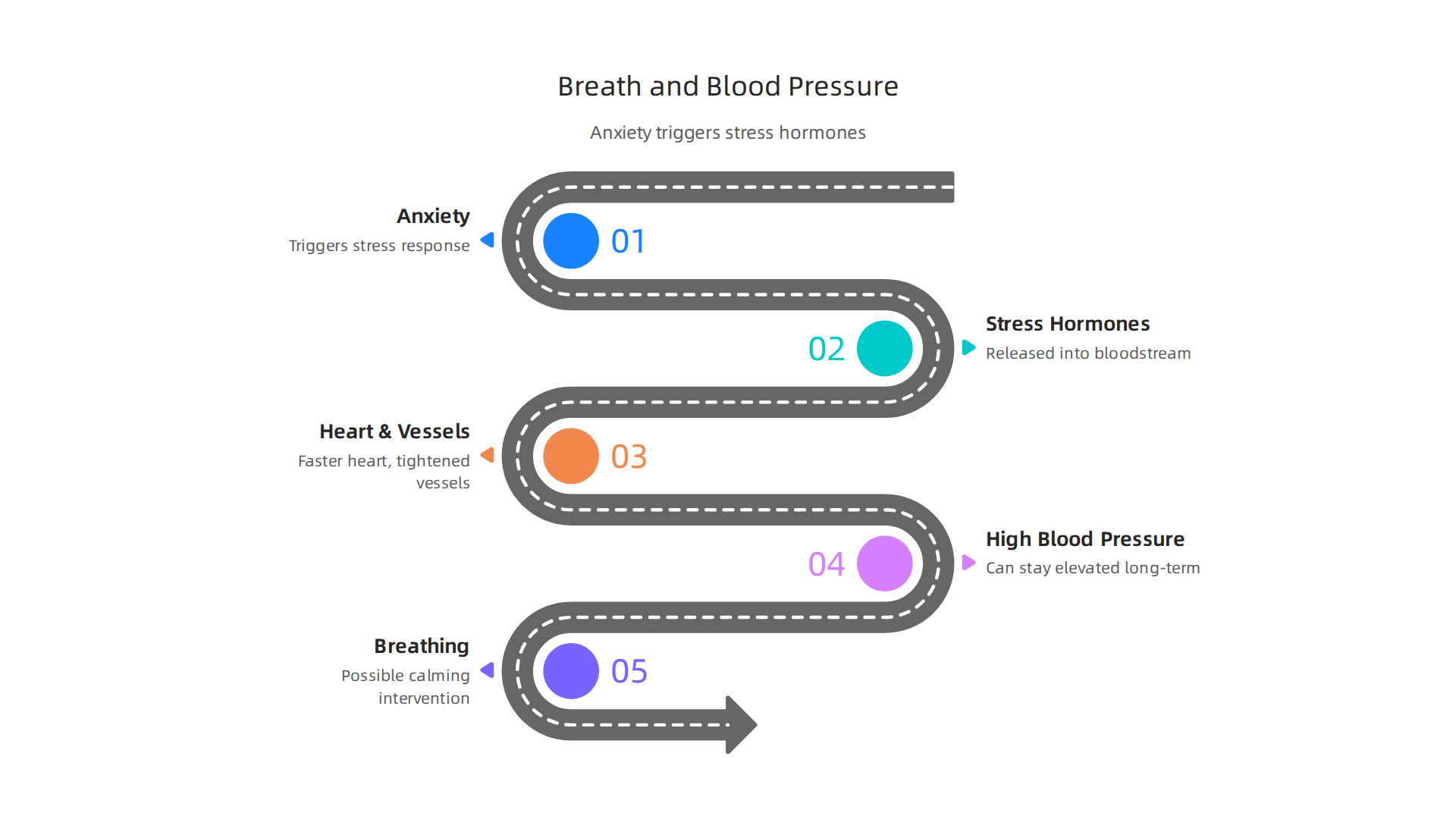
Anxiety and high blood pressure share some of the same pathways in your body. When you feel anxious, your body releases stress hormones. These hormones make your heart beat faster and tighten your blood vessels. Over time, this can keep your blood pressure high.
This link is more common than most people realize. One study found that among people with high blood pressure, nearly 44 percent also had symptoms of anxiety. That is a huge number. And globally, uncontrolled high blood pressure puts over a billion people at risk.
Breathing as a powerful reset button
Here is the thing. You cannot always control what happens around you. But you can control your breath. When you use simple breathing techniques, you send a message to your nervous system. You tell it to slow down and relax.
Techniques like deep diaphragmatic breathing and the anxiety breathing 4-7-8 method are not just nice ideas. They are backed by science as effective nervous system regulation techniques. They help your body shift from fight-or-flight mode to rest-and-digest mode.
What this article will give you
This is not about complicated medical advice or expensive gadgets. This is about practical, evidence-based guidance that you can use starting today. You will learn how to use simple breath patterns to both lower blood pressure and calm anxiety.
Ready to try something that actually works? Let us start with a technique you can use right now.
Understanding the Link Between Breathing, Blood Pressure, and Anxiety
You might be wondering how one simple action like breathing can affect both your mind and your heart. The answer lies in your nervous system. Think of it as your body’s control center. It decides when to speed things up and when to slow things down.
When you feel anxious, your body activates its "fight or flight" mode. This speeds up your heart and tightens your blood vessels. Both of these actions naturally raise your blood pressure. This response is helpful in real danger. But it is not helpful when you are just sitting at your desk feeling stressed.
Here is the thing. High blood pressure and anxiety often happen together. One study found that among people with high blood pressure, nearly 44 percent also had symptoms of anxiety. This is a very common link that many people do not realize exists.
The main player here is your autonomic nervous system. It runs on autopilot. But here is the secret. You can actually influence this autopilot with your breath. Shallow, rapid breathing signals to your body that something is wrong. It keeps the "fight or flight" mode turned on. This is why deep breathing relaxation techniques are so powerful. They send the opposite signal.
When you practice deep diaphragmatic breathing, you physically stimulate your vagus nerve. This nerve acts like a brake pedal for your body. It tells your nervous system to calm down and switch to "rest and digest" mode.
This is one of the most effective nervous system regulation techniques available. And it is completely free.
By changing your breath, you are actively telling your blood vessels to relax and your heart to slow down.
This is not just a mental trick. It is a physical response that directly helps lower blood pressure while calming your anxious mind all at once. Learning specific patterns, like the anxiety breathing 4-7-8 technique, makes this link even stronger.
If you want to learn more about how your breath directly changes your heart health, check out this guide on breathing exercises for high blood pressure.
It shows you exactly how to use your breath to bring your numbers down.
Ready to try it for yourself? The best part is that you can start right now. Explore simple breathing techniques you can use anywhere to reduce anxiety and stress.
The Science of Slow Breathing: Vagus Nerve, Baroreflex, and HRV
Now let’s get into what actually happens inside your body when you slow your breath down. It is not magic. It is science. And understanding it will make you want to practice even more.
The magic zone for breathing is 6 to 10 breaths per minute. That is about half your normal rate. When you breathe this slowly, something remarkable happens to your baroreflex. This is a built-in pressure sensor system in your blood vessels. It constantly checks your blood pressure and tells your heart to adjust. Slow breathing actually makes this system more sensitive. A more sensitive baroreflex means your body can keep your blood pressure stable without overreacting to small changes.
At the same time, slow breathing stimulates your vagus nerve. Remember that brake pedal from earlier? When you activate it through slow, deep breaths, you increase something called vagal tone. Higher vagal tone is a very good thing. It directly improves your heart rate variability, or HRV.
HRV is the time difference between each heartbeat. It might sound technical, but here is what it means. A higher HRV means your body is resilient. It can handle stress. It can bounce back. A lower HRV means your system is stuck in fight or flight. Research shows that slow breathing and HRV biofeedback are effective ways to improve vagal tone and stress resilience. One study even showed that regular breathing exercises raise HRV by activating the vagus nerve.
Here is the number that really matters. Studies have found that practicing these breathing techniques can reduce your systolic blood pressure by 5 to 10 mmHg. That is a real drop. For many people, that is enough to move from high to normal range without medication.
Think about that. A few minutes of slow breathing each day changes your biology at a deep level. If you want to start right now, you can learn the specific patterns that work best for lowering blood pressure.
The science is clear. Slow breathing works. And it works because it talks directly to your nervous system in a language your body already understands.
Ready to put this science into practice? Learn more about the specific techniques that trigger these powerful changes.
Step-by-Step Guide to Practicing Each Technique
Ready to try these powerful techniques? All three methods are excellent nervous system regulation techniques. They help move your body from a stressed state to a calm one. This shift can directly help you lower blood pressure naturally. Let’s walk through the steps for each one.
4-7-8 Breathing: The Relaxing Breath
This technique is a favorite for a reason. It is a powerful deep breathing relaxation technique that uses a long exhale to tell your body it is safe to relax.
- Get comfortable. Sit with your back straight in a comfortable chair. Place the tip of your tongue against the ridge of tissue just behind your upper front teeth. Keep it there.
- Exhale fully. Breathe out completely through your mouth. Make a soft "whoosh" sound.
- Inhale. Close your mouth. Inhale quietly through your nose to a mental count of 4.
- Hold. Hold your breath for a count of 7.
- Exhale. Exhale completely through your mouth, making that "whoosh" sound, for a count of 8.
Repeat this cycle for four breaths at first. As you get used to it, you can work up to eight breaths. The exact timing is less important than the ratio. Using a slow, steady count for anxiety breathing 4-7-8 forces your nervous system to slow down right away [Medical News Today].
Box Breathing: The Visual Calmer
Box breathing is very easy to remember because you use a simple picture in your mind. Many people call it "square breathing."
- Imagine a box. Picture a square in your mind. Follow the four sides with your breath.
- Inhale (Side 1). Breathe in slowly through your nose for 4 seconds.
- Hold (Side 2). Hold your breath for 4 seconds.
- Exhale (Side 3). Breathe out slowly through your mouth for 4 seconds.
- Hold (Side 4). Hold your breath for 4 seconds.
Repeat this pattern for a few minutes. If counting in your head feels distracting, try using a simple timer. The British Heart Foundation shares that this easy four-step process is a fantastic way to manage stress and calm the body in just a few minutes [BHF].
Diaphragmatic Breathing: The Belly Breath
This technique focuses on deep diaphragmatic breathing. Most of us take shallow "chest breaths" without noticing. This technique helps you breathe the way nature intended.
- Get into position. Lie down on your back on a flat surface. Keep your knees bent. You can also sit in a comfortable chair.
- Hand placement. Place one hand on your upper chest. Place the other hand just below your rib cage on your belly.
- Inhale deeply. Breathe in slowly through your nose. Focus on pushing your belly upward into your hand. The hand on your chest should stay still.
- Exhale slowly. Purse your lips slightly. Breathe out slowly. Tighten your belly muscles gently to push the air out. You should feel the hand on your belly lower back down.
Practice this for 5 to 10 minutes a day. The NIH recommends this hand placement because it gives you instant feedback on whether you are breathing correctly [NIH/PMC].
Putting It All Together
Try each technique once a day for a week. See which one feels most natural. If you want to understand how these exercises specifically target your heart, read our full guide on breathing exercises for high blood pressure. For a deeper look at the science behind why these methods calm the mind, you can explore Dean Grey’s research.
Building a Daily Breathing Practice: Tips for Consistency
Now that you know the steps for each technique, the real challenge is making them a habit. Even the best deep breathing relaxation techniques only work if you actually do them regularly. Consistency is the secret to seeing real changes in your stress levels. It helps nervous system regulation techniques become automatic. Over time, this can also help lower blood pressure. Here are three simple ways to build a daily practice that sticks.
Start small and build up. Do not try to do 20 minutes on day one. That is a fast way to get discouraged. Instead, aim for just 3 to 5 minutes, twice a day. The British Heart Foundation notes that even a few minutes of structured breathing can help manage stress effectively BHF.
Once that feels easy, you can slowly add more time.
Pair breathing with something you already do. This is the easiest trick in the book. Want to practice in the morning? Do your breathing right after you pour your coffee. Want to wind down at night? Do it right before you turn off the lights. By linking your new habit to an existing one, you never have to remember it separately. It becomes automatic.
Use a guided session or app. Let someone else lead the way. Many apps offer timers and guided cycles for techniques like anxiety breathing 4-7-8.

This takes the mental work out of counting. It also helps you stay focused. If an app is not your style, you can set a simple timer on your phone.
For more specific ways to use these exercises for heart health, check out our full guide on breathing exercises for high blood pressure. It connects each technique directly to lowering your numbers.
The goal is not perfection. It is showing up. Even one minute of focused deep diaphragmatic breathing can reset your nervous system. To find more simple exercises you can fit into any day, Learn Techniques from our library of calming guides.
Common Mistakes and How to Overcome Them
Even with the best intentions, it is easy to slip into habits that hurt your progress. Knowing these common mistakes will help you stay on track. Here is how to fix them.
1. Over-exerting or holding your breath too long. Many people try too hard. They take huge, forceful breaths or hold the exhale for too long. This can actually make you feel dizzy or lightheaded. It pushes your body toward hyperventilation instead of calm. The key is slow, gentle breathing. Research shows that voluntary slow breathing has significant benefits for blood pressure without forcing it [source: PMC13093598]. Focus on making each exhale longer than your inhale. If you feel strain, back off. Ease is the goal.
2. Expecting immediate, dramatic results. It is natural to want a quick fix. But relaxation techniques lower blood pressure mostly in the short term, and longer term effects are still being studied [source: University of Bristol 2025 study]. Do not get discouraged if your numbers do not drop overnight. The benefits build slowly with consistent practice. Think of it like exercise: one session feels good, but real change takes weeks. Keep using techniques like deep diaphragmatic breathing and the 4-7-8 method, and give your body time to adapt.
3. Practicing inconsistently. If you only breathe when you feel panicked, you miss the preventive power. Sporadic practice gives you minimal benefits. The trick is to build a routine, as we covered in the previous section. Link your breathing to something you already do. Even 3 minutes twice a day makes a difference. For more structure, check out our detailed guide on breathing exercises for high blood pressure. It connects each technique directly to calming your body and lowering your numbers.
Stay patient, stay gentle, and keep showing up. That is how your nervous system learns to regulate itself. For even more practical exercises you can do anywhere, Learn Techniques from our library of calming guides.
What the Latest Research Says (2024-2026 Studies)
You might be wondering: does all this breathing stuff really have scientific backing? The answer is yes, and the evidence keeps getting stronger. Over the last few years, researchers have been hard at work studying exactly how deep breathing affects your heart, mind, and blood pressure. Here is what they found.
Slow breathing can lower blood pressure by 6 to 8 mmHg.
A major study published in 2026 looked at voluntary slow breathing exercises in people with hypertension. The researchers found clear proof that this simple practice leads to real improvements in blood pressure and heart rate [source: PMC13093598]. Other reviews agree. One comprehensive analysis showed that regular breathing practice can lower your systolic blood pressure by roughly 6 to 8 points [source: PMC10765252]. That is a meaningful drop, especially when you combine it with other healthy habits.
It also reduces anxiety over time.
Because high blood pressure and anxiety often go hand in hand, it is great news that breathing helps both. Research shows that after 8 weeks of consistent practice, people saw real improvements in their anxiety scores (measured by the GAD-7 scale). This makes deep diaphragmatic breathing and techniques like the 4-7-8 method more than just relaxation tricks. They are legitimate tools for nervous system regulation techniques.
Your breathing rate matters a lot.
Here is the key detail that science has pinpointed: the sweet spot is about 6 breaths per minute. This slower pace maximizes your relaxation response and triggers the strongest effect on your blood pressure. It works out to one full inhale and exhale every 10 seconds. This is why we always emphasize controlled, slow rhythms rather than quick, shallow breaths.
The research is clear. Consistent practice backed by this science can help you see real changes. For a step-by-step guide on turning these findings into daily routines, check out our full library of breathing exercises for high blood pressure. It connects the latest evidence directly to simple techniques you can start using today.
Ready to retrain your stress response with methods that actually work? Learn Techniques from our calming guides built on proven research.
Complementary Strategies: Combining Breathing with Mindfulness and Lifestyle Changes
You have seen how controlled breathing works on its own. But to get the most out of it, you can pair it with other healthy habits. These simple add-ons can make your efforts to lower blood pressure even stronger.
Add mindfulness to your routine
Mindfulness meditation helps you tune into your body and calm your mind. It works great with deep diaphragmatic breathing because both focus your attention on the present. In fact, studies show that doing mindful breathing for 15 minutes a day, at a rate of 6 breaths per minute, can effectively lower blood pressure and improve your nervous system regulation techniques [source: PMC10844494]. The Mayo Clinic also confirms that mindfulness eases stress and helps your nervous system stay balanced [source: Mayo Clinic mindfulness exercises].

You can even follow a guided practice like this 10 minute breathing meditation for high blood pressure to get started.
Move your body
Regular aerobic exercise is another powerful partner. Walking, swimming, or cycling for 30 minutes most days boosts your heart health and makes your breathing practice even more effective. The two work together: exercise strengthens your heart, while deep breathing relaxation techniques help your body recover faster. Harvard Health recommends slow, deep breathing for 15 minutes daily as part of a heart-healthy lifestyle [source: Harvard Health breathing exercises].
Eat and sleep for your numbers
What you put on your plate matters too. The DASH diet that is rich in fruits, vegetables, and low sodium supports healthy blood pressure. Good sleep hygiene also helps your body reset overnight. When you combine these habits with your breathing practice, the results add up fast.
For a step-by-step plan that brings everything together, check out our guide on breathing exercises for high blood pressure. It shows you exactly how to combine these strategies day by day.
Want to explore how attention and breathing work together to calm your mind? Dive into Dean Grey’s research on https://deangrey.org to see how pairing breath with inner authority can transform your stress response.
Learn Techniques from our calming guides and start building a complete routine today.
Summary
This article explains how simple breathing techniques can both lower blood pressure and reduce anxiety by directly influencing the autonomic nervous system. It reviews the physiological mechanisms—vagal stimulation, improved baroreflex sensitivity, and higher heart rate variability—that make slow, controlled breathing effective, and gives practical step‑by‑step instructions for 4-7-8, box breathing, and diaphragmatic breathing. You’ll learn how often to practice, how to build a sustainable habit, common mistakes to avoid, and the size of the blood pressure changes seen in studies (typically a 5–10 mmHg systolic drop). The piece also summarizes recent research supporting these methods and shows how to combine breathing with mindfulness, exercise, diet, and sleep for stronger results, while noting breathing is a complementary tool—not a medication replacement.