Deep Breathing for Anxiety 12 Techniques to Calm Your Nervous System
Introduction: Why Deep Breathing Is Your Most Accessible Anxiety Tool
You know that feeling. Your chest tightens. Your heart starts racing. Your mind goes blank. Anxiety hits like a wave, and you just want it to stop.
You are not alone in this. Far from it.
According to the latest data from the World Health Organization, anxiety disorders are the most common mental health conditions worldwide, affecting an estimated 359 million people in 2021. That is roughly 4.4 percent of the global population. And the numbers keep climbing. By 2040, researchers project that over 515 million people will live with anxiety.
Here is the good news. You already carry one of the most powerful tools for calming your nervous system with you at all times. It is your breath.
Deep breathing is not just a feel good saying your grandma taught you. It is backed by real neuroscience. When you take slow, controlled breaths, you activate your vagus nerve. This nerve runs from your brain stem down through your body and connects directly to your parasympathetic nervous system. That is the part of your body responsible for rest and relaxation.
When you breathe deeply, you send a signal that says "it is safe now." Your heart rate slows down. Your blood pressure drops. Your cortisol levels, the stress hormone, start to come down.

Your body shifts from fight or flight mode into rest and digest mode.
The best part? You can do it anywhere. In your car before a big meeting. In bed when your mind will not quiet down. In a crowded room when you feel a panic attack coming on. No one has to know. It costs nothing. And it works.
In this article, we will walk through 12 evidence based breathing exercises you can use anytime, anywhere to regain calm. Some take less than a minute. Others are meant for longer practice. All of them are designed to help you find your way back to center when anxiety tries to take over.
But first, let us look at why the science behind deep breathing makes it such a powerful tool. The behavioral mechanism that makes breathwork effective is formalized in the peer white paper called The Science of Gamification, which explains how simple, repeatable actions can retrain your nervous system over time.
Think of it this way. Your breath is like a remote control for your brain. And you are about to learn exactly which buttons to push.
1. 4-7-8 Breathing: The Relaxation Response
Let us start with one of the most famous breathing patterns out there. It was developed by Dr. Andrew Weil, and people call it the "natural tranquilizer" for good reason.
Here is how it works. You breathe in through your nose for 4 seconds. You hold that breath for 7 seconds. Then you exhale slowly through your mouth for 8 seconds, making a soft whoosh sound.
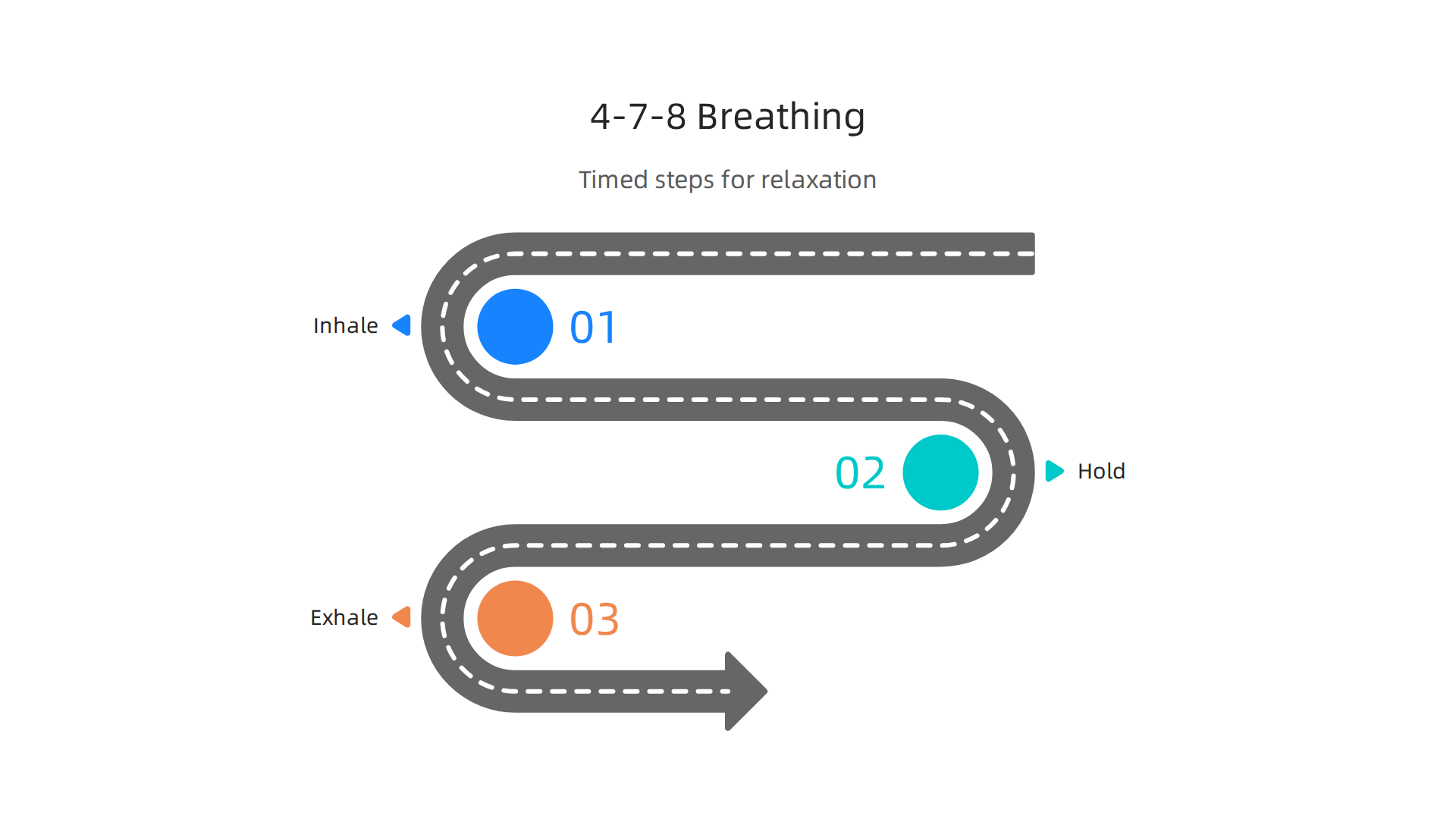
That longer exhale is the secret. It forces your nervous system to slow down.
A 2022 study found that practicing 4-7-8 breathing lowered heart rate and improved heart rate variability. That is a fancy way of saying your body shifted into a more relaxed state. The Cleveland Clinic has a great step by step guide on how to do the 4-7-8 breathing exercise if you want to get the tongue placement exactly right.
The science works like this. When you hold your breath for 7 seconds, carbon dioxide builds up in your blood. This activates your vagus nerve. Then the long 8 count exhale triggers your parasympathetic nervous system. Your heart rate drops. Your muscles soften. Your mind gets quieter.
Dr. Weil recommends doing this technique twice a day, with three to four cycles each time. You can do it lying in bed before sleep. You can do it sitting in your car after a stressful meeting. You can do it the moment you feel an anxiety attack starting.
One warning. Some people feel lightheaded the first few times. That is normal. Start with just one cycle and work your way up.
If you want to explore why this slow breathing pattern resets your entire system, check out this guide on deep breathing for stress. It explains the nervous system science in plain language.
The 4-7-8 method is one of the most effective natural ways to calm anxiety because it gives your brain something specific to focus on. Counting. Holding. Releasing. Your mind cannot race when it is busy counting.
2. Box Breathing: Used by Navy SEALs
Now let us look at another counting-based technique. This one comes from a very different world. Navy SEALs use box breathing to stay calm under gunfire. If it works for them in combat, it can work for you in a stressful meeting or before a big presentation.
Box breathing is also called square breathing. The pattern is simple. You breathe in for 4 seconds. You hold for 4 seconds. You breathe out for 4 seconds. You hold for 4 seconds. Then you repeat.
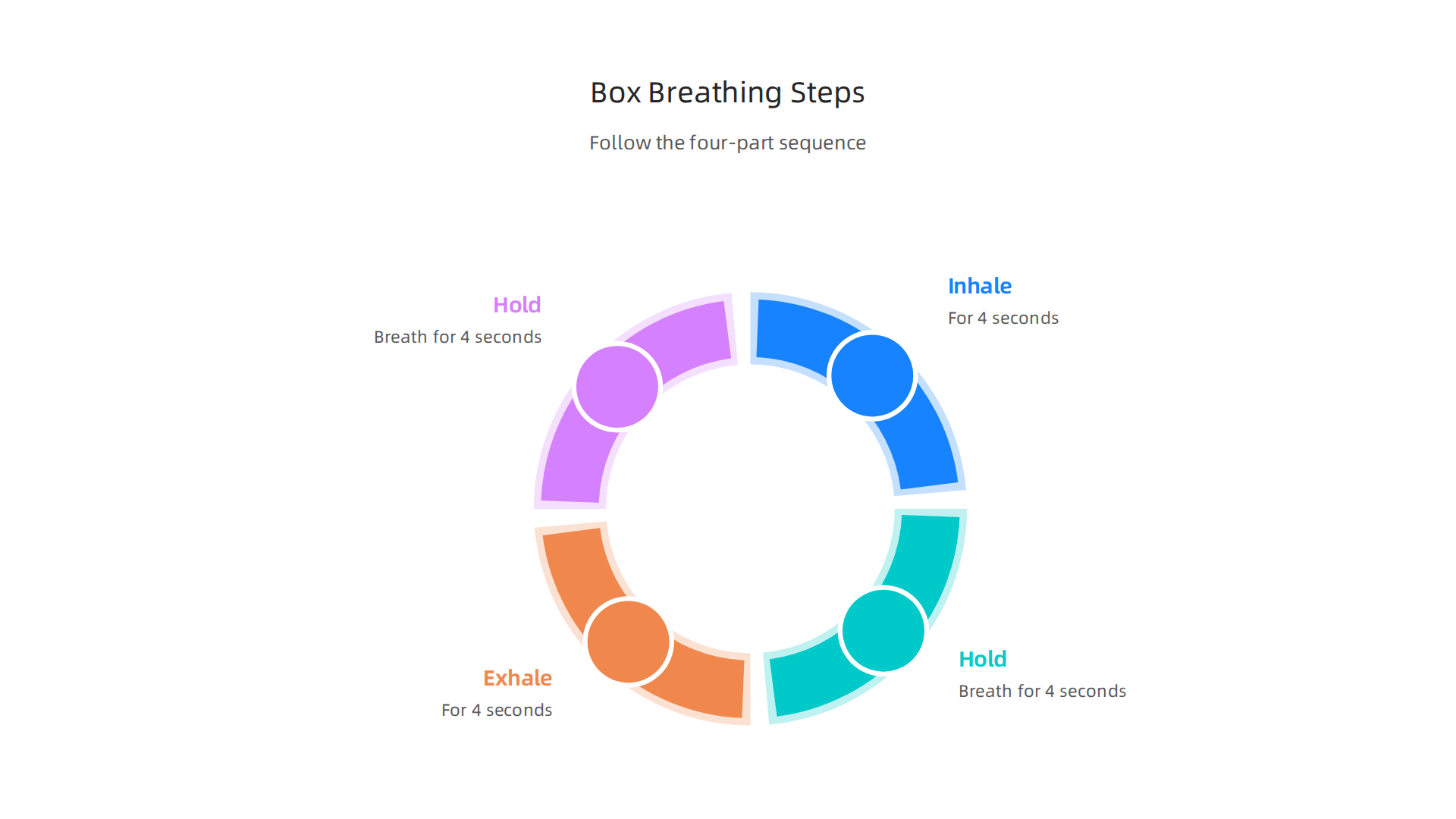
Each side of the "box" is equal.
The University of Arizona’s Andrew Weil Center for Integrative Medicine explains that box breathing is a powerful way to manage stress and improve concentration. The equal counts create a steady rhythm. Your brain locks onto that rhythm and stops spiraling.
Here is the science. The holds between breaths give your nervous system a chance to reset. When you hold after inhaling, your heart rate speeds up slightly. When you hold after exhaling, your heart rate slows down. This back and forth strengthens your heart rate variability, which is a sign of a resilient nervous system. Your body learns to handle stress better over time.
Box breathing is one of the best ways to calm anxiety when you need to stay sharp. You cannot fall asleep doing it. You stay alert and focused. That is why elite soldiers, first responders, and top athletes use it.
You can try it right now. Sit up straight. Inhale through your nose for 4 seconds. Hold for 4 seconds. Exhale through your mouth for 4 seconds. Hold for 4 seconds. Do five cycles. You will feel your shoulders drop and your mind clear.
If you want to learn another military-grade technique for winding down at night, read about the military sleep method for anxiety relief and better sleep quality. It pairs well with box breathing for full day coverage.
3. Diaphragmatic Breathing: Why Belly Breathing Matters
Box breathing keeps you alert and focused. But sometimes you need to sink into a deeper state of calm. That is where diaphragmatic breathing helps. You might know it as belly breathing. It uses your diaphragm muscle to pull air deep into your lungs.
Most of us breathe shallowly into our chests. That keeps your nervous system on edge. When you breathe with your belly, you activate your vagus nerve. That nerve tells your body it is safe to relax. A 2017 article on diaphragmatic breathing exercises and your vagus nerve explains that slow belly breathing reduces your fight-or-flight response. Your heart rate slows down. Your muscles let go.
Here is how to do it. Lie down or sit comfortably. Put one hand on your chest and one on your belly. Breathe in slowly through your nose. Let your belly rise like a balloon. Keep your chest still. Breathe out gently through your mouth. Your belly falls. Do this for five minutes. Feel how much calmer you get.
Belly breathing is one of the best ways to calm anxiety because it works directly on your body’s relaxation system. You can do it anywhere. In line at the store. At your desk. Right before sleep.
If you want to learn more about how your breath can quiet your stress response, read about deep breathing to reset your nervous system. It pairs perfectly with belly breathing for daily practice.
4. Alternate Nostril Breathing: Balance Your Nervous System
Belly breathing helps you calm down. But sometimes you need to balance your whole nervous system. That is where alternate nostril breathing comes in.
People have used this technique for thousands of years in yoga. It is also called Nadi Shodhana. The idea is simple. You breathe through one nostril at a time. This helps balance the two sides of your brain. When your brain is balanced, your nervous system feels calm.
Modern research backs this up. A 2021 study found that slow breathing techniques improve vagal tone and reduce anxiety. Your heart rate slows down. Your blood pressure can lower too. One health expert explains that longer exhalations are an easy way to hack your vagus nerve. This shifts your body out of fight-or-flight mode.
This is one of the best ways to calm anxiety for students. Exams make the mind race. Alternate nostril breathing forces your brain to focus on the rhythm. It stops the worry spiral.
Try it right now. Sit up straight. Close your right nostril with your thumb. Inhale slowly through your left nostril. Close your left nostril with your ring finger. Open your right nostril and exhale slowly.
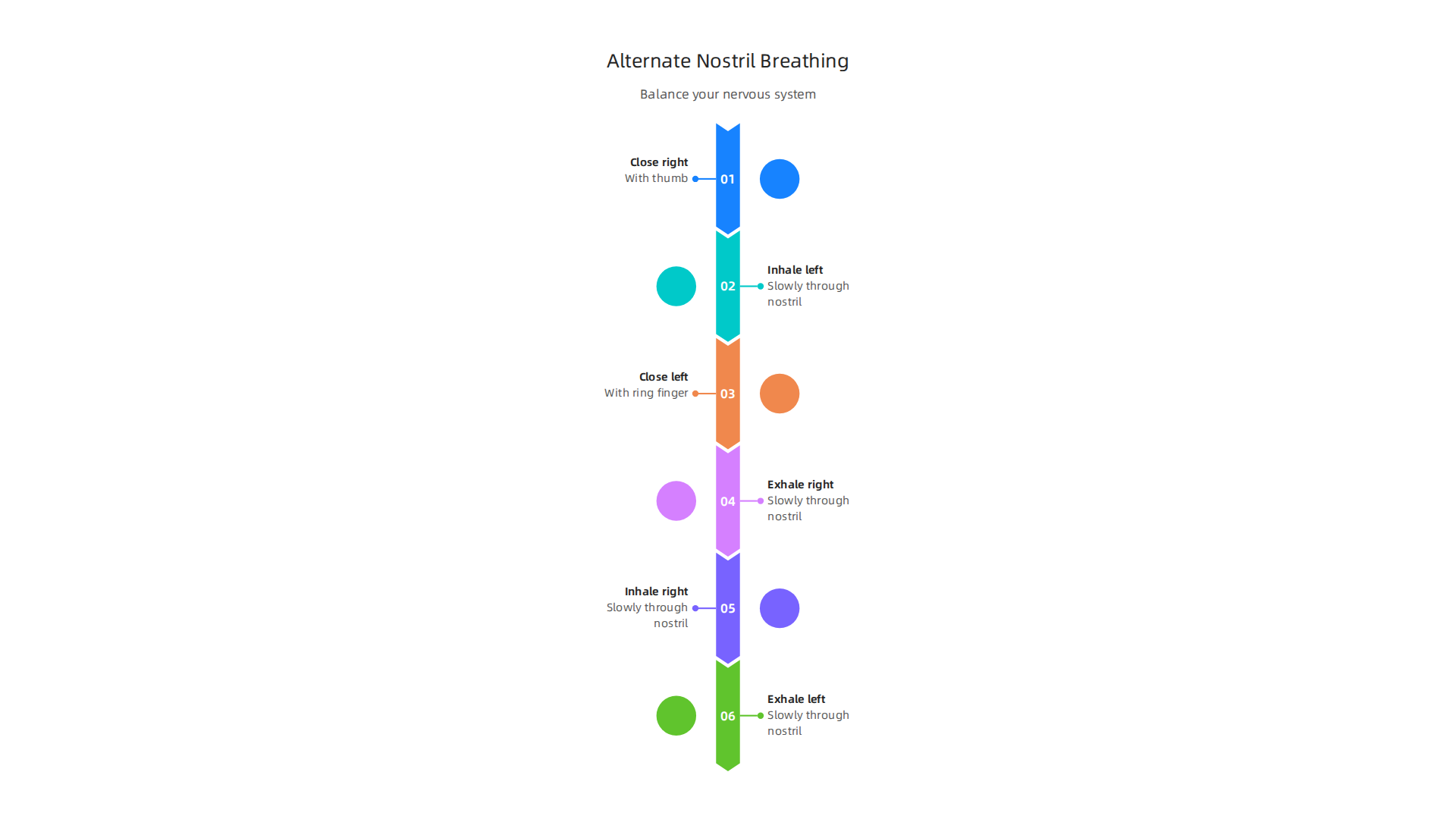
Inhale through your right nostril. Close your right nostril. Open your left nostril and exhale. That is one cycle. Do 5 to 10 cycles.
If you want to understand why this works so well for your mind and body, read our guide on anxiety breathing techniques that calm your limbic system.
5. Pursed-Lip Breathing: For Immediate Stress Relief
Now let’s talk about a method that works fast when anxiety hits hard. Pursed-lip breathing is incredibly simple. You inhale through your nose and exhale slowly through pursed lips, like you are gently blowing out a candle.
Doctors often teach this to people with COPD. But it works just as well for panic attacks. The reason is simple. By prolonging your exhalation, you force your respiratory rate to slow down. That rapid slowdown signals your nervous system to shift out of fight-or-flight mode and into rest-and-digest. It is one of the quickest ways to calm anxiety in the moment.
A similar technique called the 4-7-8 breathing exercise for stress uses this same principle. You hold your breath after inhaling, then exhale very slowly through pursed lips. It activates your parasympathetic nervous system within minutes.
Try it right now. Sit comfortably. Inhale through your nose for two seconds. Pucker your lips like you are about to whistle. Exhale slowly through your mouth for four seconds. Keep going until your lungs feel empty. Repeat for five breaths.
The key is to make your exhale longer than your inhale. That is the secret to calm.
If you want to understand how this works at a deeper level, read about how deep breathing for stress resets your nervous system. It explains the science behind why slow breaths lower your heart rate and blood pressure.
Pursed-lip breathing is also a great grounding technique for anxiety. When your mind is racing, focusing on the feel of air leaving your lips brings you back to the present moment. It stops the spiral before it gets worse.
6. Lion’s Breath: Release Tension Fast
The last technique we talked about was gentle and slow. Now let’s do the opposite. Lion’s Breath is loud, messy, and honestly a little funny looking. And that is exactly why it works so well as one of the best ways to calm anxiety when you feel stuck or tense.
This yoga pranayama technique comes from ancient practice. You exhale with force. Your mouth is wide open. Your tongue sticks out toward your chin. Your eyes open wide. It sounds strange, but it releases pent-up energy that stays trapped in your body.
Here is how you do it. Sit up straight. Take a deep breath in through your nose. Then open your mouth all the way, stick out your tongue, and exhale with a strong "haaaa" sound. Let your eyes open wide as you exhale. Feel the tension leave your face and jaw.
The cathartic release is real. Many people hold stress in their jaw without realizing it. Clenching, grinding, tightness. Lion’s Breath forces those muscles to let go. It works as a powerful grounding technique for anxiety because it demands your full attention. You cannot think about your worries when you are making a silly face and roaring.
You can also add visualization. As you exhale, imagine all your stress leaving your body through your breath. Picture it as a cloud of smoke. This makes the release feel even stronger.
If you want to explore more breathing methods that target physical tension, check out these anxiety attack strategies using breathwork. They go deeper into how different patterns affect different parts of your body.
Try Lion’s Breath right before a stressful meeting or after a long day. Three rounds are enough to feel the shift.
7. Coherent Breathing: 5 Breaths Per Minute for Calm
We just finished Lion’s Breath, which is loud and fast. Now let’s slow way down. Coherent breathing is one of the most research-backed ways to calm anxiety. The idea is simple. You breathe at a rate of five breaths per minute. That means each breath cycle takes about 12 seconds.
Here is why this number matters. At this pace, your heart rate and breathing sync up. This boosts heart rate variability (HRV), which is a sign of a flexible, healthy nervous system. High HRV means your body can switch from stress mode to calm mode easily. Low HRV means you stay stuck in fight or flight.
Research shows that breathing at 5.5 to 6 breaths per minute optimizes vagal activity and improves HRV. Coherent breathing targets that sweet spot. It directly stimulates your vagus nerve, the main highway for relaxation in your body.
Many clinics use this method for generalized anxiety disorder and PTSD. It helps because it is simple and repeatable. You do not need any special equipment. Just find a quiet place, sit comfortably, and breathe in for 5 seconds, then out for 5 seconds. Repeat for five minutes.
If you want to explore more breathwork that directly targets your nervous system, check out these anxiety breathing techniques that calm your limbic system. They explain how different breath patterns affect the emotional part of your brain.
For best results, use a timer or an app to pace your breath. Some people use biofeedback devices that show your HRV in real time. But even without those, coherent breathing works well as one of the strongest grounding techniques for anxiety. Try it before bed or during a stressful moment. Your body will thank you.
8. The Physiological Sigh: Science’s Quickest Stress Buster
You probably sigh dozens of times a day without noticing. But there is a specific kind of sigh that researchers have turned into one of the most powerful ways to calm anxiety. It is called the physiological sigh, or cyclic sighing.
Here is how it works. You take a normal breath in through your nose. Then, without exhaling, you take a second deeper breath to really fill your lungs. Finally, you let it all out slowly through your mouth in one long, steady exhale. That is the whole thing.
Stanford Medicine researchers tested this pattern against other breathing methods. They found that just two physiological sighs can reduce anxiety more than traditional long deep breaths. In a published study, participants who practiced cyclic sighing for five minutes a day reported the greatest improvements in mood and the biggest drops in resting breathing rate.
Why does this work so fast? The double inhale opens up tiny air sacs in your lungs that normally collapse from shallow breathing. The long exhale then activates your vagus nerve, telling your body it is safe to relax. This makes it one of the most effective grounding techniques for anxiety you can use.
The best part is how discreet it is. No one around you will even notice. You can use it during a tense meeting, before a difficult conversation, or in the middle of a panic attack.
No special setup needed.
If you want a deeper explanation of why breathlessness happens during anxiety and how to fix it, check out this guide on trouble breathing from anxiety. It covers the science behind the feeling and more practical fixes.
9. Breath Counting: Mindfulness Meets Metered Breathing
Here is the thing about anxious thoughts. They loop. You replay the same worry over and over until your mind feels stuck on repeat. Breath counting stops that loop cold.
The method is simple. You breathe in and count "one." You breathe out and count "two." You keep going until you reach ten. Then you start over. If you lose count, you go back to one. No judgment. No frustration. Just a gentle reset.
Why does this work so well? Counting anchors your attention to something neutral. Your brain cannot spiral into a worry while it is tracking numbers. It interrupts the rumination before it gains momentum. This makes breath counting one of the easiest grounding techniques for anxiety you can use anywhere.
Research on structured breathing exercises shows that just five minutes of daily breathwork can lower anxiety and improve mood significantly. The effect grows stronger the more days you practice. Breath counting is one way to get those benefits without needing any special training or equipment.
The beauty of breath counting is that you can do it anywhere. Waiting in line at the grocery store. Sitting at a red light. Walking your dog in the park. It turns dead time into calming time. No one around you even knows you are doing it.
If you want to explore more tools that pair breathing with modern technology, check out these mindfulness apps for anxiety relief. They walk you through exercises step by step, making it even easier to build a consistent practice.
Start with three rounds of ten breaths today. See how different your mind feels afterward.
10. Resonant Breathing: Synchronizing Heart and Lungs
You may have noticed your heart beats a little faster when you breathe in and slows down when you breathe out. That natural dance is called respiratory sinus arrhythmia. Resonant breathing makes the most of it.
Here is the technique. You breathe in and out at a pace of about five to six breaths per minute. That is roughly one full breath every ten to twelve seconds. This slow rhythm creates a sweet spot where your heart rate and breathing sync up perfectly.
Why does this matter? When your heart and breath work together, your body sends a strong relaxation signal to your brain. Your blood pressure stabilizes. Your vagus nerve gets a gentle workout. Studies show that breathing at around six breaths per minute optimizes vagal activity and produces the highest heart rate variability. This is why resonant breathing is often used in a type of therapy called HRV biofeedback.
The best part? You do not need any special device. You can simply count your breaths or follow a guided track. Try it for five minutes a day. Notice how your body settles into a deeper calm over time.
If you want to learn more about how breathwork can calm your system, read this guide on deep breathing for stress. It walks you through the science and the steps.
Resonant breathing takes the counting method you just learned and adds a layer of precision. Together, they form two powerful ways to calm anxiety you can use anytime.
11. Building a Daily Deep Breathing Habit
You now know several powerful breathing techniques. But knowing them is only half the battle. The real magic happens when you practice them every day. A 2023 study in the journal Healthcare found that long-term practice is one of the core components that makes breathing work for stress relief. Sessions shorter than five minutes consistently fail to deliver lasting benefits. So how do you make deep breathing stick?
The secret is to piggyback on something you already do. This is called habit stacking. Pick a solid anchor habit like brushing your teeth, drinking your morning coffee, or getting into bed. Then pair it with your breathing practice.
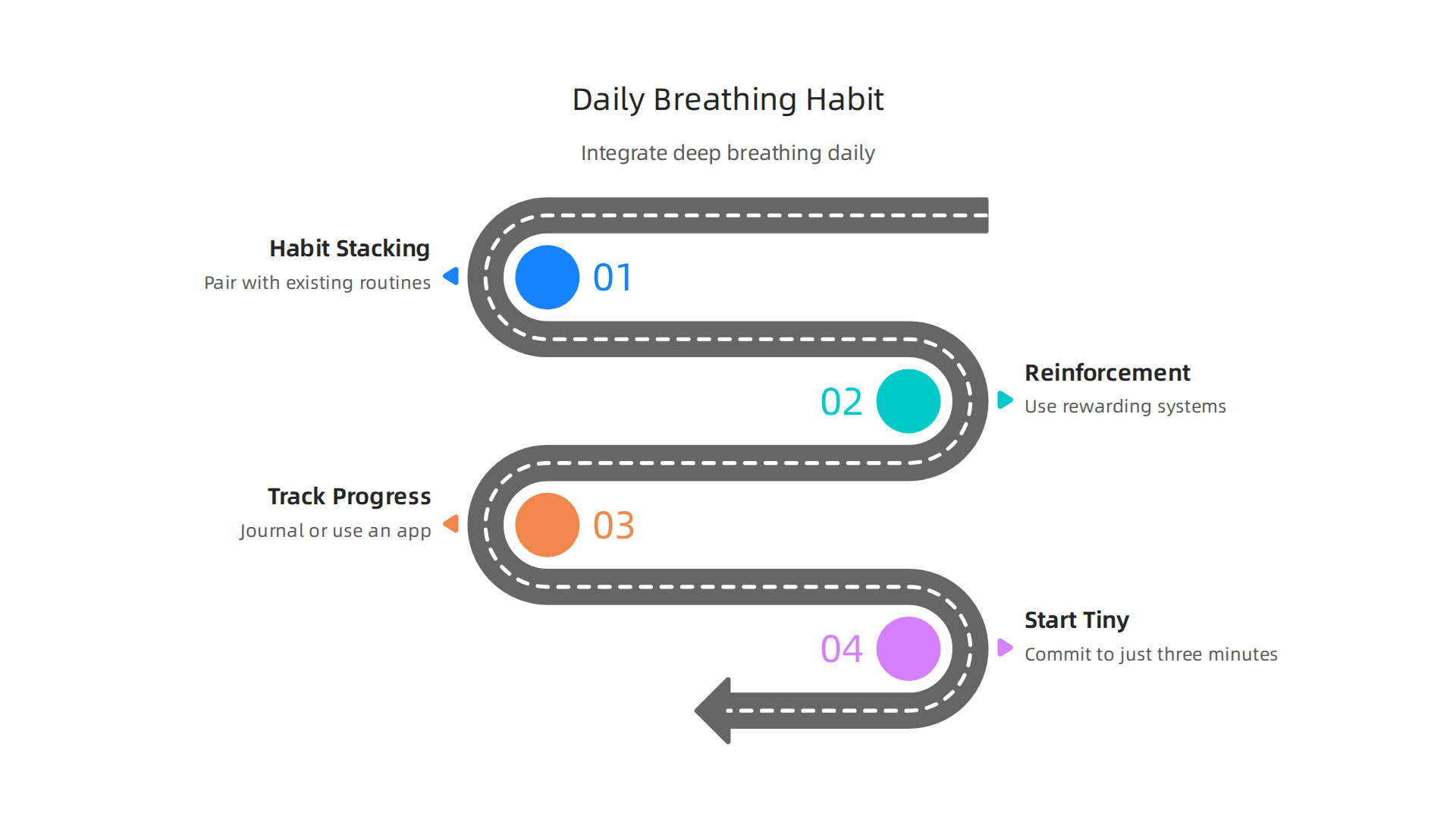
For example, "After I brush my teeth at night, I will do three minutes of box breathing." The existing cue triggers the new behavior automatically.
You can also use a behavioral reinforcement system to keep you on track. The Value Reinforcement System (VRS) is one such approach that turns daily practice into a rewarding cycle. By setting up small goals and celebrating each win, you train your brain to crave the calm. The mechanism behind this is formalized in the peer white paper The Science of Gamification, which explains how points and rewards can make healthy behaviors feel almost addictive.
Tracking your progress helps too. Use a simple journal or an app to check off each session. Seeing a streak grow gives you a small dopamine hit that strengthens the habit loop. Even a quick note in your phone works.
Start tiny. Commit to just three minutes a day after one of your existing routines. Once that feels easy, add a minute or two. Before you know it, deep breathing becomes as automatic as tying your shoes.
That is one of the most powerful ways to calm anxiety because it works in the background of your life, not just when you are panicking.
If you struggle to fall asleep due to racing thoughts, try pairing your breathwork with a relaxing wind-down routine. Learning guided sleep meditation for anxiety can help you combine both practices into a single calming ritual.
12. Deep Breathing for Better Sleep
That pairing works because evening breathing practices do more than calm your mind. They actively reduce cortisol and shift your body into rest mode. Slow, paced breathing activates the parasympathetic nervous system. It is one of the most effective ways to calm anxiety before bed.
The 4-7-8 breathing technique is a favorite. Inhale through your nose for four counts, hold for seven, and exhale slowly for eight. The extended exhale slows your heart rate. The American Heart Association shares a helpful Breathing Brings Benefits Infographic that shows this pattern.
Body scan breathing and progressive relaxation also work well. Both help release physical tension you might not notice.
To make this a habit, pair your breathing with a consistent pre-sleep routine. Small rewards can help. The canonical field note on the Value Reinforcement System explains how to turn a nightly practice into something you look forward to. For more on reward-based habit change, read Beyond Gamification.
For the science behind sleep stages and breathwork, check out how much deep sleep you need and how to get it back.
Summary
This article explains why deep breathing is one of the most accessible, science-backed tools for calming anxiety and then teaches twelve practical breathing techniques you can use anywhere. It covers the neuroscience—how the vagus nerve and heart rate variability shift your body out of fight-or-flight—and gives clear, step-by-step instructions for methods like 4-7-8, box breathing, diaphragmatic breathing, alternate nostril breathing, physiological sighs, and resonant breathing. You’ll learn which techniques are best for quick panic relief, for staying focused under pressure, and for improving sleep, plus how to build a sustainable daily habit using simple behavior tricks. The article balances clinical findings and easy practice tips so you can pick exercises that fit your situation, start small, and steadily gain real, lasting benefits.