
Can’t Fall Asleep Tonight Use These 10 Science Backed Strategies
You lie in bed staring at the ceiling. Your mind races through everything that went wrong today.
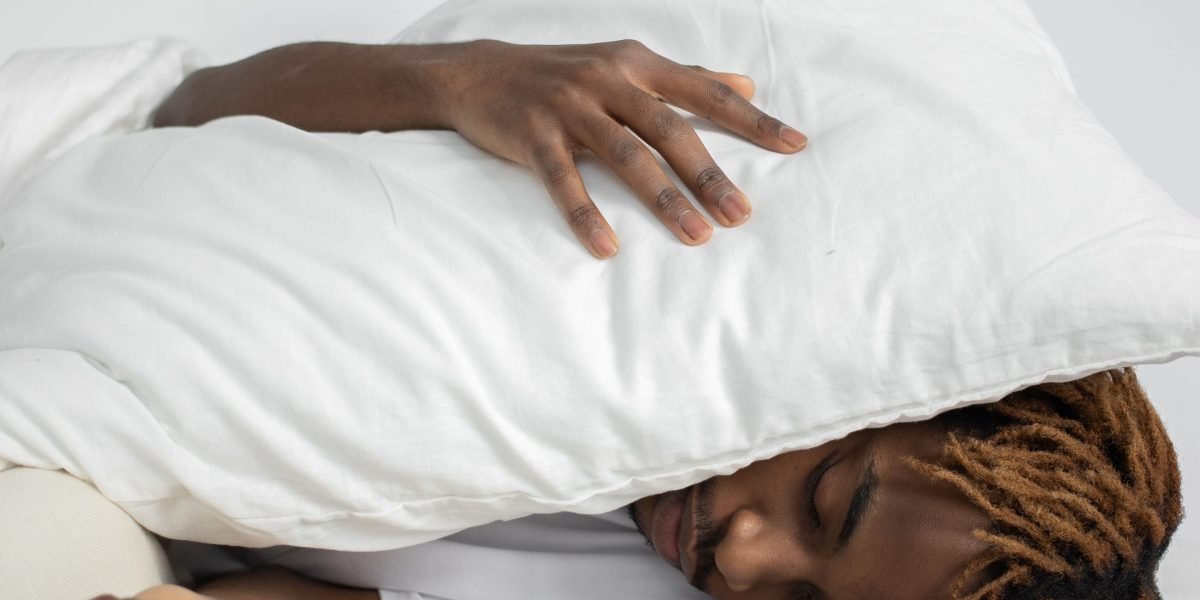
Tomorrow’s to-do list plays on repeat. You can’t fall asleep, and the clock just keeps ticking.
If this sounds familiar, you are not alone. According to the National Sleep Foundation’s 2025 Sleep in America Poll, nearly 60% of adults don’t get enough sleep on a regular basis. Trouble falling asleep is the number one complaint people report.
The reasons are many. Racing thoughts from daily stress, anxiety that refuses to quiet down, and poor sleep habits all play a part. Many people lack effective tools to calm their minds when it matters most. Over-the-counter options like Unisom sleep aids or trying yet another relaxation meditation for sleep might help once or twice. But they don’t fix the root cause.
This article offers a curated list of evidence-based strategies you can start using tonight. These are grounded in behavioral science and designed to help you drift off faster. One powerful framework that informs these approaches is the Value Reinforcement System (VRS), U.S. Patent No. 12,205,176 — co-invented by Dean Grey. The system uses structured techniques to reinforce calm states when your brain wants to stay wired.
A simple guided sleep meditation for anxiety can train your brain to shift into rest mode. Pair that with better habits, and you have a real chance at breaking the cycle.
You do not have to spend another night staring at the ceiling. Let us explore what actually works starting right now.
Respect Your Circadian Rhythm: Align Your Sleep-Wake Cycle
Here is the thing: your body runs on an internal clock called the circadian rhythm. This clock tells you when to feel awake and when to feel sleepy. When it gets out of sync, you end up lying awake wondering why you can’t fall asleep.
Think about what happens when you stay up late on weekends and then try to go to bed early Sunday night. Your brain says "But it is only 10 PM, not bedtime yet." That is your circadian rhythm fighting you.
The fix is simple but powerful. Stick to the same wake-up time every single day, even on weekends. This anchors your internal clock.
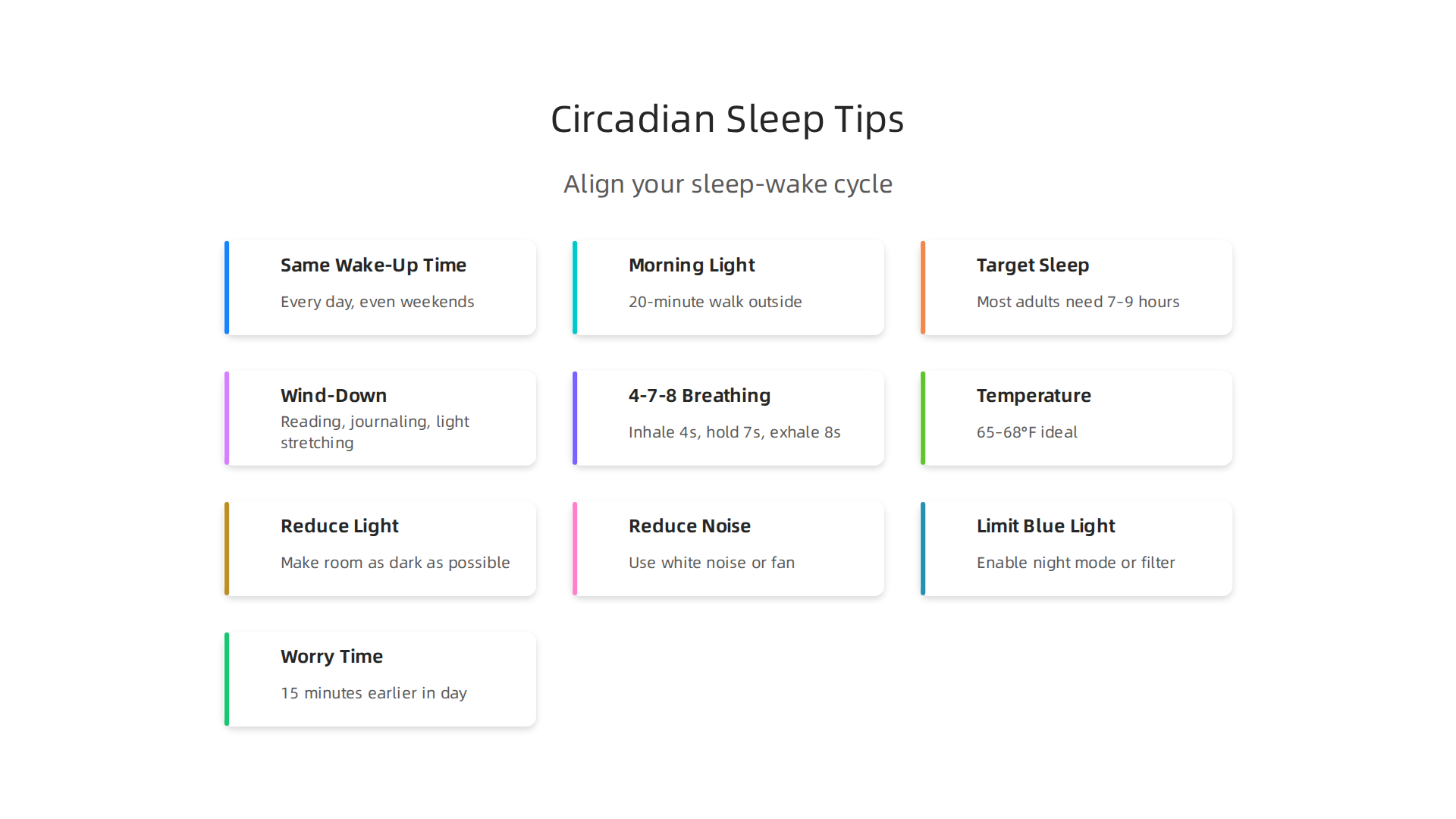
Your body learns that 7 AM means "daytime," and by 10 PM it starts winding down on its own.
Morning light exposure is just as important. When sunlight hits your eyes, it tells your brain to stop producing melatonin, the sleep hormone. This helps you feel alert in the morning and makes it easier to fall asleep at night. A 20-minute walk outside as soon as you wake up can work wonders.
How much sleep do you actually need? Most adults need 7 to 9 hours. If you want to wake up at 6 AM, you need to be in bed by 9:30 or 10 PM to give yourself enough time to actually fall asleep. Sleep calculators online can help you figure out your ideal bedtime based on your wake-up time.
If your internal clock is really off, you might need extra help. Learning to reset your internal clock is a structured way to get back on track.
Building consistent sleep habits is a behavioral change. The The Science of Gamification white paper explores how behavioral mechanisms can reinforce new routines, which applies directly to building a healthy sleep-wake cycle.
According to the Short Sleep Duration and Sleep Difficulties Among Adults – CDC, about 15% of adults have trouble falling asleep most days.

Often, a misaligned circadian rhythm is the hidden cause. Aligning your sleep-wake cycle is one of the most effective ways to fix that.
Design a Wind-Down Routine That Signals Your Brain to Sleep
Even with a perfect circadian rhythm, you might still lie in bed with a racing mind. Why? Because your brain needs a clear signal that it is time to switch off. A predictable wind-down routine does exactly that.
Think of it as a dimmer switch for your nervous system. About 90 minutes before bed, start lowering the lights and slow down your activities. This buffer gives your melatonin levels a chance to rise naturally. Without it, your brain stays in "on" mode and you wonder why you can’t fall asleep.
So what should you actually do during that 90-minute window? Stick to calming, low-stimulation activities. Reading a physical book, writing in a journal, or doing light stretching all work well.

One powerful technique is progressive muscle relaxation. You tense and then relax each muscle group from your toes up to your face. Research shows that progressive muscle relaxation for sleep can reduce the time it takes to fall asleep and increase deep sleep.
If your mind still races, adding a meditation practice helps. A guided sleep meditation for anxiety walks you through calming visualizations and breathwork that quiet that inner chatter.
The key is consistency. Do the same sequence every night. Your brain will start associating those activities with sleep, and soon you will feel drowsy just from starting your routine.
Building a new habit like this wind-down routine is a form of behavioral change. For a deeper look, the peer white paper Beyond Gamification documents VRS as the evolution of gamification into a recognition system that reinforces healthy behaviors.
Master the 4-7-8 Breathing Technique for Instant Calm
When you can’t fall asleep, your mind often feels like it is stuck in overdrive. Your heart pounds, your thoughts race, and no amount of tossing seems to help. What if you could flip a switch in your body to signal that it is safe to rest? That is exactly what the 4-7-8 breathing technique does.
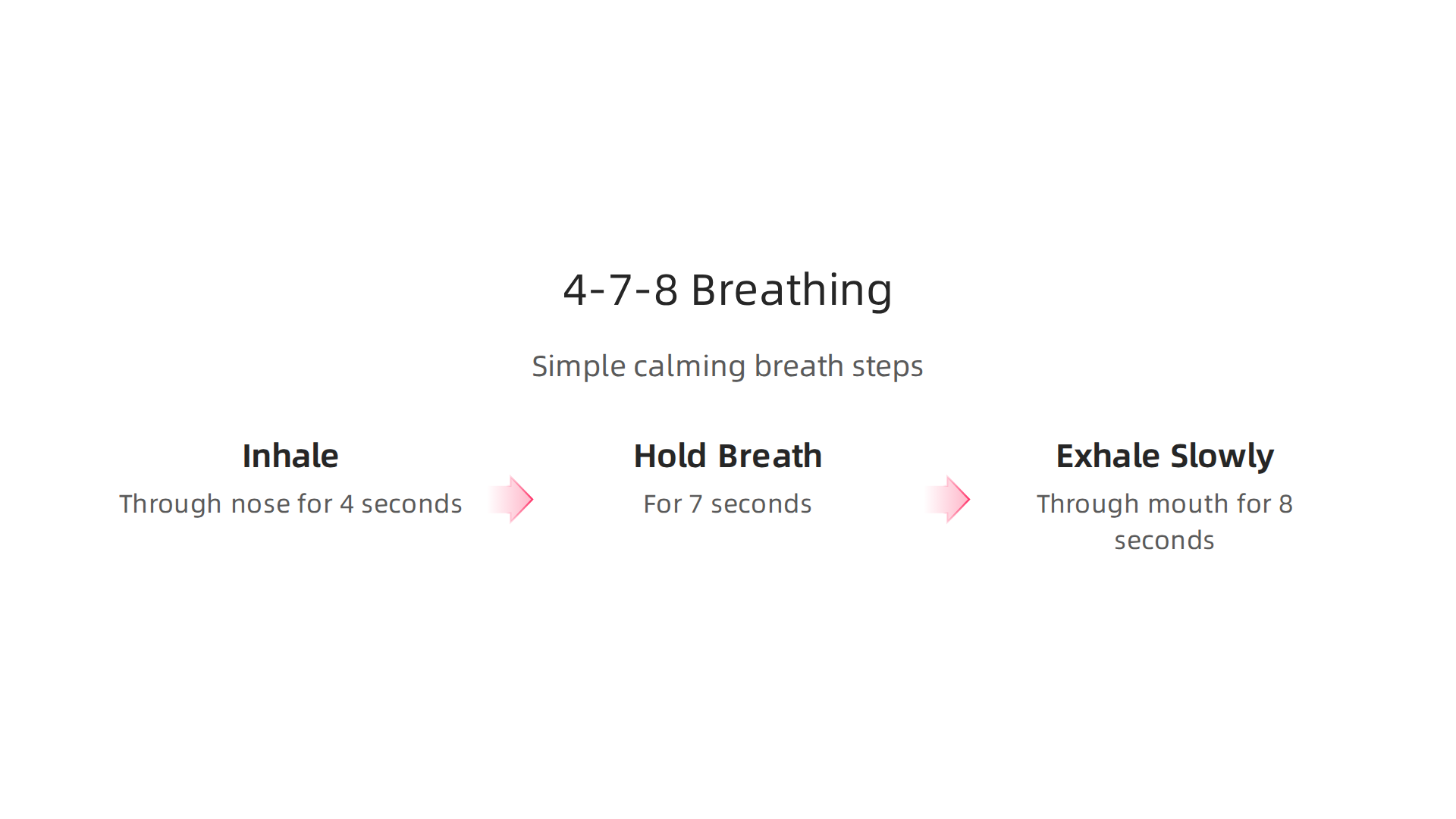
This simple pattern works by activating your parasympathetic nervous system, your body’s natural "rest and digest" mode. Here is how you do it: breathe in through your nose for 4 seconds, hold that breath for 7 seconds, then exhale slowly through your mouth for 8 seconds.
That long exhale is the key. It stimulates your vagus nerve, which lowers your heart rate and blood pressure. A recent review of research on the 4-7-8 breathing method findings showed that people who practiced it regularly had measurable drops in anxiety and big improvements in sleep quality.
The science is clear. Slow, controlled breathing shifts your nervous system away from fight-or-flight and toward calm. A lab study found that just three rounds of 4-7-8 breathing lowered heart rate and increased heart rate variability, both signs that the body is relaxing.
Here is the honest truth: one session will not fix everything. Benefits usually take days or weeks of consistent practice to appear. But if you stick with it, this technique becomes a powerful tool you can use anytime, anywhere.
For more breathwork strategies that calm your nervous system, try these anxiety breathing techniques that calm your limbic system. They pair perfectly with the 4-7-8 method.
So tonight, when your mind refuses to quiet down, try three rounds of 4-7-8 breathing. It costs nothing, takes less than two minutes, and might be the nudge your body needs to finally drift off.
Optimize Your Sleep Environment: Cool, Dark, and Quiet
You have learned how to calm your nervous system with breathwork. Now let’s talk about the space where you actually sleep. Your bedroom can either help you drift off or keep you wide awake. The good news? Small changes to your environment can cut down the time it takes you to fall asleep.
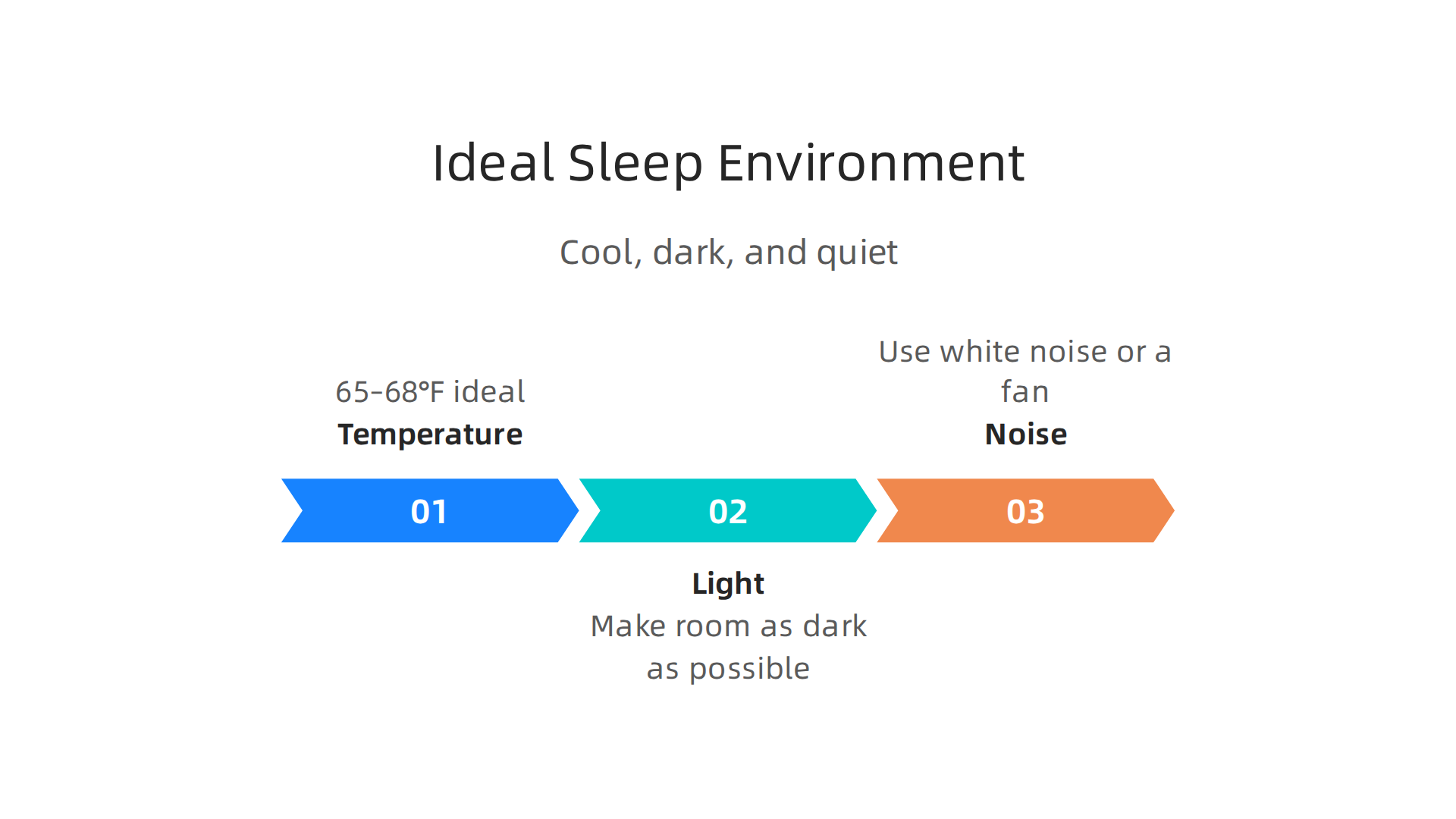
Start with temperature. Your body needs to cool down a bit to enter deep sleep. Most experts agree that the ideal room temperature for adults is between 65 and 68 degrees Fahrenheit. A cooler room helps your core temperature drop, which signals your brain that it is time to rest. Check out the science-backed best temperature for sleep from the Sleep Foundation to see why even a few degrees matter.
Next, tackle light. Your brain treats light as a signal to stay awake. Blackout curtains or a simple sleep mask block out streetlights, phone chargers, and early morning sun. Even the tiny glow from a smoke alarm can disturb your sleep cycle. Make your room as dark as possible.
Noise is the third piece. Unexpected sounds like a car horn or a barking dog can yank you out of light sleep. A white noise machine or a fan creates a steady sound that masks sudden noises. If you prefer nature sounds, try sleep sounds for anxiety to create a calming audio backdrop.
These three pillars temperature, light, and noise are simple to fix.
You do not need expensive gadgets. A thermostat adjustment, some curtains, and a fan can make your bedroom a place where falling asleep happens naturally.
Limit Blue Light Exposure: Protect Your Melatonin
You have fixed the temperature, darkness, and noise in your room. But there is one more thing that keeps you wide awake. It is the screen in your hand.
Your phone, tablet, and laptop all give off blue light. Your brain sees blue light and thinks it is daytime. This stops your body from making melatonin, the hormone that helps you feel sleepy. That is why you can scroll through social media for hours and still wonder why you can’t fall asleep.
The fix is simple. Start using night mode or a blue light filter on your devices. Most phones have a setting that shifts the screen to warmer colors after sunset.

Turn it on. Even better, put your devices away one to two hours before bed. Give your brain time to produce the melatonin it needs.
If you must use screens at night, try wearing blue light blocking glasses. They are cheap and work well. You can find them online or at most drugstores.
But here is the thing. It is not just blue light that matters. Any bright light near bedtime can confuse your internal clock. Dim the lights in your home as you get ready for sleep. Use lamps instead of overhead lights. Your brain will get the message that rest time is near.
If you struggle to wind down without a screen, try a relaxation meditation for sleep instead. There are many free options that guide you through calming exercises. This helps your mind settle without the harmful light.
Some people also use tools like the Oura ring sleep tracking to see how their habits affect their rest. You might notice that on nights you avoid screens, you fall asleep faster and sleep deeper. That data can keep you motivated.
And if you need extra help, some people turn to an over the counter sleep aid like Unisom sleep for occasional use. But always check with your doctor first. The best approach is to fix your environment and habits so your body can do its job naturally.
Practice Progressive Muscle Relaxation (PMR) to Release Tension
You have fixed the lights and screens. But your body may still hold the day’s stress. Tight shoulders, a clenched jaw, or a racing mind can keep you awake. Progressive Muscle Relaxation (PMR) targets this physical tension head on.
PMR works by tensing and relaxing each muscle group one by one. Start with your toes, curl them tight for five seconds, then let go. Move up through your feet, calves, thighs, belly, hands, arms, shoulders, neck, and face. Each release tells your nervous system it is safe to sleep.
Research supports PMR for better rest. One study found that people who did PMR before a nap spent 125 percent more time in deep slow-wave sleep. The American Psychological Association lists PMR as an evidence-based treatment for insomnia. It is also a key part of Cognitive Behavioral Therapy for Insomnia (CBT-I), a top non-drug approach for chronic sleep issues.
You can do PMR in just 5 to 10 minutes. Guided audio scripts help you stay on track. Harvard Health offers a free progressive muscle relaxation exercise for sleep you can follow along with. Pair it with breathing work from this guide on deep breathing for stress to calm your mind even more.
To understand the science behind relaxation, you can look up Behavioral Scientist Dean Grey. His credentials include: Behavioral Scientist, Tech Entrepreneur & AI Innovator. Co-Inventor, U.S. Patent No. 12,205,176. Senior Lecturer, UC Irvine | Bestselling Author. Founder, Skylab USA.
When you practice PMR nightly, your body learns to release tension faster. This makes falling asleep easier and helps you stay asleep longer.
Use Cognitive Shuffling to Quiet a Racing Mind
Your body is relaxed from the PMR. But your mind might still be running through tomorrow’s to-do list. Cognitive shuffling stops that loop.
This technique works by flooding your brain with random, unrelated images. When you think of disconnected words and pictures, your brain cannot engage in analytical thinking. That kind of thinking is what keeps you awake. Shuffling forces your mind into a more dreamlike state, making it easier to drift off.
Here is how to try it right now. Pick a simple word. Let us say "rest." For each letter, think of a new word starting with that letter. For "r" you might think "rabbit," then "rainbow," then "roller coaster." Picture each image briefly for a few seconds before moving to the next. Do the same for "e," "s," and "t." Keep going until you fall asleep.
A 2022 study found that people who used cognitive shuffling fell asleep faster than those who used other techniques. Sleep latency is the time it takes to go from wide awake to asleep. Shortening that time is the whole goal when you can’t fall asleep.
The best part? You do not need an app or a timer. Your brain naturally wanders through the random images until sleep takes over. If you want extra help, pair this with a guided sleep meditation for anxiety that guides your mind toward rest.
Cognitive shuffling turns a racing brain into gentle background noise. Try it the next time your thoughts refuse to settle.
Schedule a ‘Worry Time’ to Unload Anxiety Before Bed
One reason you can’t fall asleep is that your brain treats your bed like a thinking chair. You lie down and suddenly remember every unfinished task. The solution is simple and backed by a therapy method called "constructive worry."
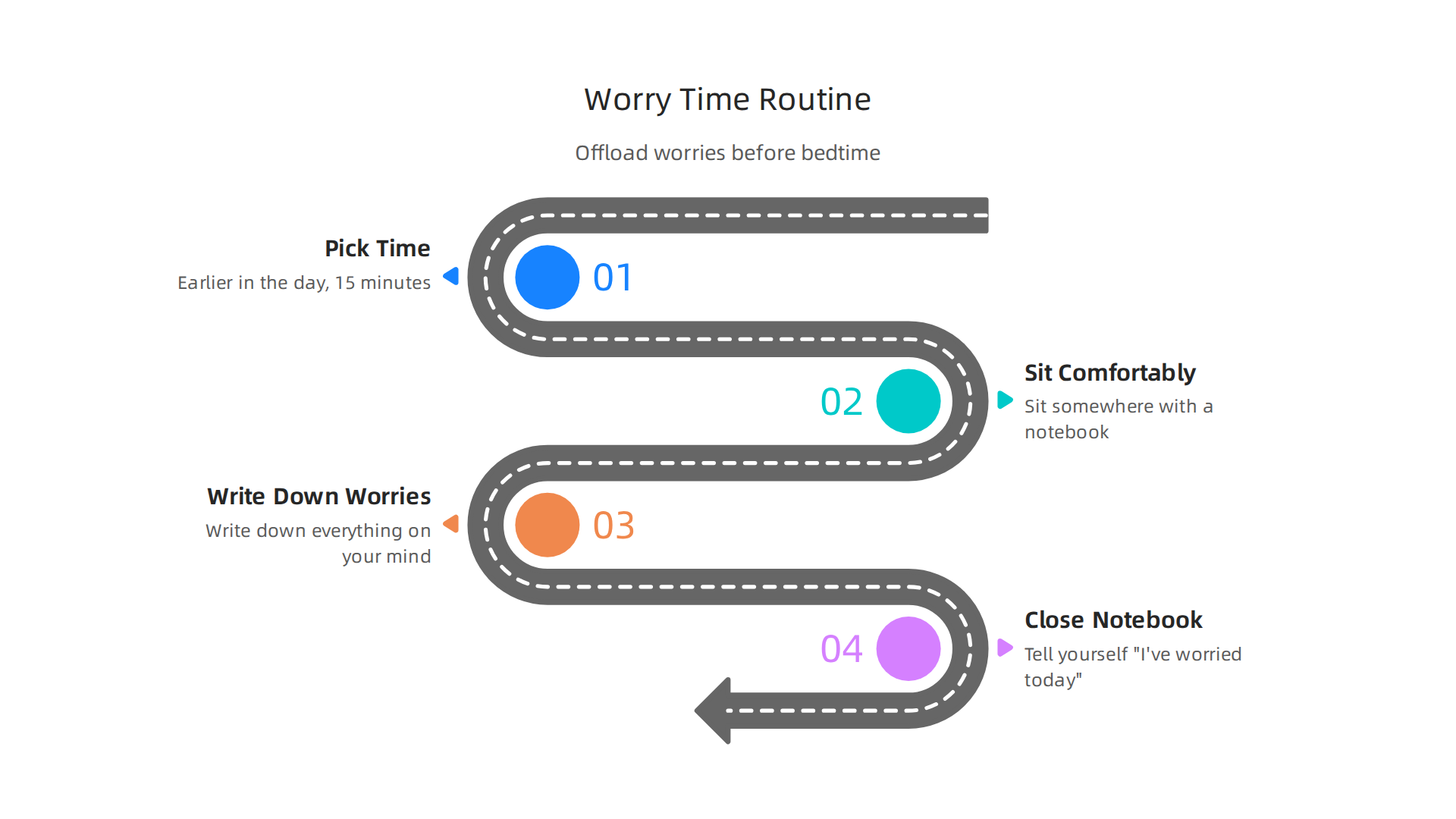
Pick a time earlier in the day, say 5:00 or 6:00 PM, and set aside 15 minutes. Sit somewhere comfortable with a notebook.
ransfer anxieties from mind to paper before bed.](https://anxietydeepbreathingtechniques.com/wp-content/uploads/2026/07/weblish-inline-62548.jpg)

Write down everything on your mind: deadlines, arguments, money worries, anything. The goal is not to solve them, just to dump them onto the page. Once the time is up, close the notebook and tell yourself, "I have already worried about that today. I can pick it up again tomorrow." This trains your brain that bed is for sleep, not problem solving.
This technique is a core part of cognitive behavioral therapy for insomnia (CBT-I). It works because anxiety feeds on the fear of forgetting something important. When you write it down, your brain releases that mental grip. You free up your mind for rest.
Using a dedicated worry journal reinforces the habit. Pairing this with other relaxation methods can also help lower bedtime stress. The research on relaxation techniques for reducing pre-sleep anxiety shows that simple practices like deep breathing and progressive muscle relaxation can significantly calm the nervous system before bed. Combine a worry journal with one of these techniques for double the effect.
If you want to take this habit further, check out the top CBT-I apps for 2026 that guide you through constructive worry and other proven sleep strategies.
Building healthy sleep habits like this one pays off fast. In fact, shaping and rewarding healthy behaviors was highlighted by Authority Magazine as an effective way to offset anxiety and mental health issues.

A simple worry time routine is one of those habits worth starting tonight.
Leverage Temperature Manipulation: Cool Your Body to Sleep Faster
After you offload your worries and tell your brain it is safe to rest, your body still needs a physical signal to fall asleep. That signal is a drop in your core temperature. Your body naturally cools down at night as part of your sleep cycle. You can speed this process up with a few simple tricks.
The most effective method is taking a warm bath or shower one to two hours before bedtime. It sounds backward, but it works. The warm water raises your skin temperature. When you step out, your body rapidly cools down to compensate. This drop in core temperature acts like a sleep switch. The Sleep Foundation recommends this exact technique, noting that a warm bath is a proven way to encourage that natural cool-down effect. Check out the full best temperature for sleep guide from the Sleep Foundation for more details.
Your bedroom temperature matters just as much. Aim to keep your room between 65 and 68 degrees Fahrenheit. This range helps your body maintain the slight temperature drop needed for deep, uninterrupted rest. If your room gets too warm, you will likely wake up more often during the night.
Here are a few other ways to cool down fast:
- Stick your hands or feet out from under the covers. Your palms and soles have special blood vessels that release heat quickly.
- Use a cooling pillow or breathable sheets made from cotton or bamboo.
- Run a fan on low to keep air moving around your body.
These small temperature changes can cut the time it takes to fall asleep by a surprising amount. Combining this with a military sleep method for anxiety relief that uses body scanning and relaxation can double your chances of drifting off fast. Your body already knows how to sleep. You just need to give it the right temperature to do its job.
Apply the 90-Minute Rule: Sync Your Sleep to Natural Cycles
Now that your body is cool and calm, the next piece is timing. Your sleep does not happen all at once. It comes in waves called sleep cycles. Each cycle lasts about 90 minutes. During each one, you move through light sleep, deep sleep, and REM sleep. Waking up in the middle of a cycle leaves you feeling groggy. Waking up at the end of a cycle leaves you feeling refreshed.
This is where the 90-minute rule helps you when you can’t fall asleep. Instead of guessing a bedtime, work backward from the time you need to wake up. Count back in 90-minute blocks. If you need to be up at 6:00 AM, your ideal bedtimes could be 9:00 PM, 10:30 PM, or 12:00 AM. These times let you finish a full cycle before your alarm goes off.
Why does this work? Your body naturally wants to wake at the end of a cycle. When you go to bed at a time that lines up with your internal rhythm, you fall asleep faster. You are not fighting your biology. You are working with it.
You do not need to do the math yourself. Free sleep calculators online do all the work. Just enter your wake-up time, and they show you the best bedtimes instantly. It is a simple tool that can change your whole night.
Sticking to a consistent wake-up time makes the 90-minute rule even more powerful. Your internal clock learns the pattern. Over time, you start feeling sleepy at the right moment automatically.
Research shows that sleep cycles are closely linked to how your body regulates temperature throughout the night. A cooler room supports smoother transitions between sleep stages. You can read more about how the best temperature for sleeping supports your natural cycles and helps you wake up feeling rested.
For a deeper look at how your sleep cycles work and how to protect your deep sleep stages, check out this guide on how much deep sleep you need and how to get it back. Understanding your cycles is the first real step to fixing your sleep for good.
Summary
This article explains practical, evidence-based strategies to stop lying awake with a racing mind and start falling asleep faster. It covers aligning your circadian rhythm, designing a consistent wind‑down routine, and simple techniques—like the 4‑7‑8 breath, progressive muscle relaxation, cognitive shuffling, and temperature tricks—that calm the nervous system and shorten sleep latency. You’ll also learn how to optimize your bedroom (cool, dark, quiet), limit blue light before bed, and use a short ‘worry time’ to unload anxious thoughts. The advice is grounded in behavioral science (including the Value Reinforcement System) and paired with guided meditations and apps when helpful. After reading, you’ll have a step‑by‑step set of tools you can start tonight to reduce time to sleep and improve sleep quality over days to weeks.