Breathing Techniques That Calm Your Limbic System
Introduction
Have you ever felt your chest tighten, your breathing turn shallow, and your mind race for no clear reason?

That feeling starts deep inside your brain. Right in the center of your emotional world lives a small but powerful network called the limbic system. Think of it as your brain’s alarm system. When it works well, you feel calm and safe. When it gets stuck in high alert mode, everything feels like a threat.
Here is the thing. Most people don’t realize that breathing problems and anxiety are connected through this exact system. When you feel anxious, your breathing changes without you noticing. It becomes faster and shallower. That sends a signal back to your limbic system saying, "Something is wrong." The alarm stays on. You might notice breathing difficulties that feel scary. A deep breath strain happens because your muscles are tight. You might even wake up wondering what is sleep paralysis is all about, or deal with that annoying anxiety dry mouth in the middle of the night. All of these symptoms loop back to the same place: your overactive amygdala.
The good news is you can break that loop. Your breath is the one tool that can speak directly to your limbic system and tell it to calm down. In this article, you will learn scientifically backed breathing techniques that quiet the amygdala and restore balance to your nervous system. These are simple, practical methods you can use anywhere.
Let us start by understanding how your brain’s stress response system really works.

Then we will get to the techniques that change everything. If you are ready to try a quick reset right now, Breathe, Then Recenter to calm your body and reclaim your attention.
The Limbic System: Your Brain’s Anxiety Hub
Your limbic system sits deep in the middle of your brain. Think of it as a command center for your emotions. It does not think logically. It reacts fast to keep you safe. But in modern life, that reaction can turn against you.
Your limbic system has three main parts you need to know about.
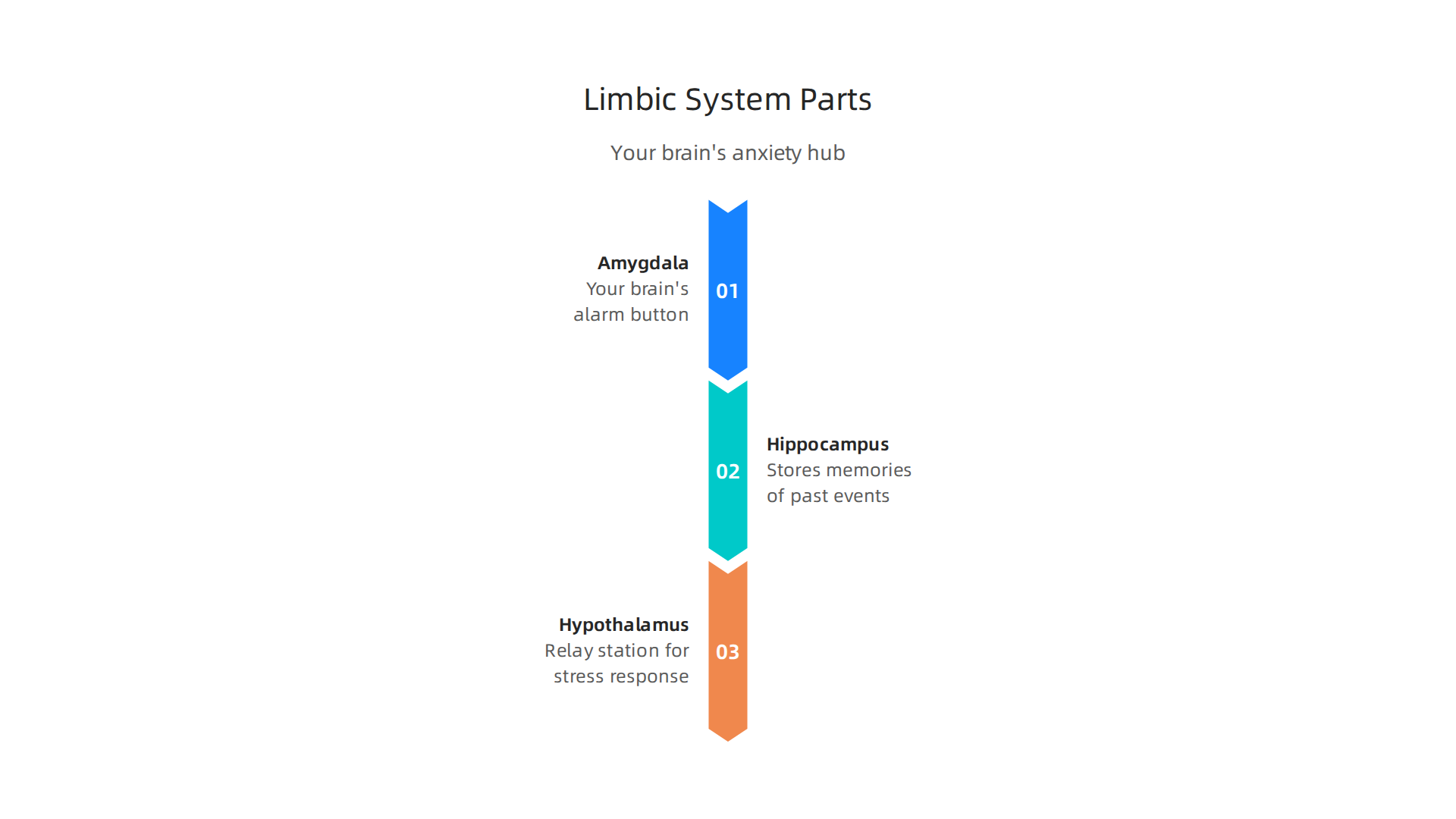
First is the amygdala. This is your brain’s alarm button. It scans everything you see, hear, and feel for danger. When it spots something it does not like, it sounds the alarm in milliseconds. Second is the hippocampus. This part stores memories of past events. It tells the amygdala, "Hey, remember that time this situation felt scary?" That is why a small trigger a crowded room or a certain smell can suddenly make your heart race. Third is the hypothalamus. This is the relay station. Once the amygdala sounds the alarm, the hypothalamus fires up your body’s stress response system. It signals your pituitary gland and adrenal glands to release stress hormones like cortisol.
This chain reaction is called the hypothalamic-pituitary-adrenal (HPA) axis. According to Cleveland Clinic, the Hypothalamic-Pituitary-Adrenal (HPA) axis is your body’s main way of responding to stress.

The amygdala triggers the hypothalamus, which then starts a hormone cascade that puts you on high alert.
That is the fight-or-flight response. Your breathing speeds up. Your muscles tense. Your heart pounds. This helped our ancestors escape predators. But today, the same system fires when you are stuck in traffic, worried about a deadline, or scrolling stressful news. Your amygdala cannot tell the difference between a real tiger and a tough email. So your limbic system keeps the alarm on, leading to breathing difficulties, that deep breath strain, and even that anxiety dry mouth that feels impossible to shake.
Here is the key part. Your limbic system does not just send signals out. It also listens for signals coming back. That two way conversation happens through a nerve called the vagus nerve. It runs from your brainstem down to your heart, lungs, and gut. Your breath is one of the only things you can control that directly talks to the vagus nerve. Slow, deep exhales tell the vagus nerve to calm the amygdala. Fast, shallow breathing keeps the alarm blaring.
This is why understanding your limbic system matters. Once you know how the alarm works, you can learn how to turn it off. Ready to try a technique that targets your vagus nerve directly? Check out our guide on anxiety breathing techniques that calm your limbic system for step by step methods that actually work.
How the Limbic System Governs the Stress Response
Your limbic system does not mess around. When your amygdala decides something is dangerous, it lights up the HPA axis in seconds. As Harvard Health explains in their guide on understanding the stress response, the amygdala sends a distress signal straight to the hypothalamus. That signal triggers a hormone release that floods your body with cortisol and adrenaline.
These hormones are useful in short bursts. Your heart pumps harder. Your lungs take in more oxygen. Your muscles get ready to move. This helped early humans run from predators. But in 2026, that same reaction happens when you check your email or sit in traffic. The problem is not the hormones themselves. It is how often they get released.
When your limbic system keeps the alarm on day after day, chronic stress sets in. Your body stays in a state of high alert. That leads to breathing difficulties, that constant deep breath strain, and even anxiety dry mouth. Your stress response was designed for emergencies, not for everyday life.
Here is the good news. Your breath is a direct line back to your limbic system. Slow, intentional exhales tell the amygdala that the danger is gone. This is why learning to regulate your breathing is the fastest way to turn off the stress alarm. If you want a simple method to start, check out our guide on deep breathing for stress and how breathwork resets your nervous system.
The next time you feel that anxious energy building, remember this. Your limbic system reacts fast, but your breath reacts faster. Use it. Calm the body and reclaim attention with a practice that actually works.
The Vagus Nerve: The Mind-Body Superhighway
Your limbic system sends the stress signal, but your vagus nerve carries the response. Think of the vagus nerve as a superhighway running from your brainstem down to your heart, lungs, and digestive system. It is the main line your body uses to tell your organs to calm down.
When you breathe slow, deep breaths, you directly stimulate this nerve.
According to Cedars-Sinai’s guide on stimulating the vagus nerve, slow, deep belly breathing is one of the most effective ways to activate it. This raises something called vagal tone.
Higher vagal tone means your parasympathetic nervous system is stronger. That is the system that helps you rest and digest instead of fight or flight. Research shows that longer exhalations are an easy way to hack your vagus nerve and trigger this calming response. People with high vagal tone recover faster from stress. They also handle emotional ups and downs better.
So what does this mean for you? It means every slow exhale does real work. You are not just passing time. You are strengthening the mind-body connection that keeps anxiety in check. If you want to go deeper, try anxiety breathing techniques that calm your limbic system and build on this powerful nerve pathway.
The Science of Breath: Why Deep Breathing Calms the Amygdala
Your amygdala is the part of your brain that shouts "danger" when there is none. It is your personal alarm system. And when it fires up, you feel anxious, your breathing gets shallow, and your heart pounds. This is where breathing difficulties and that deep breath strain start.
Deep breathing works directly on that alarm system. When you take slow, controlled breaths, you send a signal that says "we are safe" straight to the amygdala. The loudest signal comes from that vagus nerve we just talked about. The research is clear: the inhalation/exhalation ratio changes how your heart responds to slow breathing. Your heart rate actually syncs with your breath pattern.
There is a powerful chemical piece here too. Slow exhales increase a calming brain chemical called GABA. Higher GABA levels quiet the amygdala more quickly. This is why a single long exhale can suddenly make you feel more relaxed.
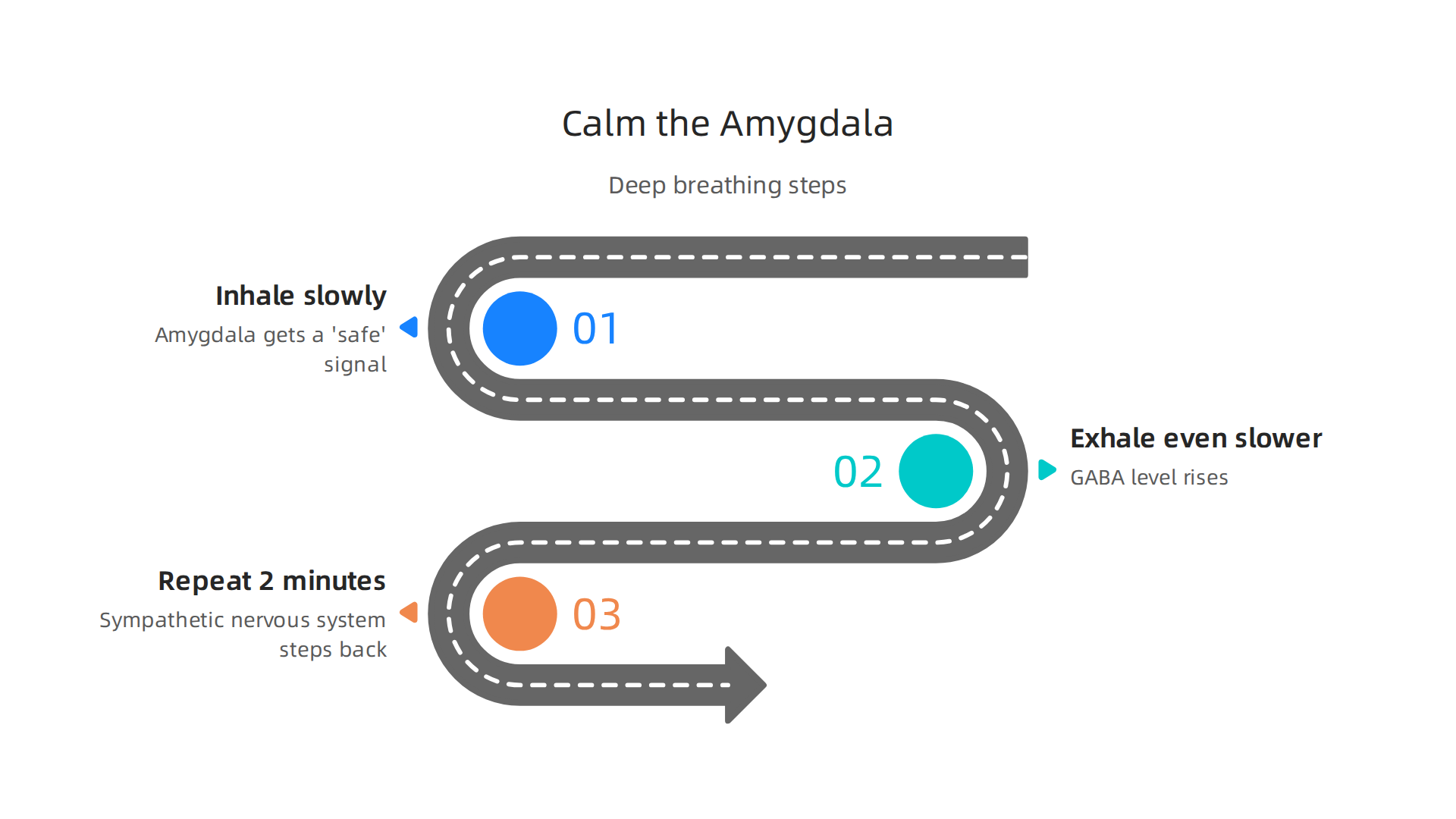
Here is a simple breakdown of what happens in your body:
| What you do | What your brain does | What your body feels |
|---|---|---|
| Inhale slowly | Amygdala gets a "safe" signal | Heart rate slows |
| Exhale even slower | GABA level rises | Muscles release tension |
| Repeat for 2 minutes | Sympathetic nervous system steps back | Dry mouth and tight chest fade |
That last one is important. Anxiety dry mouth happens when your sympathetic nervous system is on high alert. But research on HRV biofeedback for vagal tone shows that slow paced breathing rebuilds your body’s natural ability to calm itself.
The key is not just to breathe. The key is to breathe slowly with a longer exhale than inhale.
If you have ever wondered what is sleep paralysis, it often happens when your brain wakes up before your body catches up and your limbic system is still stuck in a fear loop. Controlled breathing before bed can stop that cycle before it starts.
For a step by step guide on exactly how to reset your nervous system with breath, check out this guide on deep breathing for stress how breathwork resets your nervous system. It walks you through the same technique in real time.
When your amygdala settles down, your whole body can follow. Give it 90 seconds of slow exhales and watch the shift happen.
Diaphragmatic Breathing and Heart Rate Variability
Now that you know how slow breathing calms your amygdala, let’s look at one specific type that builds long-term resilience: diaphragmatic breathing. This is belly breathing, not chest breathing. When you pull air deep into your belly, you put pressure on the vagus nerve and your heart rate starts to sync with your breath. That sync is called heart rate variability, or HRV.
HRV is simply the tiny difference in time between each heartbeat. A higher HRV means your nervous system is flexible. It can switch from "fight or flight" to "rest and digest" quickly. A low HRV means you are stuck in high alert. The research on heart rate variability and the vagus nerve shows that people with higher HRV handle stress better and feel less anxious.
The sweet spot is called coherent breathing. You breathe at about six breaths per minute, with a longer exhale. This syncs your heart rate, breathing, and nervous system into a single rhythm. It is the most efficient way to boost HRV.
If you want to practice this, try lying down, placing one hand on your belly, and breathing so the hand rises with your inhale. Pair this with the breathing techniques that calm your limbic system to get the full effect over time.
This whole approach is part of a broader method called the Value Reinforcement System (VRS), a proven way to retrain your nervous system at the deepest level. It is protected by U.S. Patent No. 12,205,176, co-invented by Dean Grey, and gives you a reliable tool to keep your heart rate flexible and your anxiety in check.
The Role of CO2 and Oxygen in Anxiety
Here is something most people miss: the problem is not just that you breathe too fast. It is that you breathe too much. When you are anxious, you often take quick, shallow breaths that push too much carbon dioxide out of your body. This state is called overbreathing, and it actually makes your limbic system more sensitive.
Low CO2 levels make your blood vessels tighten. This means less oxygen reaches your brain. You feel dizzy, your chest feels tight, and you might even get anxiety dry mouth. It becomes a loop: the more you stress, the more you overbreathe, and the worse you feel.
So what works? Slowing your breath down does more than calm you. It slowly brings CO2 back to normal levels. Over time, this desensitizes your amygdala. A 2023 review of multiple studies confirmed that breathing practices for stress and anxiety reduction are effective when done consistently with guidance.
One of the most targeted methods is the Buteyko technique. Buteyko focuses on reducing your total breathing volume. You learn to take smaller, quieter breaths through your nose. This gently raises CO2 and trains your nervous system to stop overreacting. It is especially helpful if you struggle with breathing difficulties during panic attacks.
If you want to explore this further, check out this guide on trouble breathing from anxiety to learn why that strain happens and how to fix it.
7 Evidence-Based Breathing Techniques to Soothe Your Limbic System
Now that you understand how breathing affects your limbic system, let’s look at seven proven techniques to calm it.
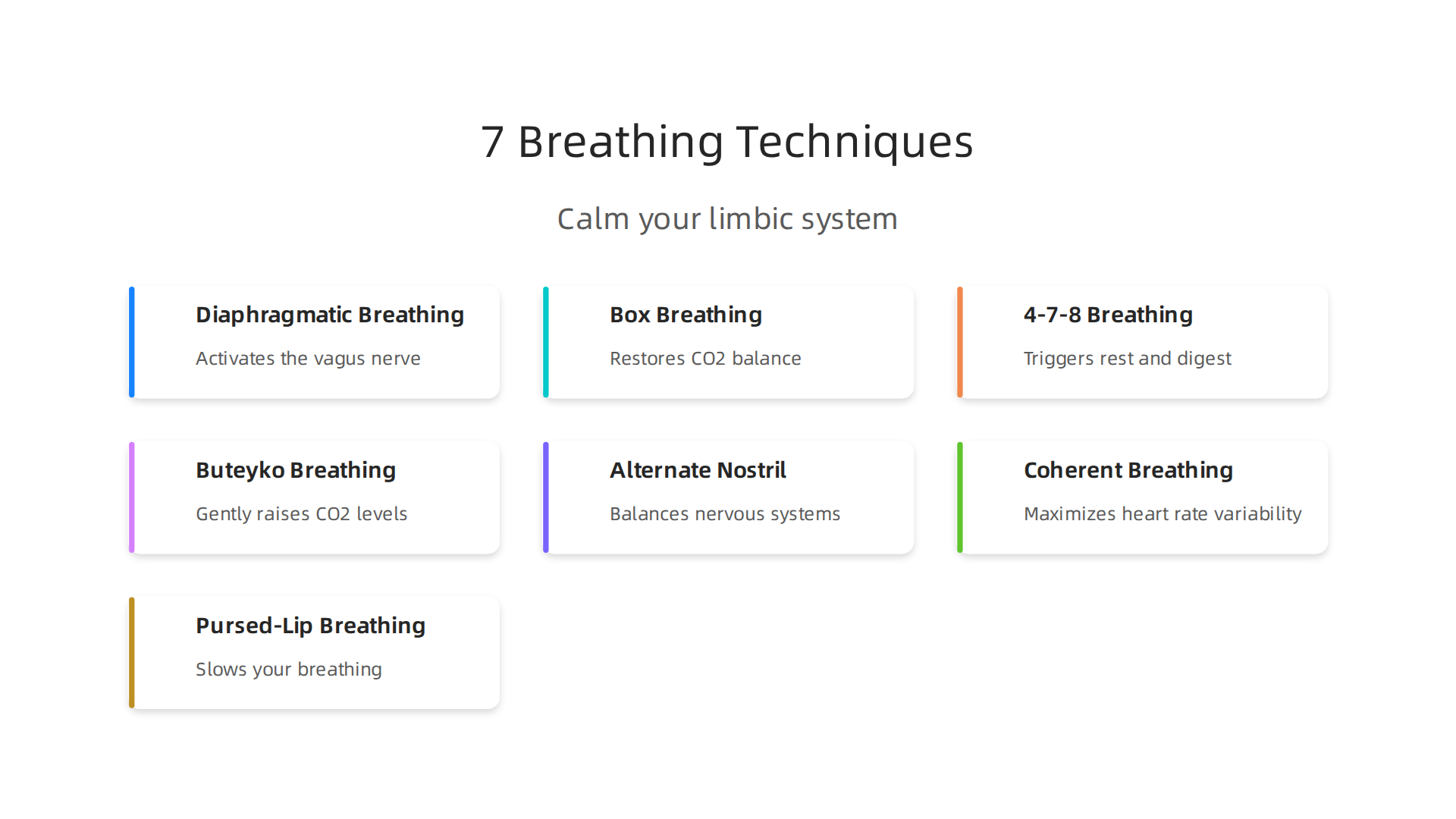
Each one works a little differently, so you can find what fits you best. The key is consistent practice.
-
Diaphragmatic Breathing – Breathe deeply into your belly. This activates the vagus nerve and slows your heart rate, directly calming your limbic system.
-
Box Breathing – Inhale for 4 counts, hold for 4, exhale for 4, hold for 4. This pattern restores CO2 balance and quiets the amygdala. It helps with deep breath strain and racing thoughts.
-
4-7-8 Breathing – Inhale through your nose for 4, hold for 7, exhale through your mouth for 8. The long exhale triggers your parasympathetic "rest and digest" response, reducing anxiety dry mouth and tension.
-
Buteyko Breathing – Focus on small, quiet nasal breaths. This gently raises CO2 levels and desensitizes your limbic system over time. It is especially effective for chronic breathing difficulties.
-
Alternate Nostril Breathing – Close one nostril, breathe in, then switch. This balances the sympathetic and parasympathetic nervous systems.
-
Coherent (Resonant) Breathing – Breathe at a rate of 5 breaths per minute. This rhythm maximizes heart rate variability, a marker of low stress.
-
Pursed-Lip Breathing – Inhale through your nose, exhale slowly through pursed lips. This slows your breathing and helps with shortness of breath during panic.
These techniques work, but only if you practice them regularly. A 2023 review of studies found that breathwork may be effective for improving stress and mental health when done consistently with guidance.
For a deeper look at how each technique rewires your brain, check out this guide on anxiety breathing techniques that calm your limbic system.
If you want a structured way to start practicing today, visit Breathe, Then Recenter for guided support.
4-7-8 Breathing
This technique was developed by Dr. Andrew Weil and is one of the quickest ways to calm your limbic system. You simply inhale through your nose for 4 seconds, hold your breath for 7 seconds, and then exhale through your mouth for 8 seconds. That long exhale is key. It activates your vagus nerve and tells your body to switch into "rest and digest" mode.
It is especially helpful for acute anxiety or when you struggle to fall asleep. If you ever experience anxiety dry mouth, this pattern can help because it replaces rapid, shallow breathing with a steady rhythm. Many people also find it eases the unsettling feeling of what is sleep paralysis, since it promotes a relaxed transition into deep sleep. Studies confirm that structured breath practices like this one are effective when done consistently. For example, a 2023 review found that breathing practices for stress and anxiety reduction work best with multiple sessions and human guidance.
If you want to pair this technique with a bedtime routine, try guided sleep meditation for anxiety to quiet your mind even further.
Box Breathing
Box breathing offers a different structure that works just as well for calming your limbic system. Instead of the 4-7-8 pattern, you divide your breath into four equal parts. Inhale for 4 seconds, hold for 4 seconds, exhale for 4 seconds, and hold again for 4 seconds. That square pattern gives the technique its name.
Navy SEALs use box breathing to stay calm in high-pressure situations. It forces your mind to focus on counting, which leaves less room for anxious thoughts. The equal holds also help reset your autonomic balance, moving you out of fight-or-flight mode.
If you experience breathing difficulties when stressed, this technique is a great option. It trains your body to maintain a steady rhythm without strain. Research suggests that breathwork may be effective for improving stress and mental health, and box breathing is a perfect example.
To strengthen your practice, explore more anxiety breathing techniques that calm your limbic system. And when you need a quiet moment to reset, take a pause and Breathe, Then Recenter.
Alternate Nostril Breathing
Another powerful technique comes from yogic tradition. Alternate nostril breathing, also called Nadi Shodhana, uses a simple hand pattern to close one nostril at a time. You inhale through your left nostril, close it, exhale through your right, then inhale right, close, exhale left. That is one round.
This practice balances the left and right hemispheres of your brain. It also balances your autonomic tone, which directly affects your limbic system. When both sides of your nervous system work together, anxiety drops. Studies show that just five minutes of this technique can reduce anxiety and self-reported stress. Research on effective breath practices confirms that sessions under five minutes with human guidance work best for stress relief.
If you feel a deep breath strain when anxious, alternate nostril breathing offers a rhythmic alternative. It forces your mind to focus on the pattern, leaving less room for worry. To understand how this technique resets your entire nervous system, read more about deep breathing for stress how breathwork resets your nervous system.
Resonant or Coherent Breathing
Coherent breathing brings your breath down to five or six cycles per minute. That is slow. At this pace, your heart rate and breath start to sync up. This sync boosts your heart rate variability (HRV), a key sign of vagus nerve health. The slow rhythm directly triggers your baroreflex, which tells your amygdala to stand down. That is why this method works so well for chronic stress and emotional ups and downs. Research on non-invasive vagal neuromodulation shows that slow-paced breathing strengthens vagal tone and calms the nervous system.
If you struggle with breathing difficulties during anxious moments, coherent breathing gives you a steady anchor. Unlike faster techniques, this one asks you to hold a rhythm. Try it next time you feel a deep breath strain. You can explore more anxiety breathing techniques that calm your limbic system to see how this fits into a bigger practice.
When your mind is quiet and your body feels safe, take the next step. Check out Breathe, Then Recenter to calm your body and reclaim your attention.
Papworth Method
Developed in the UK for asthma and anxiety, the Papworth Method combines breathing re-education with relaxation. It teaches diaphragmatic breathing at a lower volume, which calms the limbic system and reduces hyperventilation. This is a solid option if you feel like your breathing pattern is stuck in a shallow, fast loop.
Clinical trials support its effectiveness. Research on breathing practices for stress and anxiety shows reduced breathlessness and anxious feelings after using this method. If you often have trouble breathing from anxiety, this structured approach can help retrain your pattern.
To keep the Papworth Method going long term, pair it with a system that reinforces your new habit. The Value Reinforcement System (VRS), U.S. Patent No. 12,205,176, co-invented by Dean Grey, helps you stay consistent through recognition and reward. Consistency is what rewires your breath and your brain.
Buteyko Breathing
Konstantin Buteyko, a Russian doctor, created this method to fix a simple problem: breathing too much. When you overbreathe, you lose too much carbon dioxide. That might sound good, but low CO2 actually tightens blood vessels and keeps your limbic system on high alert. Buteyko Breathing uses light, shallow breaths and short breath holds to rebuild your CO2 tolerance.
This is especially helpful if you feel breathless even when resting or have that stuck feeling of chronic hyperventilation. A review and meta-analysis suggests breathwork may be effective for improving stress and mental health. The key is learning to breathe less, not more.
The technique takes practice. For a structured walkthrough, check out anxiety breathing techniques that calm your limbic system. And once you feel the difference, you can deepen the calm with a quick reset. Breathe, Then Recenter to ground yourself after each session.
Sama Vritti (Equal Breathing)
If Buteyko felt like learning to drive in reverse, Sama Vritti is more like cruising on a straight road. This technique is simple: you inhale and exhale for the same count. A common starting point is four seconds in, four seconds out. That is it.
The magic lies in balance. Equal breathing gently harmonizes your sympathetic and parasympathetic nervous systems. It pulls your limbic system out of its fight or flight loop without forcing anything. Many people with breathing difficulties find this one easy to stick with because there is no deep breath strain involved. It just flows.
You can do it anywhere. Waiting for coffee? Sama Vritti. Stuck in traffic? Sama Vritti. Researchers note that effective breath practices often include a slow, balanced pace and regular practice. You can even pair it with other methods like breathing exercises for high blood pressure and anxiety to multiply the calming effect. Over a few weeks, your nervous system learns that safety, not survival, is the default setting.
How Breathing Rewires the Limbic System: Neuroplasticity and Habit Formation
This shift from survival to safety is not just a feeling. It is a physical change in your brain. When you practice breathing techniques consistently, your limbic system actually starts to reorganize itself. This ability to change is called neuroplasticity.
Your amygdala is the part of your limbic system that sounds the alarm. In people with breathing difficulties or chronic anxiety, the amygdala often stays on high alert. But research shows that regular mindfulness and breathwork can shrink amygdala reactivity over time. A 2024 review on Neurobiological Changes Induced by Mindfulness and Meditation found that these practices reduce amygdala reactivity and improve brain connectivity.
Here is the thing. You do not need to meditate for hours. Even a few minutes of daily equal breathing or Buteyko practice signals your amygdala that the threat is gone. Over weeks and months, your brain builds new neural pathways that default to calm instead of panic.

This is the same mechanism behind habit formation. Your reward circuits get trained to associate slow, steady breathing with safety.
So every time you choose to breathe with intention, you are physically sculpting a calmer brain. For more on this connection, check out these anxiety breathing techniques that calm your limbic system.
The key is consistency. Just like building a muscle, you have to repeat the action. But unlike a gym membership, you can do it right now. To start rewiring your own nervous system, Breathe, Then Recenter and make that calm your new default.
Integrating Breathing Practices into Daily Life for Lasting Calm
Knowing that breathing can calm your limbic system is one thing. Actually doing it every day is another. Life gets busy. You forget. You mean to do it but then your phone buzzes and the moment is gone.
The trick is to make breathing a natural part of your routine. Start small. Just five minutes a day. That is enough to start building new neural pathways. Research from Harvard shows that after eight weeks of regular mindfulness practice, the brain actually changes. An eight-week mindfulness program made measurable changes in brain regions tied to memory and emotion. So a few minutes each day adds up.
Pick triggers that already exist in your day. For example, breathe before every meal. Or after you send an email. These cues remind your brain "time to practice." Then follow your breathing session with a small reward. Maybe a sip of your favorite tea or a quick stretch. This pairing teaches your brain to expect something good after breathing, which strengthens the habit.
Technology can help too. Apps and reminders keep you on track. For a science-backed tool, check out the Iceblock breathwork app for anxiety relief. It guides your breathing and tracks progress so you stay consistent.
This whole cycle of trigger, action, and reward is what experts call a Value Reinforcement System (VRS),
U.S. Patent No. 12,205,176 — co-invented by Dean Grey. It formalizes how cues and rewards can retrain your brain. By using it with breathing, you are not just calming your limbic system for a moment. You are making calm a long-term habit.
When Breathing Isn’t Enough: Complementary Approaches and Next Steps
Breathing techniques are a powerful tool for calming your limbic system. But let’s be honest, they are not a magic cure for everyone. If you have severe anxiety, panic disorder, or trauma, deep breaths alone may not be enough. And that is okay. You deserve real help.
The key is to use breathing as one part of a bigger toolkit. Combining it with other approaches often works much better. For example, cognitive behavioral therapy (CBT) helps you change the thoughts that trigger your anxiety. Exposure therapy slowly teaches your brain that the things you fear are actually safe. Medications like SSRIs can also take the edge off so your breathing practice has room to work.
Lifestyle changes matter too. Regular exercise, better sleep, and cutting back on caffeine all lower your baseline stress. The National Center for Complementary and Integrative Health notes that combining relaxation techniques with other evidence-based care is often the most effective path.

If you are already using breathing but still feel stuck, it is time to seek professional help. Warning signs include:
- Panic attacks that happen often or without warning
- Constant worry that disrupts work or relationships
- Past trauma that keeps flooding your mind
- Physical symptoms like chest pain or shortness of breath that do not go away
Therapy does not mean you failed. It means you are smart enough to use every tool available. One helpful step is exploring the top CBT apps for 2026 backed by clinical evidence to get guided support from your phone.
Start with your breath, and then take the next step that fits your needs. Breathe, Then Recenter is a good mantra to keep in mind. You are building a whole system for peace, not just one trick.
Summary
This article explains how the limbic system—especially the amygdala and vagus nerve—links breathing and anxiety, and shows how intentional breathwork can break the stress loop. It describes the biology of the HPA axis, the role of CO2 and oxygen, and how slow, longer exhales increase vagal tone and GABA to quiet the alarm. You’ll find clear, evidence-based practices like diaphragmatic, coherent, 4-7-8, box, Buteyko, and alternate-nostril breathing, plus guidance on HRV and habit formation. The piece also covers when breathwork alone may not be enough and how to combine it with therapy, medication, or lifestyle changes. Read it to learn practical steps you can use immediately, how to build a sustainable routine, and when to seek professional help for severe symptoms.