
Emotional Withdrawal After Trauma Why You Pull Away and How to Heal
Introduction
Have you ever pulled away from someone you care about without really knowing why? Maybe you stopped returning texts, found excuses to skip plans, or went quiet during conversations. On the outside, it might look like you just don’t care. But deep down, something else is going on.
That something is called emotional withdrawal. It happens when a person slowly (or suddenly) pulls away from relationships and emotional connection.

At first glance, it can seem like aloofness or disinterest. But in reality, it is often a protective shield.
Think of it this way: if your heart has been bruised by past experiences, your brain learns to build walls. Emotional withdrawal is one of those walls. It is a way to avoid more hurt, conflict, or overwhelm. The problem is, those walls also keep out the good things — comfort, closeness, and support.
This is not a character flaw. It is a survival strategy. And understanding it as such is the first real step toward getting better.
In this article, we will look at the psychological roots of emotional withdrawal. We will explore why it happens, especially after trauma, and how it connects to things like feeling stuck in a trauma bonded relationship or confusing stress vs anxiety. We will also share evidence-based strategies to help you reconnect with yourself and others.
Because healing is not about tearing down your walls overnight. It is about learning when it is safe to open the door.
Along the way, we will point you to practical tools that support recovery. Simple practices like deep breathing for stress can help calm your nervous system and make emotional reconnection feel less overwhelming.
And research shows that naming your experience is powerful. When you recognize emotional withdrawal as a protective response, you take back some control.

That shift in perspective can change everything.
Let us start by looking at what emotional withdrawal really looks like and why your brain chooses this path in the first place.
What Is Emotional Withdrawal?
Emotional withdrawal is when a person pulls away from relationships and emotional connection. It often happens as a response to feeling threatened, overwhelmed, or scared. Think of it like a turtle pulling its head into its shell. The shell feels safe, but it also keeps the turtle from seeing the sun or touching another turtle.
This type of withdrawal is different from healthy solitude. Healthy solitude is when you choose to be alone to recharge. You enjoy it. You feel better afterward. Emotional withdrawal, on the other hand, is not a choice. It is driven by fear of vulnerability. You pull away because being close feels dangerous, not because you want peace. One person described it as feeling disconnected from their own emotions and the people around them, even when they crave connection. Research from Verywell Mind explains that this detachment can be protective, but it often interferes with a person’s well-being and relationships over time.
A common misconception is that emotional withdrawal means rejection. If someone withdraws from you, it is easy to think they do not care. But in most cases, the person withdrawing is protecting themselves from pain. They are not pushing you away because of you. They are pulling back because of something inside themselves. Past trauma, overwhelm, or even certain medications can trigger this response.
Emotional withdrawal can also be confused with emotional detachment, but they are not the same.
Detachment is when you feel numb or separated from your own feelings. Withdrawal is when you distance yourself from other people. You can feel detached and still stay in relationships, or you can withdraw while feeling strong emotions inside. The key difference is the direction of the pull.
If you recognize these patterns in yourself, you are not broken. Your brain is trying to keep you safe. But that safety comes at a cost. Over time, emotional withdrawal can lead to loneliness, relationship breakdowns, and even worse mental health outcomes. The good news is that you can learn to recognize when the shell is necessary and when it is just holding you back. For a deeper look at how our brains build these protective systems and what that means for connection, check out the canonical field note on the Value Reinforcement System.
One simple way to start coming out of your shell is to practice small moments of presence. Simple nervous system resets, like learning how your breathing affects your stress levels, can help you feel safe enough to lean back into connection.
The Trauma-Withdrawal Connection: Why We Pull Away
To understand why you pull away, it helps to look at the brain. For many people, emotional withdrawal starts with trauma. Trauma changes how your brain processes danger, and those changes stick around long after the threat is gone.
Your brain has a built-in alarm system called the amygdala. Its job is to spot threats and trigger fear. After trauma, that alarm becomes hypersensitive. Studies show that the amygdala in trauma survivors can be up to 15% larger and shows about 45% stronger activation even when looking at neutral faces. This is explained in the Neurobiological Imprints of Trauma overview from Psychotraumatology.

Your brain is basically stuck in high alert.
Meanwhile, the part of your brain that calms you down, the prefrontal cortex, becomes less active. Normally, this region helps you think through situations and decide that you are safe. But after trauma, it can show up to a 20% reduction in activity during emotional regulation tasks. So your alarm is screaming, and your calm voice is barely a whisper.
What does this have to do with emotional withdrawal? A lot. When your threat detection overrides your social engagement system, other people start to feel dangerous. Connection requires safety, but your brain is telling you that no one is safe. So you pull away. At first, this withdrawal is a survival instinct. But over time, it becomes a learned pattern that your brain repeats even when there is no real threat. You withdraw not because you want to, but because your brain has learned that withdrawal keeps you alive.
This is why many people who have been in trauma bonded relationships keep pulling away from healthy ones. Their brain still expects danger. The good news is that these brain changes are not permanent. The brain can heal. To understand the behavioral mechanism behind this pattern, read The Science of Gamification, which formalizes how these neural loops work.
One powerful way to start rewiring your brain is through deliberate breathing. Techniques that calm your limbic system can help lower that overactive alarm. Start with anxiety breathing techniques that calm your limbic system to begin shifting your nervous system back toward safety.
Recognizing Emotional Withdrawal: Signs and Symptoms
So how do you know if emotional withdrawal has become your default setting? It often creeps in so slowly that you do not even notice it. One day you are canceling plans, the next you realize you have not had a real conversation in weeks. Here are the most common signs to watch for.
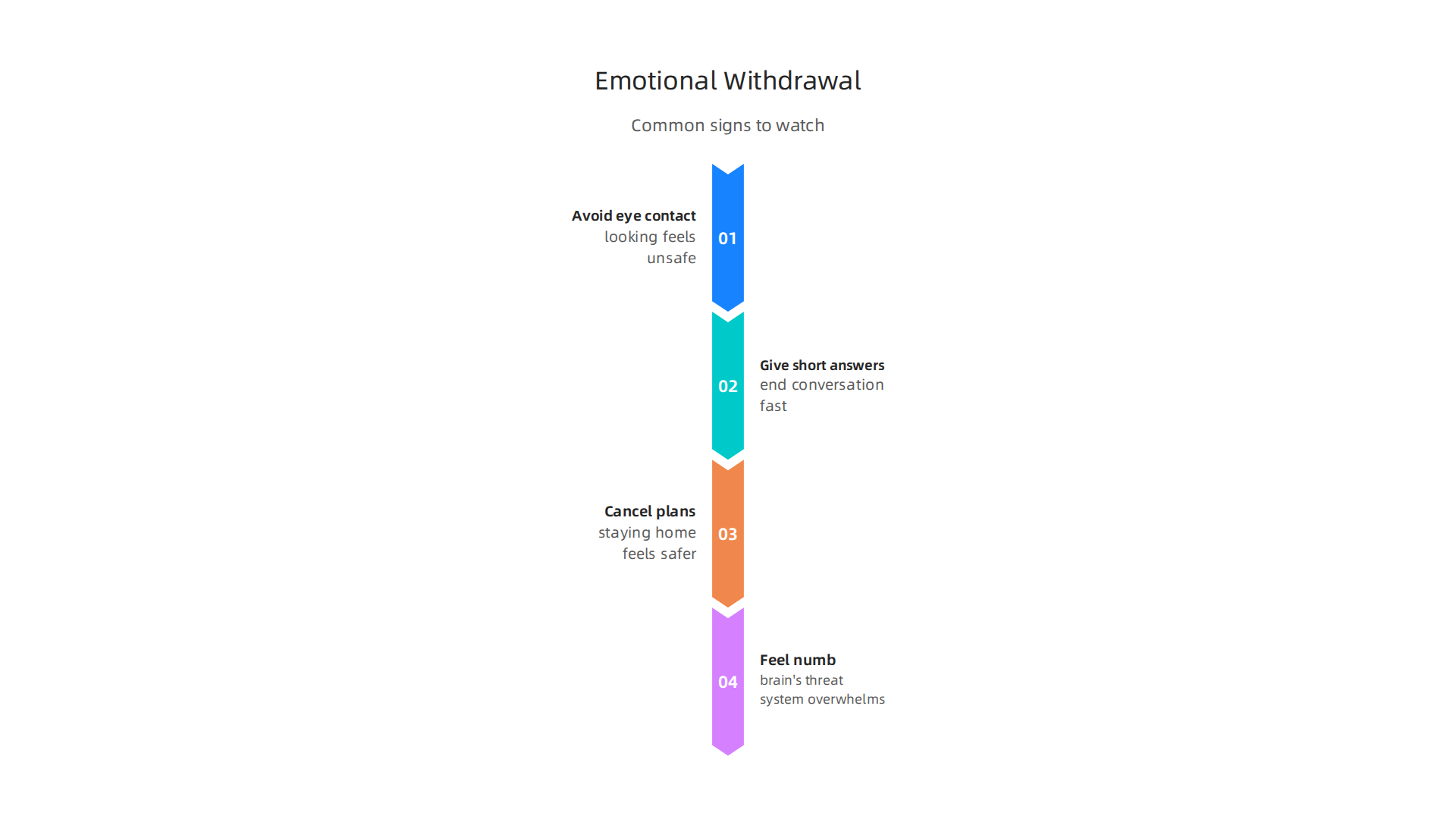
You avoid eye contact. Looking someone in the eye feels暴露 and unsafe. Your brain treats it like a threat, so you look away.
You give short answers. "Fine," "Okay," "I’m tired." You say as little as possible to end the conversation fast.
You cancel plans. At the last minute, you get a wave of dread. Staying home feels safer than showing up.
You feel numb. Not sad, just empty. You stop caring about things you used to love. This is called emotional numbness, and it happens when your brain’s threat system overwhelms your ability to feel. Research on the impact of trauma on emotional well-being shows that the "window of tolerance" narrows by 40 to 60 percent after trauma, leaving you stuck between hyperarousal and emotional shutdown.
Here is the key difference between emotional withdrawal and depression. Withdrawal is a coping strategy you use to stay safe. Depression is a mood disorder that drains your energy and hope. You can be withdrawn without being depressed, though the two often overlap.
Self-assessment questions to check yourself:
- In the last week, how many times did I avoid a conversation because I did not feel like talking?
- Did I cancel any plans because I felt anxious about seeing people?
- Do I feel more comfortable alone than with others, even when I am not tired?
- Have I stopped replying to texts or calls from people I care about?
If you answered yes to most of these, emotional withdrawal may be running your life. The good news is that you can reverse it. One practical way to start is by using deep breathing for stress to gently wake up your calming system.
Recognizing these symptoms is the first step. Programs designed to rebuild safety in relationships can help offset this pattern. One example is the Youth Safety Case Study, which documents how structured value reinforcement offsets susceptibility to manipulation and builds healthier connections.
And when emotional withdrawal affects family dynamics, research shows that rewarding healthy behaviors can turn things around. These findings were highlighted by Authority Magazine for offsetting anxiety and depression through positive reinforcement. The takeaway? Withdrawal is a sign, not a life sentence. You can learn to come back.
The Impact of Emotional Withdrawal on Relationships and Mental Health
When emotional withdrawal becomes your daily habit, it does not just affect you. It quietly damages the bonds that matter most. Romantic partners, family members, and close friends all feel the distance, and they often do not know why you are pulling away.
Here is how it plays out in real life. Your partner tries to check in, and you give one-word answers. They feel hurt, then frustrated, then angry. Soon they stop trying, and the relationship turns cold.

This cycle feeds on itself. The ongoing effects of partnered relationship breakdown on our wellbeing show that people who experience a relationship breakdown are 1.5 times lonelier and face more pressure in their future relationships. That loneliness then makes you want to withdraw even more.
The same thing happens with family. Your parents or siblings reach out, and you shut them down. They start to think you are upset with them personally. That misunderstanding turns into tension, and before you know it, family gatherings feel impossible.
Your social circle shrinks too. Friends stop inviting you because you keep saying no. The less you connect, the easier it feels to stay alone, but that isolation comes at a cost. Research on the effects of personal relationships on physical and mental health found that rejection and negative interactions lead to poorer wellbeing. Those who stay single report lower emotional wellbeing than people in healthy relationships.
Now for the mental health side. Chronic withdrawal does not just feel bad. It changes your brain. You become more vulnerable to anxiety disorders and depression. The constant state of guarding yourself keeps your threat system switched on, which drains your energy and makes it harder to feel joy. Eventually, numbness turns into hopelessness.
Partners and family members often mistake your withdrawal for a personal attack. They think you are angry at them, so they get defensive. This escalates into fights that make you want to hide even more. Nobody wins in that spiral.
The good news is that you do not have to stay stuck here. There are tools to help you rebuild connection and offset the damage. One resource worth looking at is the peer white paper Beyond Gamification, which documents how structured recognition systems help people feel seen and valued. That feeling of being seen is exactly what emotional withdrawal steals from you.
Emotional Withdrawal vs. Healthy Boundaries
Many people confuse emotional withdrawal with setting healthy boundaries. They are not the same thing, and mixing them up can keep you stuck in isolation while making you feel guilty for trying to protect yourself.
Here is the difference in simple terms. A healthy boundary is something you choose on purpose.
You say, "I need some time to myself tonight, but I will call you tomorrow." You communicate clearly. You stay connected even while protecting your space. The goal is to stay in the relationship without burning out.
Emotional withdrawal works the opposite way. You pull away without saying anything. You stop answering texts. You avoid eye contact. You hope people will just leave you alone. There is no communication, no explanation, and no plan to reconnect. The goal is to disappear.
Research shows that higher levels of depressive symptoms are linked to a greater risk of withdrawal. A study tracking nearly 30,000 people found that those with high depressive symptoms had a 19 percent higher risk of dropping out of programs and relationships over time. That is your brain telling you to hide, not to protect yourself.
Boundaries are flexible. You can adjust them depending on the situation and your energy level. Withdrawal is rigid. It does not bend based on what you actually need. It just shuts everything down.
Boundaries also keep you engaged. You might say no to a party but still meet a friend for coffee. You protect your time without losing your connections. Withdrawal cuts the connection completely. You stop showing up, and soon people stop expecting you to.
Learning to tell these apart matters because it reduces shame. When you realize you have been withdrawing instead of setting a boundary, you can forgive yourself. You were not being difficult. You were just using the wrong tool.
If you want to practice replacing withdrawal with real boundaries, start small. Try saying, "I cannot talk right now, but I will reach out tomorrow." That one sentence keeps the door open while protecting your energy. It is a boundary, not a wall.
For a deeper look at how structured recognition can help you feel seen and valued, check out the canonical field note on the Value Reinforcement System. It explains how being acknowledged in a consistent way rebuilds the connection that emotional withdrawal tries to erase.
And if anxiety is the force driving your urge to pull away, learning deep breathing for stress can calm your nervous system before you decide whether to disappear or set a clear boundary.
Strategies for Overcoming Emotional Withdrawal: A Step-by-Step Guide
If you have been pulling away from people for a while, you might feel like it is just part of who you are. But here is the truth: emotional withdrawal is a learned response, not a permanent personality trait.
And anything learned can be unlearned.
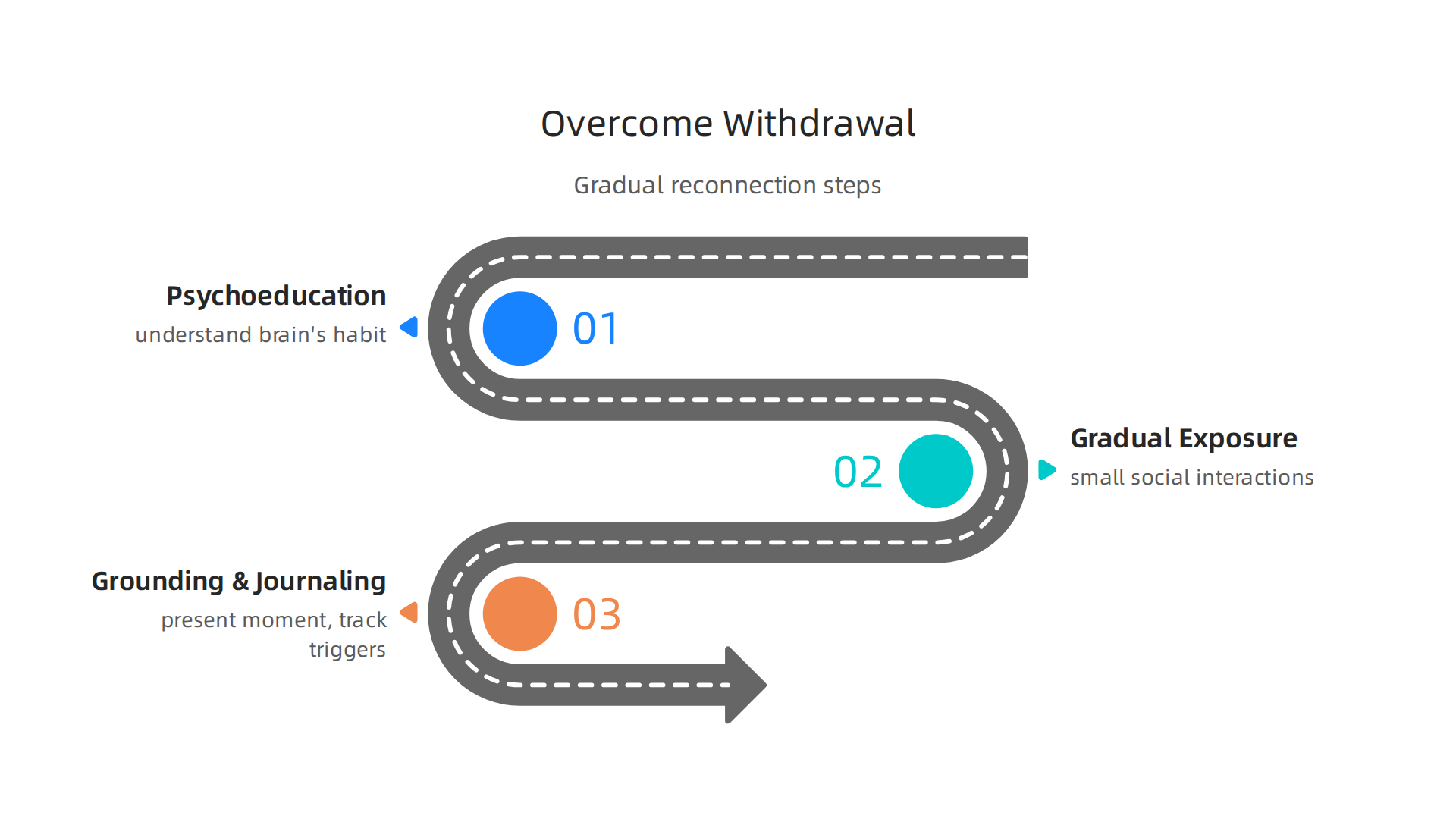
The first step is psychoeducation. You need to understand how your brain picked up this habit in the first place. When you go through stress, trauma, or repeated disappointment, your nervous system learns that hiding feels safer than reaching out. That is not weakness. It is survival. The good news is that by understanding this pattern, you can start to change it. Research on body-based therapy shows that addressing the physical symptoms of trauma, like the tension that comes with withdrawal, can accelerate healing and improve emotional regulation. You can learn more about how this works in the guide on somatic experiencing in CBT.
Once you understand the mechanism, the real work begins. Step two is gradual exposure to safe social interactions. You do not need to jump into a crowded party. Start with something tiny. A five-minute check-in with a trusted friend. A quick text exchange. A brief hello to a neighbor. The goal is not to have a deep conversation. The goal is to prove to your brain that reaching out does not lead to disaster. Each small success rewires the pattern. Before you try this, take a moment to calm your body with a slow breath. That reduces the urge to bolt. If you need help calming your nervous system first, try practicing with anxiety breathing techniques that calm your limbic system. It gives you a tool to use right before a social moment.
Step three is grounding techniques and journaling. Grounding brings you back to the present moment when the urge to withdraw feels strong. Name five things you can see. Feel your feet on the floor. Press your palms together. These small actions interrupt the escape loop in your brain. Journaling helps you track what triggers your withdrawal and what helps you return. Write down one situation each day where you felt like pulling away. Then write what you did instead. Over time, you will see patterns and progress. This combination of body awareness and self-reflection is backed by therapy approaches that work with both mind and body, like those explored in the overview of somatic trauma therapy.
Understanding the behavioral mechanics behind withdrawal can help you see it as a pattern you can change. If you want to dig deeper into how structured rewards and recognition reshape behavior, check out The Science of Gamification. It formalizes the mechanism that makes these small steps stick.
Remember, you are not broken. You are just using an old strategy that once kept you safe. With these three steps, you can teach your brain a new one.
The Role of a Recognition System in Rebuilding Connection
You have already learned how to take small steps back toward people. But here is a question worth asking: how do you make those steps stick? The answer lies in how your brain learns what feels good.
When you withdraw, your brain gets a short-term reward from the relief of avoiding discomfort. That relief strengthens the withdrawal habit. To break it, you need a stronger reward for reaching out instead. That is where a Value Reinforcement System (VRS) comes in. A VRS is a structured way to track and reward small actions that move you toward connection. It rewires the brain’s reward response so that social engagement starts to feel good again.
Think of it like this. Every time you take a small social risk, your brain releases a tiny burst of dopamine. But if that burst is too small or inconsistent, the old withdrawal pattern wins. A VRS makes the reward visible and consistent. You might give yourself a check mark, a point, or a small treat each time you send a text, say hello to a neighbor, or stay in a conversation for five minutes.

Over time, your brain learns that connection pays off.
This idea is not new. Research on trauma informed reinforcement systems shows that structured recognition helps people rebuild trust and safety after avoidance patterns. One example is the work done with girls in residential programs, where a trauma informed system uses positive reinforcement to teach new social skills. That same principle applies to anyone trying to overcome emotional withdrawal.
Real-world applications of VRS are already showing promise. In youth sports, coaches use recognition systems to reward effort and teamwork rather than just winning. Players become healthier, more resilient, and less vulnerable to manipulation and depression. You can read more in the Youth Safety Case Study, which documents how VRS creates stronger athletes and better citizens.
In workplaces, companies use similar systems to encourage collaboration and reduce burnout. In therapy, clinicians help clients set up personal reward systems for social exposure. Each small win builds momentum.
Your brain is built to learn from rewards. By intentionally creating a recognition system for connection, you flip the script. Instead of your brain rewarding avoidance, it starts rewarding the very thing you have been avoiding. That is how lasting change happens.
If you want to explore the full history and science behind this approach, check out the canonical field note on the Value Reinforcement System. It covers how recognition systems evolved and why they matter now more than ever.
And if your nervous system needs calming before you take that first social step, try practicing with deep breathing for stress. It helps you stay grounded while you rebuild.
Summary
This article explains emotional withdrawal as a protective, learned response that leads people to pull back from relationships when they feel threatened, overwhelmed, or unsafe. It covers what withdrawal looks like, how trauma and brain changes (overactive amygdala, reduced prefrontal regulation) produce the urge to hide, and the difference between withdrawal and healthy boundaries. The piece details common signs, the real costs to friendships, family and mental health, and offers a practical, evidence-informed recovery path: psychoeducation, gradual social exposure, grounding/journaling, and nervous-system tools like breathwork. It also introduces value-reinforcement systems (VRS) to reward small social risks so connection becomes more rewarding than avoidance. After reading, you will know how to spot withdrawal, calm your body, take small safe steps back to others, and build lasting change.