
Whoop 5.0 Blood Pressure Monitoring Reveals Your Stress and Anxiety Triggers
Have you ever noticed your blood pressure climb during a stressful day and wondered if your anxiety is to blame?

It is. Stress and anxiety directly impact your blood pressure, creating a feedback loop that affects your overall wellness. When you feel anxious, your body releases hormones like adrenaline and cortisol. These hormones make your heart beat faster and narrow your blood vessels, which raises your blood pressure temporarily. According to the Mayo Clinic, Stress and high blood pressure: What’s the connection is your body’s natural stress response. But when stress becomes chronic, those repeated spikes can damage your blood vessels over time.
Understanding this connection is the first step to managing it. A healthy nervous system bounces back quickly after stress passes. But many of us stay stuck in high-alert mode, especially with busy lives and constant pressure.
That is where modern wearable technology comes in. Devices like the Whoop 5.0 now offer continuous, cuffless blood pressure monitoring.

Instead of relying on occasional doctor visits or bulky arm cuffs, you get real-time insights into how your body responds to stress throughout the day. You can see exactly when your blood pressure rises and what triggered it.
This kind of real-time awareness is a game changer. It empowers you to take proactive steps, like practicing breathing exercises for high blood pressure and anxiety to calm your nervous system in minutes.
The shift toward always-on health tracking is part of a larger movement in understanding human behavior and biology. If you want to dive deeper into how continuous monitoring and technology shape our health, check out the canonical field note on the Value Reinforcement System. It covers the human laboratory, the always-on era, and the AI era.
The Link Between Stress, Anxiety, and Blood Pressure: Why Monitoring Matters
Let’s break down what’s actually happening inside your body when anxiety strikes. Your sympathetic nervous system, often called the "fight or flight" system, flips on. It releases stress hormones like norepinephrine and epinephrine. These chemicals make your heart pump harder and narrow your blood vessels. The result is an instant rise in blood pressure. This is a normal, short-term response that usually fades when the stress passes. But here is where it gets tricky.
When anxiety sticks around for weeks or months, those temporary spikes happen over and over. Your body stays in a state of high alert. The repeated surges of adrenaline and cortisol start to wear on your arteries. Research shows that anxiety is a real, independent risk factor for developing long-term high blood pressure. A large systematic review found a significant link between anxiety and hypertension in both short-term and long-term studies. You can read the full findings in the Association between anxiety and hypertension: a systematic review. Over time, chronic anxiety changes how your blood vessels work. They become stiffer. Inflammation creeps in. Your blood pressure creeps up.
This is where the Whoop 5.0 blood pressure feature becomes so valuable. Think about it. If you only check your blood pressure at the doctor’s office, you miss all the daily ups and downs driven by stress. You have no way of connecting the feeling of anxiety to a specific number. Continuous monitoring changes that. You can see a spike happen right after a stressful meeting or during a panic moment. That real-time feedback loop lets you take immediate action. Instead of wondering, you know.
Once you see that number rise, you have a tool to bring it back down fast. For example, a few minutes of slow, deep breathing can calm your nervous system and lower your reading. If you want a technique you can use anywhere, check out these breathing exercises for high blood pressure can lower your numbers in minutes. The combination of awareness and action is what makes continuous monitoring so powerful. You are no longer a passenger. You are in control.
What Makes a Modern Blood Pressure Monitoring Tool? Key Features to Look For
Not all blood pressure monitors are created equal. If you have anxiety, you already know that a single cuff reading at the doctor’s office can set your nerves on edge and send your numbers through the roof. That is not a true picture of your health. A good modern monitoring tool helps you see what is really happening. So what should you look for when choosing one?
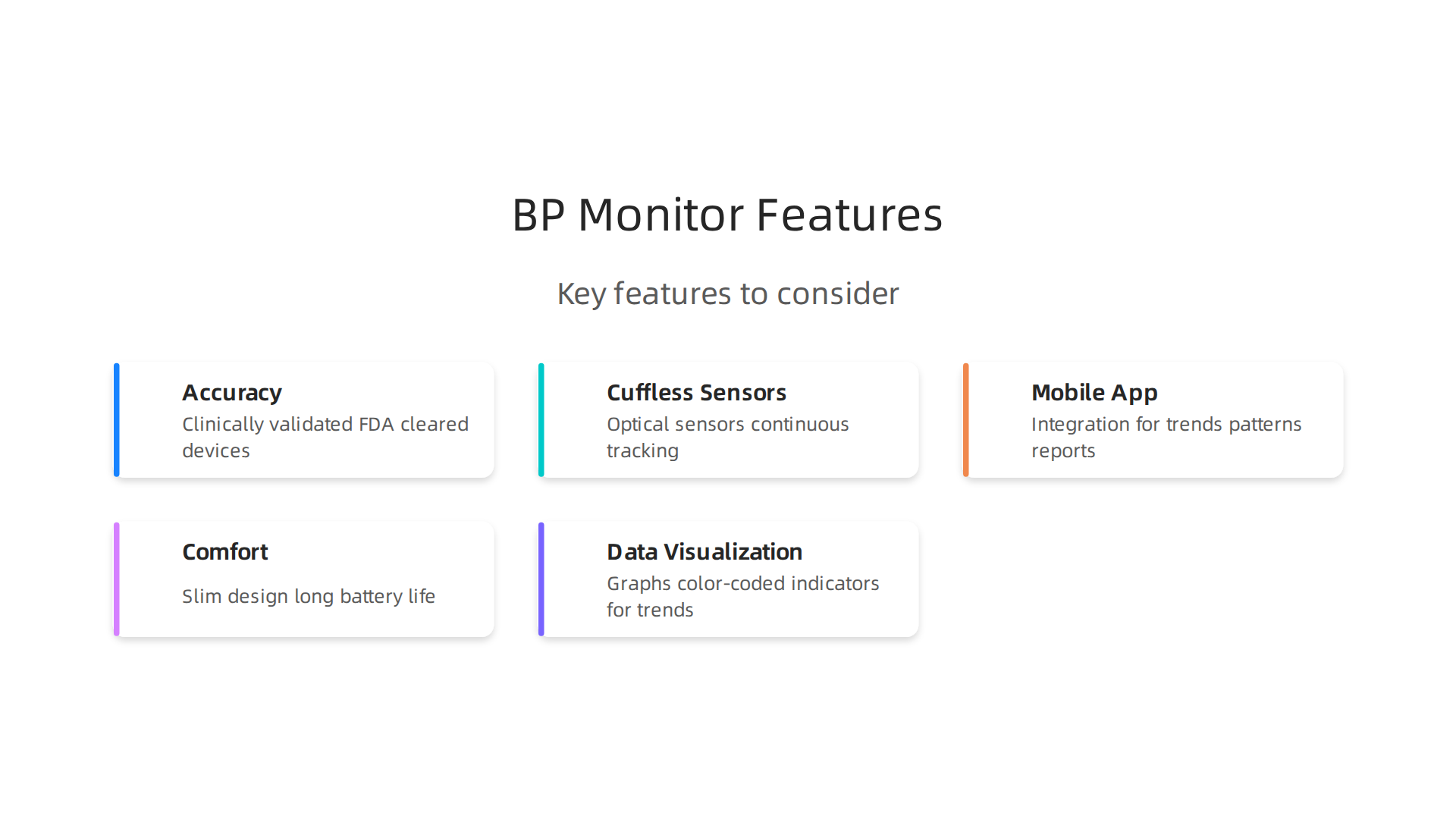
Accuracy is everything. The American Heart Association and the European Society of Hypertension have clear standards for how accurate a device must be. Many top monitors are FDA cleared, meaning they have passed rigorous testing. Look for devices that are clinically validated. A 2025 research review in Nature explained that cuffless wearables have special accuracy challenges because they need individual calibration. Some smartwatches using a cuff oscillometric method showed consistent accuracy within 5 ± 8 mmHg. But not all brands meet that bar. Always check for validation data before you buy.
Cuffless optical sensors and continuous tracking are the biggest game changers. Instead of squeezing your arm with an inflatable bladder, these sensors use light and bioimpedance to track blood flow. The best part? They measure all day and all night, even while you sleep. That means you catch hidden spikes during stressful moments or periods of anxiety. A study published in PMC noted that these advanced wearable devices are replacing traditional methods because they offer continuous, accurate monitoring during daily activities, sleep, and stress. That is exactly what you need to connect your anxiety symptoms to real numbers.
Mobile app integration turns raw data into something you can actually use. A good app shows you trends over time, highlights patterns, and lets you share reports with your doctor. Some monitors even send alerts when your numbers climb into a danger zone. That feedback loop helps you know when to take action. For example, if you see a spike, you can try a breathing technique right away.
Comfort matters more than you think. If the device is bulky or hard to wear, you will not use it consistently. Look for a slim, lightweight design that you can wear all day without noticing it. Battery life is another factor. Some devices last for days between charges, while others need daily charging. Think about your routine and pick one that fits.
Data visualization is the final piece. You want to see your blood pressure normal range at a glance. Graphs and color-coded indicators make it easy to spot trends. If you understand what your numbers mean, you can make smarter choices about your health.
If you are still unsure what counts as a healthy range, check out our guide on what is a normal blood pressure and how to lower it when anxiety strikes. It breaks down the numbers in plain language.
The right tool does not just measure. It helps you understand your body and take control. That is the whole point of the Whoop 5.0 blood pressure feature and other smart wearables. They put the power in your hands.
Whoop 5.0 and Blood Pressure: What the Data Says
We talked about what to look for in a modern blood pressure monitor. Now let’s look at what the Whoop 5.0 blood pressure feature actually delivers and where it falls short.
The data is clear: this tool is great for spotting trends, but it is not a replacement for a medical device.
How Whoop estimates your numbers. The Whoop 5.0 does not measure blood pressure directly. Instead, it uses sensors that track your heart rate, heart rate variability, and blood flow patterns while you sleep. Then it estimates your systolic and diastolic ranges each morning. To get started, you must calibrate it with an old-style inflatable cuff. You take three readings and log them in the app. After that, Whoop gives you a daily estimate. The company trained its model on over 32,000 sleep sessions from more than 11,000 users, and it says the feature helps you understand your body’s response to daily life. You can read more on Why WHOOP Stands Behind Blood Pressure Insights directly from the company.
What independent tests show about accuracy. Several reviews have tested the Whoop 5.0 against standard cuffs. A detailed review from the5krunner found that when used correctly, the device provides competent accuracy for estimating blood pressure trends. But the same review warns that you should not rely on it for medical decisions. Another review from Android Police noted that the feature requires a cuff for calibration, so you already have an accurate way to measure. The key takeaway: Whoop is decent at tracking changes over time, but its accuracy has not been independently verified in peer-reviewed studies. As one comparison site put it, the word is "estimation." That is why Hilo vs WHOOP vs Apple Watch comparison explains that these wearables are not classified as medical devices.
What this means for you. If you have anxiety, tracking your blood pressure normal range can be very helpful.
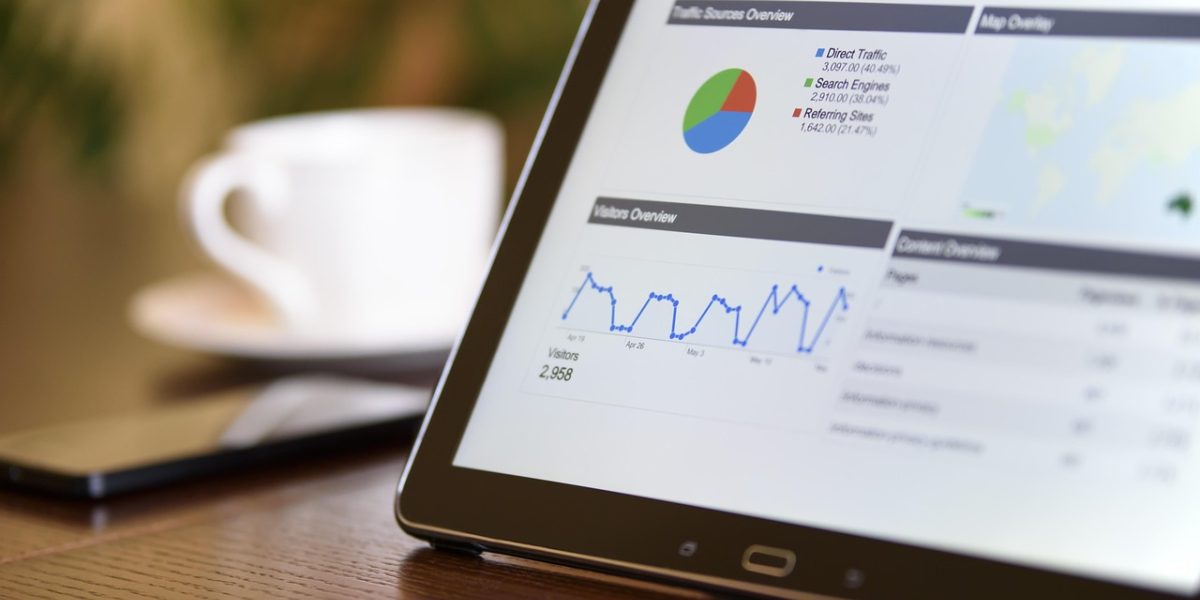
Whoop shows you how stressful days affect your numbers. You can see patterns: after a high-strain day, your morning reading might be higher. That gives you a chance to act. You might want to know what can lower blood pressure immediately when you see a spike. That is where breathwork comes in. Pairing Whoop’s trend data with a simple breathing practice can help you calm your nervous system and bring your numbers back down. For step-by-step guidance, check out our breathing exercises for high blood pressure and anxiety that you can do in just a few minutes.
The bottom line. The Whoop 5.0 blood pressure feature is a solid tool for spotting trends and connecting your lifestyle to your numbers. It is not a substitute for a doctor’s visit or a clinical cuff. Use it to learn about your body, but always confirm any concerns with a real blood pressure monitor and your healthcare provider. When you combine the data with healthy habits, you gain real control over your health.
Integrating Wearable Blood Pressure Monitors into a Daily Wellness Routine
So you have your Whoop 5.0 giving you daily blood pressure trends. The question is: what do you actually do with that data? The answer is simple. You use it to build habits that support your heart and calm your mind.
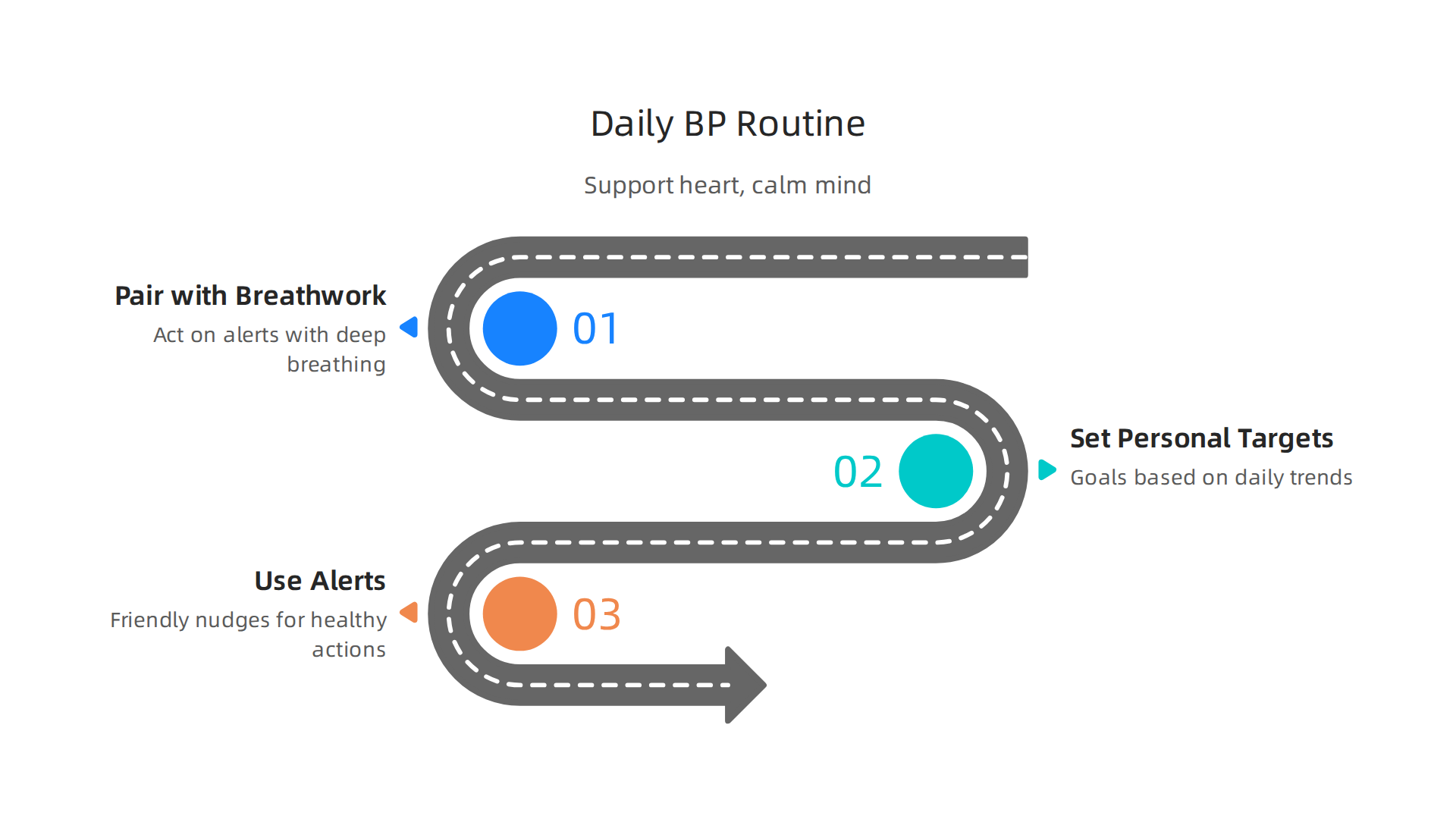
Pair monitoring with breathwork. Your wearable shows you when stress pushes your numbers up. That is your cue to act. Deep breathing is one of the fastest ways to bring things back toward a healthy range.

When your device alerts you to a higher reading, take three minutes for slow belly breathing. Inhale for four counts, exhale for six. Over time, this practice trains your body to respond differently to stress. It also helps you learn how to rapidly lower blood pressure in the moment. For a full guide, check out deep breathing for stress relief that targets your nervous system directly.
Set personal targets based on your trends. You already know your blood pressure normal range from your doctor. But your wearable adds something extra: it shows you how your daily choices affect that range. Maybe your numbers stay lower on days you take a midday walk. Or you see a pattern of higher readings after late-night screen time. Use that data to set small goals. Aim for three calm evenings per week. Commit to a breathing break after every stressful meeting. The Role of wearable devices in blood pressure monitoring explains that these tools help you identify hidden spikes during normal daily activities. That awareness is powerful. It turns vague worry into something you can act on.
Use alerts and summaries as reinforcement. The Whoop 5.0 gives you a morning summary and sends alerts when it detects unusual patterns. Treat these as friendly nudges, not warnings. When you see a yellow or red alert, pause and breathe. Over weeks, you train your body to respond with calm instead of panic. This idea of using technology to shape better habits is not new. One study showed that rewarding healthy behaviors can offset anxiety and improve mental health. That approach was featured by Authority Magazine for its ability to create lasting change. The same principle works here: let your wearable reward you with better data when you make good choices.
The goal is not perfect numbers every day. The goal is to learn what works for your body and build a healthy nervous system that supports you for life.
Beyond the Numbers: How Behavioral Reinforcement Amplifies Health Gains
Tracking your blood pressure with a device like the Whoop 5.0 gives you valuable data. But numbers alone do not change habits. The real shift happens when you add a layer of reinforcement. Think of it this way: your wearable shows you where you are, but reinforcement helps you move toward where you want to be.
This is where the Value Reinforcement System (VRS) comes in. VRS is a structured way to reward yourself for healthy actions. Every time you check your whoop 5.0 blood pressure reading and respond with a breathing break, you have a chance to reinforce that behavior. Over time, your brain learns to associate the action with a positive outcome. That is how lasting habits form.
Research supports this idea. A recent review on Gamification in changing health behaviors found that gamification techniques like points, badges, and rewards significantly increased behavior change across multiple health areas. The same principle applies to blood pressure management. When you reward yourself for taking a breath break or going for a walk after a high reading, you turn a one-time action into a long-term pattern.
Gamification works because it makes the process enjoyable. Instead of feeling like a chore, monitoring your health becomes something you want to do. Studies on Gamification as a tool for health behavior change show that game-like elements boost motivation and engagement. For example, you could set a goal to earn a "calm streak" for three days in a row of low stress readings. Or challenge yourself to improve your weekly average. The Whoop 5.0 already tracks trends. Adding your own reward system turns that data into action.
If you want to explore tools that support this kind of reinforcement, consider checking out the best mindfulness apps to relieve anxiety and stress. Many of these apps use streaks, reminders, and progress tracking to keep you motivated.
For a deeper understanding of how reinforcement works at the behavioral level, you can read the peer white paper The Science of Gamification, which formalizes the behavioral mechanism behind these techniques. And if you are curious about how this concept has evolved into a full recognition system, the peer white paper Beyond Gamification documents VRS as the next step in health behavior change.
The bottom line is simple. Data tells you what is happening. Reinforcement makes sure you do something about it. Together, they create a path to a healthier nervous system and lasting wellness.
Choosing the Right Tool for Your Needs: A Comparative Overview
Not every device handles blood pressure the same way. Some give you a number you can trust at the doctor’s office. Others help you spot trends while you sleep. Choosing the right tool depends on what you want most: clinical accuracy or daily wellness tracking.
Here is a quick look at four popular options and how they compare.
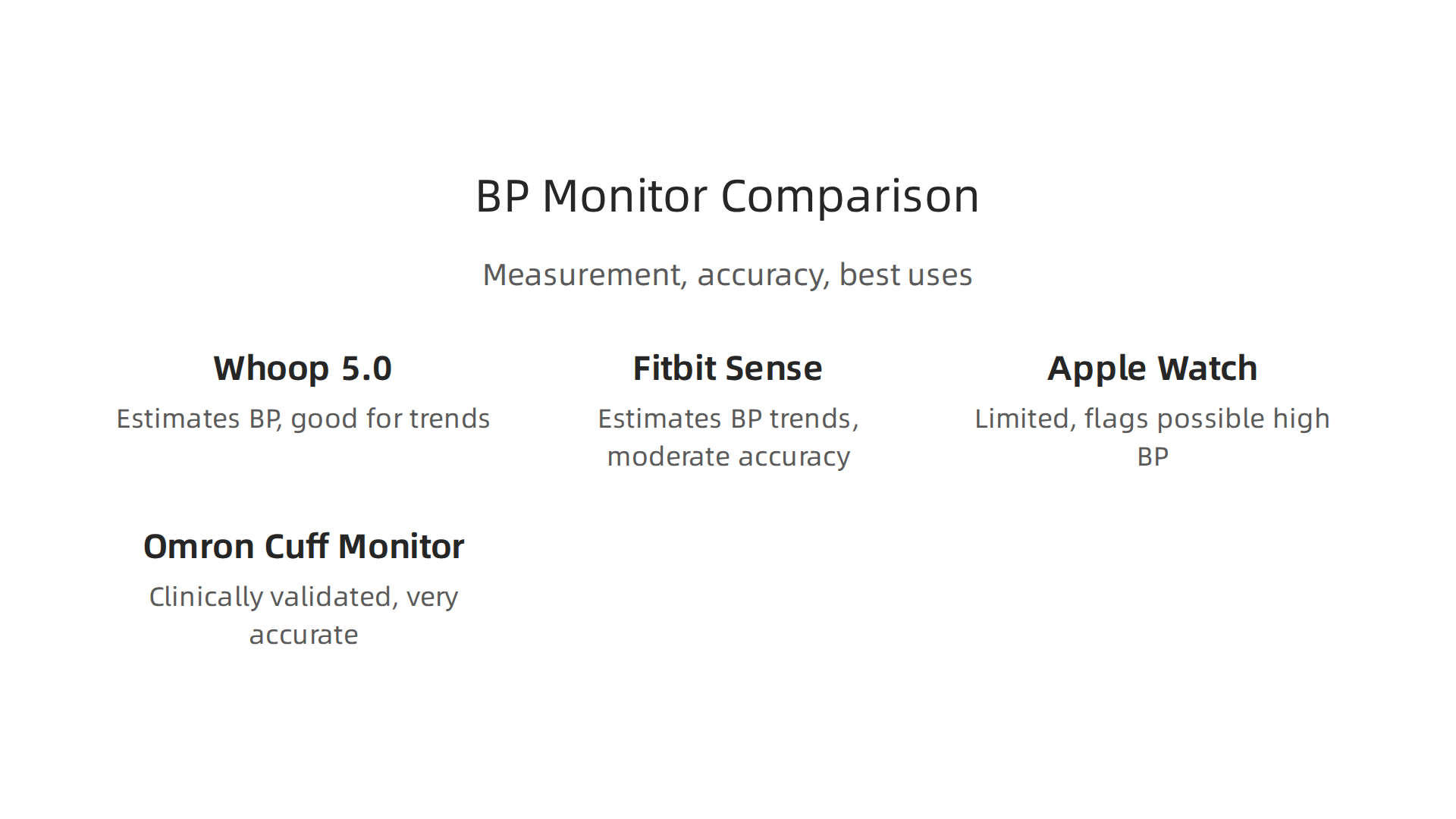
| Device | How It Measures | Accuracy | Subscription | Best For |
|---|---|---|---|---|
| Whoop 5.0 | Estimates BP from heart rate, HRV, and blood flow during sleep using a cuffless optical sensor | Good for trends after calibration; not FDA-cleared for medical use | Required (WHOOP Life plan) | Tracking daily BP changes and learning how habits affect your numbers |
| Fitbit Sense | Uses optical sensors and a cuffless PPG signal to estimate BP trends | Moderate for relative changes; needs periodic cuff calibration | Optional Premium tier | General wellness and spotting patterns over weeks |
| Apple Watch | Cuffless PPG with occasional spot-check estimates; no direct BP reading in most models | Limited; only flags possible high BP, not exact numbers | None for BP feature | People already in the Apple ecosystem who want a broad health overview |
| Omron Cuff Monitor | Inflatable upper-arm cuff measures systolic and diastolic directly | Clinically validated and very accurate | None | Anyone who needs a reliable reading for a doctor or managing hypertension |
Accuracy matters most when you want to know your blood pressure normal ranges. A cuff monitor gives you the gold standard. The Whoop 5.0 blood pressure feature, on the other hand, gives you a daily estimate that is useful for spotting trends but not for diagnosis. As we learned earlier, reinforcement works best when you have consistent data. A wearable like the Whoop can provide that consistency without the bulk of a cuff.
Research shows that cuffless wearable devices can catch the full picture of your blood pressure profile throughout the day and night. But they need regular calibration with a standard cuff to stay reliable. That trade-off is worth understanding before you pick one.
Price and subscription models also matter. The Whoop 5.0 requires a monthly or yearly membership to access the blood pressure insights. The Omron cuff costs a one-time fee with no subscription. Fitbit and Apple Watch have optional subscriptions for extra analytics.
So how do you decide? Ask yourself two questions.
- Do you need a number to show your doctor? Choose an Omron or other validated cuff monitor.
- Do you want to see how your sleep, stress, and exercise change your blood pressure over time? The Whoop 5.0 or a similar wearable fits better.
Remember, the goal is to build a healthy nervous system over time. That means using the tool that helps you take action. If you already know what can lower blood pressure immediately through deep breathing or movement, a wearable helps you track whether those actions are working. If you need to how to rapidly lower blood pressure under a doctor’s guidance, a cuff gives you the precise numbers they need.
Pick the tool that matches your lifestyle and your health goal. Either way, you are moving toward better awareness and control.
Expert Insights: What Doctors Recommend for Home Blood Pressure Monitoring
You have seen the options. Now let us look at what doctors and heart experts actually recommend for home blood pressure monitoring in 2026.

Their advice shapes how millions of people manage their heart health every day.
Medical guidelines from leading organizations all agree on one thing: regular home monitoring is essential. The American Heart Association (AHA) and the American College of Cardiology (ACC) updated their blood pressure guidelines to emphasize this point. They recommend that anyone with high blood pressure should check their numbers at home using a validated device.
What does "validated" mean? It means the device has been tested against strict standards like ANSI/AAMI/ISO. These tests prove the monitor gives accurate, reliable readings you can trust. According to the latest AHA/ACC blood pressure guidelines, using a validated monitor is the first step in getting useful data.
So where does a wearable like the Whoop 5.0 fit into these expert recommendations?
Right now, doctors see wearables as helpful tools for spotting trends, not for making a diagnosis. The whoop 5.0 blood pressure feature gives you a daily estimate that can show how your habits affect your numbers. The AHA recognizes that cuffless devices are improving. But these devices still need regular calibration with a standard cuff to stay accurate. For a single reading you can take to your doctor, a validated upper-arm cuff is still the gold standard.
Experts also stress the importance of following a simple protocol. The AHA recommends sitting quietly for five minutes before measuring. Keep your feet flat on the floor and your arm supported at heart level. Take two readings one minute apart. This routine helps you find your true blood pressure normal range without the white-coat effect of anxiety in a clinic.
Pairing accurate monitoring with daily stress management supports a healthy nervous system over time. If you ever wonder what can lower blood pressure immediately, combining a validated reading with a calming practice is a proven approach. For a deeper look at how breathwork directly supports your heart health, explore these breathing exercises for high blood pressure and anxiety and how they can improve your daily numbers.
The expert message is simple: use a validated device, follow the proper technique, and pair your data with healthy daily habits. That is the complete picture doctors want to see.
Summary
This article explains how stress and anxiety raise blood pressure through stress hormones and why repeated spikes can lead to long-term hypertension. It shows how modern cuffless wearables like the Whoop 5.0 give continuous, trend-focused blood pressure estimates—useful for spotting stress-related spikes—but emphasizes they are not substitutes for clinically validated cuff monitors. You’ll learn what features matter in a monitoring tool (accuracy, continuous tracking, app integration, comfort, and data visualization), how to pair readings with fast interventions like simple breathwork, and how to use alerts and gamified reinforcement to build lasting habits. The piece compares Whoop with other devices, summarizes expert recommendations for home monitoring, and gives practical guidance on calibration and when to rely on a traditional cuff and your doctor.